


 Network Security
 Vulnerability Management
 Privileged Access Management
  Endpoint Security
 Threat Hunting
 Unified Endpoint Management
 Email & Collaboration Security



Contents:
Whether an end-of-service notice just landed on a rack of FortiGate 60Fs, an emergency SSL-VPN patch ate your weekend, or the one engineer who understood FortiManager handed in their notice, something forced this question and you’re here for an answer.
This piece covers all of those situations. It sets out what the network security market actually looks like as of August 2026, which Fortinet competitors and alternatives are credible, and for whom, and where the honest answer is to stay on FortiGate and fix the one thing that is actually annoying you.
Research is current as of August 2026, and the time-sensitive parts are flagged where they matter.
The bottom line up front
| Vendor | Best for | Standout strength | Main trade-off | Pricing model |
|---|---|---|---|---|
| Heimdal | Teams whose real objective is prevention across DNS, endpoint, privilege, email and remote access | One agent and one console across the prevention layers. Any module standalone, unified, or run for you as a managed service | No firewall appliances, no chassis platforms, no SD-WAN. Sits next to a firewall, not instead of one | Modular per endpoint, via the pricing calculator |
| Fortinet | Branch-dense, cost-sensitive, network-engineering-led estates | Dedicated inspection silicon and SD-WAN included in FortiOS rather than licensed separately | Firmware release-train management, licensing complexity, a significant KEV record | Quote-driven through partners |
| Palo Alto Networks | Large enterprises with dedicated security engineering and cloud-heavy estates | App-ID policy granularity, the strongest SASE story among appliance vendors, identity after CyberArk | Highest acquisition and renewal cost, and it needs dedicated engineers to run | Quote-driven, among the highest in the category |
| Cisco | Organizations already standardized on Cisco networking and identity | Stack gravity across ISE, Duo, Umbrella, Splunk and Meraki, with Talos feeding detection | Firewall Management Center learning curve, and two overlapping firewall portfolios | Quote-driven, license tiers vary widely |
| Check Point | Regulated enterprises with large multi-administrator rule bases | Prevention accuracy and the most mature policy and logging console in the category | Blade and package licensing is hard to model without a specialist | Quote-driven, built from blades and packages |
| Sophos | 100 to 2,000 seats with no dedicated security specialist | Sophos Central plus Synchronized Security, with Secureworks depth behind the MDR | Less granular at scale, and smaller XGS models struggle with TLS decryption | Quote-driven by seat count and feature set |
| SonicWall | Cost-constrained multi-site and retail estates with many VPN endpoints | Price and performance at the low end, with a very large installer base | Only viable with mandatory MFA, credential hygiene and a real patch SLA | Quote-driven through the channel |
| WatchGuard | Small multi-site organizations that want predictable bundling | Single-SKU Total Security Suite removes most licensing ambiguity | IPS and sandbox depth below the enterprise leaders, limited TLS throughput for the price tier | Quote-driven, single-SKU suite |
| Juniper, part of HPE | Service providers, data centers and routing-critical estates | Junos routing correctness, automation quality and high-end threat-enabled throughput | Post-acquisition roadmap uncertainty. Get lifecycle commitments in the contract | Quote-driven, not published |
| Barracuda | Azure-centric distributed mid-market organizations | Azure and Azure Virtual WAN integration where the WAN hub already sits in Azure | Core NGFW capability less deep than the top four, and thinner independent validation | Quote-driven, pay-as-you-go in Azure |
| Netgate pfSense | Technically strong teams at small scale, labs, sovereignty-sensitive sites | Cost, transparency and full configuration control with no telemetry obligations | Not an NGFW in the enterprise sense, and certification coverage is narrow | CE free, Plus inexpensive, support sold separately |
| SASE and SSE cohort | Estates where remote-user and SaaS traffic dominates | Takes the appliance out of the path, with no hardware to size and no patch treadmill | No east-west or on-premises enforcement, and cost scales with users | Per user, varies by vendor |
Three closing points hold regardless of which row you land on.
First, the incumbent counter-offer will arrive as soon as your evaluation becomes visible, and accepting it is a legitimate outcome if the underlying problem was commercial.
Second, the vendor’s security engineering practice now belongs in the scored criteria alongside throughput and price, and transparency is the thing to score rather than an absence of CVEs.
Third, whatever Fortinet competitor or alternative you choose, the operating discipline around MFA, patch SLAs for internet-facing components and rule-base review is what actually determines the outcome. No purchase substitutes for it.
Where the traditional approach falls short
None of the following is a Fortinet-specific complaint. It is what the appliance-centric model costs you in 2026, wherever you buy it.
Agent Fatigue. The appliance covers the perimeter, so the rest arrives as agents. A firewall client, an EDR agent, a patch agent, a DNS filtering agent, an email add-in, a vulnerability scanner. All on the same host, each running with privilege. Each of those agents is a signed, trusted execution path into the operating system.
More of them means more trusted paths, not more protection. Each agent is also another console to check, another update cycle to track, another alert stream to triage, another renewal date to remember. Headcount does not grow at the same rate.
Teams do not fail because they lack tools. They fail because nobody had time to look at the fourth console this week.
Datasheet throughput is not the throughput you get. Every major vendor’s own datasheet footnotes show that threat-protection throughput with TLS inspection enabled is a fraction of headline firewall throughput, often by a large multiple. Undersized appliances hit CPU ceilings the moment inspection is actually turned on. This is the single most common source of post-purchase regret reported by buyers in this category.
Firmware and release-train management is unpaid engineering work. Vendors maintain multiple concurrent software branches at differing maturity. Recurring themes in practitioner discussion include a convention of never deploying a release before a specific patch level, and real difficulty finding a firmware combination that is stable across firewall, switch and access point in a single-vendor stack. One reviewer’s assessment of FortiOS releases, echoed in community discussion, is that a new release takes roughly a year to stabilize and closer to two to be considered mature. If that pattern holds in your environment, features you have paid for arrive later than the release date suggests.
The management plane is a separate product with its own failure modes. FortiManager, Panorama, Firewall Management Center or Security Cloud Control, and SmartConsole each carry their own licensing, sizing, upgrade path and learning curve. The console is where the real operating cost lives, and it rarely appears in the comparison spreadsheet.
Licensing comprehension has a cost. Fortinet’s UTP, ATP (Advanced Threat Protection) and Enterprise tiers combined with FortiCare levels, Check Point’s blade and package model, Palo Alto’s stacked subscriptions and Cisco’s license tiers all require a specialist to price accurately. A consistent theme in buyer feedback across this category is that three-year cost cannot be self-served. If you cannot model year four without a partner call, you cannot really compare vendors either.
Consolidation cuts both ways. Putting more of the stack with one vendor reduces integration cost and headcount. It also concentrates pricing power and correlates your risk, so that a single pre-authentication VPN advisory becomes an enterprise-wide emergency. That belongs in the consolidation business case explicitly, not as a footnote.
Migration is not a config conversion exercise. Conversion tools handle syntax. They do not handle identity mapping, NAT edge cases, TLS inspection re-tuning, application-policy re-derivation, or the accumulated tribal knowledge inside a ten-year-old rule base. Budget for the parts the tool will not do.
Where we fit, and where we do not
This is the Heimdal blog, so read this section as our argument rather than a neutral verdict. We have tried to make it the honest version.
Start with what we are not. We do not sell firewall appliances. If your job is to terminate and inspect multi-gigabit traffic in a data center rack, or to run BGP correctly at a carrier handoff, we are not the product you are shopping for, and no amount of platform language changes that. An agent-based platform is not a like-for-like FortiGate replacement, and we are not going to describe ourselves as one.
What we do is the rest of the answer to the question the firewall was supposed to solve. Organizations buy inspection at the perimeter to stop malicious destinations, stop malware, stop credential abuse, stop unauthorized remote entry and stop email-borne fraud. As of August 2026, we deliver those controls at the DNS, endpoint, privilege, email and identity layers, and we do it whether the user is behind your firewall or in an airport lounge.
Three parts of that are worth naming specifically, because they map directly to the failure modes in the research above.
Remote access is where the incidents actually started. The recent exploitation record in this category is overwhelmingly a remote-access and management-plane story. Our Remote Access Protection blocks unsolicited external remote access by default, including RDP and remote tools, and allows only explicitly approved connections with IP and port allowlisting, brute-force login protection and adaptive controls driven by user and session risk scoring. That does not patch your firewall for you. It does reduce what an attacker can do with the credentials they take off one.
DNS sees things the firewall does not. Heimdal DNS Security Network applies machine learning to device-to-infrastructure communication to spot and stop activity a firewall cannot see. In practice, filtering can also be applied onto a local DNS server, so internal DNS traffic can be secured without forwarding every query out to our resolvers, which suits on-premises and cloud DNS estates equally.
Deployment modes and their naming vary by product edition, so confirm the specifics against the current DNS Security datasheet for the estate you are scoping.
On the endpoint, DarkLayer Guard performs two-way traffic filtering with customizable allow and block lists, and our Threat To Process Correlation identifies the attacking process rather than just the destination. VectorN Detection tracks device-to-infrastructure patterns to surface second-generation malware that code scanners miss.
https://www.youtube.com/watch?v=5qzat5clO1c
Privilege is how a stolen credential becomes an incident. Our Privileged Access Management suite covers Privileged Account and Session Management, Privilege Elevation and Delegation Management, and Application Control with AppFencing, our trademarked ringfencing equivalent.
PEDM removes standing local admin rights, supports approval workflows through dashboard, mobile or ServiceNow, and can revoke elevated rights in real time and terminate system processes automatically when a session expires. AppFencing enforces zero-trust execution policies that block unauthorized applications, restrict unauthorized processes and cut lateral movement paths. Ninety days of allowed, blocked and monitored execution logs come with it for audit.
You can buy any of this three ways
Every module we build is available on its own, as part of one unified platform, or delivered as a managed service. That is a deliberate choice, because the right shape depends on your team rather than on our packaging.
On its own. DNS Security, Email Security, Privileged Access Management, Next-Gen Antivirus with Firewall and Remote Access Protection, Ransomware Encryption Protection, Patch and Asset Management, Application Control and the rest are all available as individual purchases. Pick one, keep everything else you already run.
Patch and Asset Management is the easiest one to picture concretely, since it automates deployment across Microsoft, Linux, macOS and 300+ third-party applications, deploying patches within four hours of vendor release, with zero-disruption installs and audit-ready compliance reporting against frameworks including GDPR, NIST, NIS2 and Cyber Essentials.
It is an example rather than the offer, and any module above stands alone on the same basis.
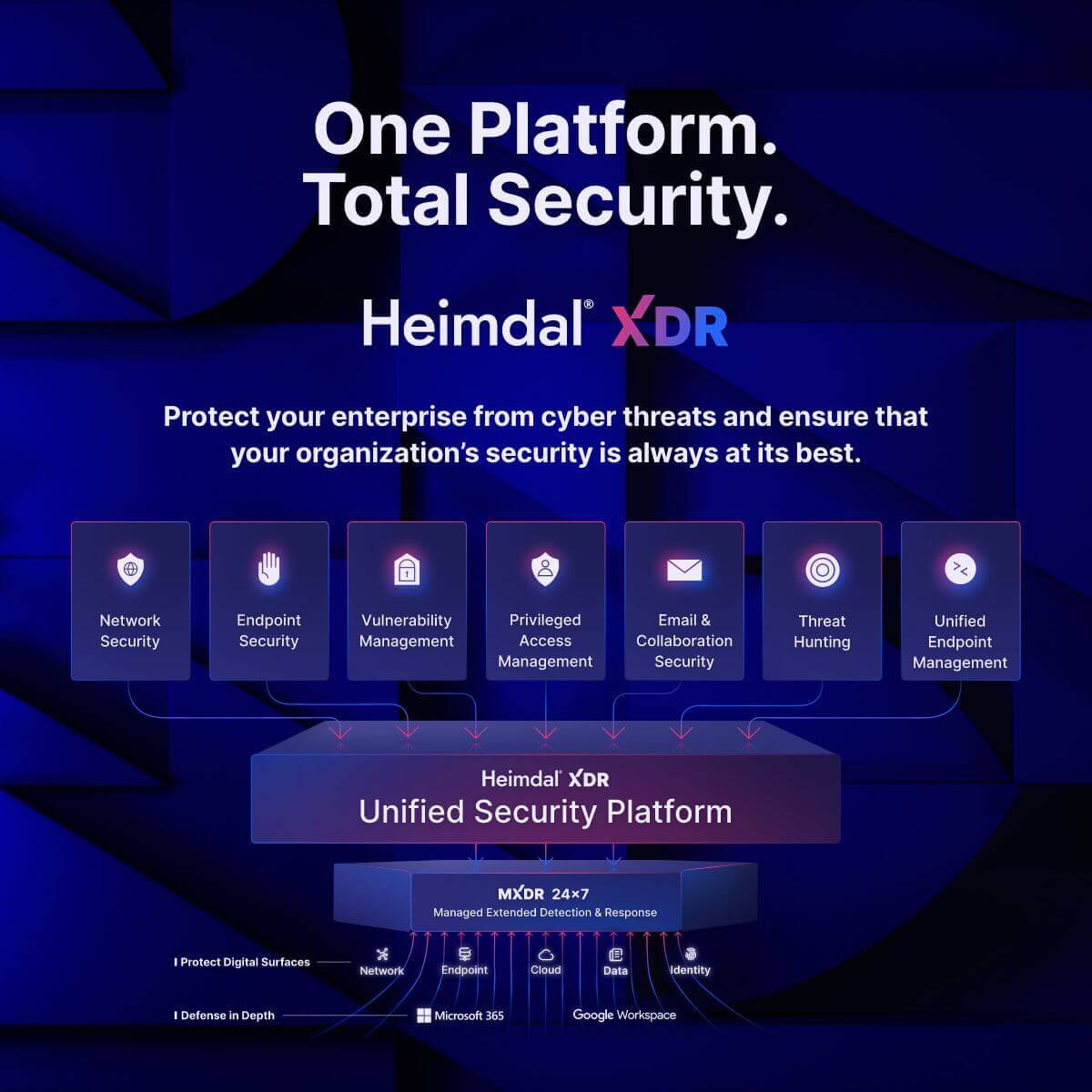
As one unified platform. One agent. One console. One contract.
- DNS Security for network and endpoint
- Next-Gen Antivirus with Extended Threat Protection, endpoint firewall and Remote Access Protection
- Ransomware Encryption Protection
- Patch and Asset Management, with Infinity Management for in-house software
- Privileged Access Management with PASM, PEDM and Application Control with AppFencing
- Email Security 365, plus Email Security ATP and Fraud Prevention
- Threat-hunting and Action Center for estate and M365 user monitoring
- Endpoint management utilities including Remote Desktop, Scripting, BitLocker Management, USB Management and PXE Deployment
One place to look, one agent footprint on the host, and one renewal conversation instead of eight.
As a managed service. MDR adds 24×7 security operations center (SOC) triage and guided remediation. MXDR adds 24x7x365 SOC coverage with incident response. Managed ITDR adds SOC coverage for identity threats across M365. If the constraint is people rather than product, this is the version to look at, and it is the honest answer for teams who were never going to staff a night shift.
On AI, stated plainly
Two AI capabilities are live in the platform today, and both predate AI Wingman, our newer cross-platform intelligence layer described below. Predictive DNS applies AI and machine learning analysis to identify suspicious destinations and likely attack activity before threats fully materialize, which is prevention rather than post-hoc alerting.
AI-powered email fraud prevention uses outlier detection across inbound and outbound mail to surface impersonation attempts, CEO fraud and out-of-character behavior, working alongside what our own product documentation puts at more than 125 vectors of analysis, on top of existing Microsoft 365 filtering.
AI Wingman is a separate cross-platform intelligence layer built on top of capabilities like those, and it arrives in phases. AI Wingman Assist provides guidance inside the platform and surfaces the right next action. AI Wingman Triage uses multi-agent systems to validate incidents and accelerate triage, and it is included with the Threat-hunting and Action Center.
AI Wingman SOC brings that acceleration into our managed SOC and is included with TAC plus MXDR. We keep those two stories separate on purpose. A live detection engine and a phased roadmap layer are different things, and they should be evaluated separately.
Third-party validation, stated plainly
We were named in the Gartner Europe Context Magic Quadrant for Endpoint Protection in May 2026, and we were listed as a representative vendor in Gartner’s Market Overview for Workspace Cybersecurity Platforms in August 2026, alongside vendors including Microsoft, CrowdStrike and Sophos. That is a Market Overview listing rather than a Leader ranking, a different research format from a Magic Quadrant, but it is a second independent data point.
On MITRE, our ATT&CK coverage is publicly mapped on the Tidal Cyber Registry. Search for Heimdal and you can see exactly which attack techniques and sub-techniques we detect and stop, down to the sub-technique level. We have not paid to participate in the MITRE Engenuity Evaluations, which are a vendor-funded program.
Our coverage is transparent and independently verifiable at any time. Pull the mapping into your PoC scorecard and compare it directly against the firewall or endpoint vendor you are evaluating alongside us.
Practical buyer guidance
Do you actually need to switch?
A large share of the people reading Fortinet alternatives content are not re-platforming. They received a quote, lost a weekend to a patch, or hit end-of-support. Three different problems, three different answers.
Work through this before you build a shortlist.
- Is the problem price? Then the fastest fix is a competitive evaluation you are genuinely willing to complete, plus a written renewal cap. Meaningful incumbent discounts commonly appear once a competitive evaluation becomes visible. A discounted renewal is sometimes the correct outcome, and it is not a failure.
- Is the problem firmware discipline? Switching vendors moves the problem rather than solving it. Every vendor in this category runs multiple branches. A documented internal standard on minimum patch level, a staging device and a maintenance window schedule fixes more than a migration will.
- Is the problem exposure? Then start with what is reachable from the internet. MFA on every VPN account with no exceptions, no local VPN accounts carried over from an old migration with unchanged passwords, management interfaces off the public internet, and a patch SLA for internet-facing components measured in days.
- Is the problem the operating model? If nobody on the team can safely run the console at 2am, more capability will not help. That is the case where managed detection and response, or a genuinely simpler platform, changes the outcome.
- Is the problem hardware end-of-service? Then you have a real decision window. Use it properly instead of defaulting to the refresh quote in front of you.
Signals it is time to move
- Your appliance cannot hold your traffic with TLS inspection enabled, and the next model up costs more than the alternative platform.
- You have deferred security features because enabling them would break the sizing.
- Two or more emergency patch events in a year have forced change-freeze exceptions.
- Your renewal now includes entitlements you cannot map to a capability you use.
- The console requires a specialist you no longer employ.
- An auditor has asked for a certificate that your deployed version is not covered by.
Signals you should stay and renegotiate
- Your estate is branch-dense and the price per protected megabit genuinely matters.
- SD-WAN being included in the operating system is load-bearing in your branch design.
- You have OT sites with industrial protocol requirements and ruggedized hardware.
- Your team runs firmware trains well, and the last two upgrades were uneventful.
- The complaint is commercial rather than technical, and nobody has actually tested a competitive quote.
What the datasheet will not tell you
Ask for four numbers, in writing, for the exact model you intend to buy. Threat-protection throughput with your inspection profile enabled. The same figure with TLS decryption enabled. The percentage of your traffic that will be exempt from decryption because of pinned certificates or privacy carve-outs. The failover time on a stateful HA pair during an upgrade. Headline firewall throughput figures are measured with large packets and inspection disabled, so they will not describe your traffic.
Compliance gates worth checking before you shortlist
- PCI DSS 4.0 and 4.0.1, mandatory since March 2025, reframes firewalls as Network Security Controls. It requires documented business justification for every allowed service, protocol and port, default-deny in both directions including explicit egress control out of the cardholder data environment, configuration standards and secure baselines, rule-base review at least every six months with evidence, current network diagrams, secured configuration files, and a WAF or equivalent in front of public-facing in-scope web applications.
- NIS2 is outcome-based. In practice Article 21 obligations and ENISA implementation guidance point to segmentation of production, office, management and OT networks, least-privilege rules with no any-to-any between zones, centralized logging and anomaly detection, documented data flows and defined zones, MFA for administrative access, and supply-chain risk governance.
- DORA does not prescribe firewall controls. Financial entities translate its ICT risk and resilience obligations into HA and stateful failover for critical controls, change management with rollback, and third-party ICT documentation covering patch cadence and advisory practice.
- FIPS 140-3, Common Criteria and NDcPP, and FedRAMP. A certificate that does not cover the version you intend to deploy is not usable. Match certificate numbers to the exact hardware model and OS release, and re-verify at the time of purchase rather than at the time of shortlisting.
- IEC 62443 for OT, which means zone-and-conduit architecture, industrial protocol awareness across Modbus, DNP3, PROFINET and similar, industrial-grade hardware and deterministic behavior.
How to run a proof of concept that settles the argument
- Test on your own traffic, not the vendor’s. Mirror a representative site rather than a lab segment.
- Turn everything on. Full inspection profile, TLS decryption, IPS, sandboxing. Then look at CPU.
- Break something on purpose. Fail over the HA pair mid-upgrade and time the recovery.
- Raise a real support ticket during the evaluation and watch what happens at first line. This is the single most predictive test of your next three years.
- Ask for the current independent lab report for the specific model and quarter you are buying, not a summary slide. Results in this category have moved within a single cycle.
- Pull the vendor’s KEV history and ask three questions. What is your patch SLA for internet-facing components? Do you publish post-exploitation guidance and indicators of compromise? What are your secure-by-design commitments? A vendor that claims immunity is not describing this category accurately.
- Get lifecycle and end-of-support commitments in the contract, especially where the vendor has recently been acquired.
- Model year four, not year one. Written multi-year pricing with a capped uplift is worth more than a first-year discount.
What switching will not fix
Changing vendor will not give you a rule base with owners and review dates, will not create the change control you do not have, will not make an unstaffed console safe, and will not remove your exposure to pre-authentication vulnerabilities. Those are operating problems, and every vendor in this comparison will hand them straight back to you.
Fortinet competitors and alternatives, vendor by vendor
No ratings-style shorthand below. Each entry gives what the product is, who it fits, real strengths, real trade-offs and what is publicly known about pricing.
The twelve, at a glance
A one-screen summary of the vendor-by-vendor section. Every cell is condensed from the profiles in this article, including the trade-offs. Read the full profile before you shortlist anything on this table alone.
| Your situation | Where to look first | Why |
|---|---|---|
| Branch-dense, cost-sensitive, network-led | Fortinet, Versa | Cost per protected megabit, SD-WAN included in the OS |
| The real gap is DNS, endpoint, privilege, email and remote access rather than perimeter inspection | Heimdal | One agent and one console across the prevention layers, standalone or unified or managed |
| No security specialist, and hiring one is not happening | Heimdal MDR or MXDR, Sophos | The SOC gets run for you rather than staffed by you |
| Large enterprise, deep control, cloud-heavy, budget available | Palo Alto Networks | Application and user granularity, Prisma SASE, identity convergence |
| Regulated, prevention-first, complex rule base, experienced admins | Check Point | Prevention accuracy, sandboxing depth, SmartConsole |
| Already standardized on Cisco networking and identity | Cisco Secure Firewall, Meraki MX for lean branches | Stack coherence, ISE and Duo integration |
| 100 to 2,000 seats wanting firewall, endpoint and MDR in one console | Sophos | Sophos Central, Synchronized Security, Secureworks depth |
| Cost-constrained retail or multi-site with many VPN endpoints | SonicWall | Price and performance, conditional on MFA and patch discipline |
| Small multi-site estate wanting predictable bundling | WatchGuard | Single-SKU suite, simple central management |
| Azure-hub WAN | Barracuda | Azure Virtual WAN integration, pay-as-you-go licensing |
| Service provider, data center, routing-critical | Juniper with HPE | Junos routing correctness, high-end throughput |
| Remote-user and SaaS traffic dominant | Zscaler, Netskope, Cato | Takes the appliance out of the path |
| Technical team, small scale, budget or sovereignty constrained | pfSense Plus, OPNsense | Cost, transparency, control |
| Hardware end-of-service, otherwise happy | Fortinet, renegotiated | Use the window for leverage, not necessarily for a migration |
Heimdal is listed first because it is the vendor writing this comparison, not because it outranks the others. It is not a like-for-like FortiGate replacement, and the trade-off column says so.
1. Heimdal
What it is. A unified security and compliance platform covering DNS security for network and endpoint, next-generation antivirus with endpoint firewall and Remote Access Protection, ransomware encryption protection, patch and asset management, privileged access management with PASM, PEDM and Application Control with AppFencing, email security and fraud prevention, and threat hunting.
Any of those modules can be bought on its own, all of them can run as one platform on a single agent and console, and any of it can be delivered as a managed service through MDR, MXDR or Managed ITDR.
Best for. Enterprise and mid-market teams whose real objective is threat prevention and containment across DNS, endpoint, privilege, email and remote access, and who want fewer agents and fewer consoles rather than another appliance. Also for teams who would rather have a SOC run for them than hire one.
Key strengths
- We are not a like-for-like firewall replacement, and we say so up front. That means you can add us alongside a FortiGate you are keeping, or alongside whatever you replace it with, without a rip-and-replace project.
- Remote Access Protection blocks unsolicited external remote access by default, including RDP and remote tools, with IP and port allowlisting, brute-force protection and risk-scored adaptive access. Given that remote access is where the recent incidents in this category started, this is the control most directly relevant to the reason you are reading this page.
- DNS Security Network applies machine learning to device-to-infrastructure traffic, and filtering can be applied onto your existing local DNS server so internal queries need not all be forwarded out, with the exact deployment modes worth confirming against the current datasheet for your edition. Predictive DNS adds AI and ML analysis that flags likely malicious destinations before they host anything malicious, and it is live today.
- The PAM suite is purpose-built rather than a breadth argument. PEDM removes standing local admin rights, supports approval workflows through dashboard, mobile or ServiceNow, and can revoke elevated rights in real time and terminate system processes automatically when a session expires. AppFencing enforces zero-trust execution, restricts unauthorized processes and cuts lateral movement, with 90-day audit logs.
- Email Security ATP and Fraud Prevention runs on top of existing Microsoft 365 filtering, using what our product documentation puts at more than 125 vectors of analysis, alongside AI-led outlier detection, to catch business email compromise, CEO fraud and modified-invoice impersonation.
- One agent and one console across all of it, with MITRE ATT&CK, OPSWAT and Sigma rule enrichment, an audit trail for every action and investigation, and compliance-ready reporting. Coverage spans Windows, macOS and Linux.
- Third-party firewall alerts can be pulled into the Threat-hunting and Action Center and correlated with endpoint telemetry, so your firewall stops being a separate console to check.
Trade-offs
- No firewall appliances, no chassis platforms and no carrier-grade routing. If you need inspection at the network edge, you still need a firewall vendor, and we will be sitting next to it rather than instead of it.
- No SD-WAN, so branch WAN convergence is not a conversation we can have.
- Our independent-lab and analyst footprint in the network firewall category is thin by definition, because we are not in it. We were named in the Gartner Europe Context Magic Quadrant for Endpoint Protection in May 2026, and our MITRE ATT&CK mapping is public on the Tidal Cyber Registry for anyone who wants to check technique-level coverage rather than take our word for it.
- Breadth means implementation sequencing matters. Turning on eight modules in one week is a bad plan, and we will tell you that during scoping rather than after.
Pricing. Use our pricing calculator to select modules and enter your endpoint or server count. Up to 5,000 endpoints you get an instant price estimate on-page and by email rather than waiting on a callback. Above that, pricing is scoped with our enterprise team, and final pricing is confirmed with a sales representative in either case.
2. Fortinet FortiGate, the baseline you are comparing against
What it is. Converged networking and security on one operating system, FortiOS, running from desktop SKUs up to chassis platforms, with the Security Fabric as the integration story.
Best for. Branch-dense, cost-sensitive, network-engineering-led organizations that want SD-WAN and security converged, and that have the discipline to manage firmware trains carefully.
Key strengths
- Dedicated inspection silicon. Fortinet’s custom network and content processors do in hardware what most competitors do in software, which is the actual mechanism behind its price, performance, power and rack efficiency at the branch. Fortinet’s own materials claim FortiGate NGFWs are on average 15 times faster than competitors with average latency across its portfolio under 10 microseconds. Those are vendor-measured figures and should be read as such.
- SD-WAN included in FortiOS rather than licensed separately, confirmed in Fortinet’s licensing documentation. Few competitors match this, and it is a material branch TCO advantage.
- Independently validated security effectiveness. The FortiGate-200G holds a Recommended rating in the CyberRatings 2025 enterprise cycle, following an initial Caution result and a retest on an updated build.
- Named a Leader in Gartner’s inaugural 2025 Hybrid Mesh Firewall Magic Quadrant, with Fortinet reporting the highest placement for Ability to Execute.
- Genuine breadth from one vendor across firewall, switch, access point, endpoint, analytics, SIEM and SOAR, email, WAF, OT-specific hardware and FortiSASE, plus a very large channel and deep OT presence.
Trade-offs
- Security incident history. Multiple FortiOS and FortiWeb vulnerabilities appear in CISA’s KEV catalog with confirmed exploitation, including FortiWeb CVE-2025-64446, added on 14 November 2025. The April 2025 symlink disclosure showed compromised devices retaining attacker read access after patching, which required the builds named in that advisory plus credential rotation and configuration review. In January 2025 the Belsen Group published configuration files and VPN credentials from more than 15,000 FortiGate devices. Fortinet and independent researchers stated the data had been exfiltrated back in 2022, in a campaign against a vulnerability patched since, which limits its current relevance but not its value to an attacker holding credentials that were never rotated.
- Release-train fragmentation. Fortinet’s own lifecycle documentation shows multiple concurrent FortiOS branches at differing maturity. Practitioner convention is to wait several patch levels before production.
- Full-stack version interlock. Some users running FortiGate, FortiSwitch and FortiAP together report difficulty finding a firmware combination that is stable across all three at once.
- Feature availability by hardware tier. According to Fortinet’s product documentation, certain Security Fabric roles require devices with more than 2GB of RAM from FortiOS 7.2.6 and 7.4.1 onward, which excludes several low-end models. Verify current requirements against the exact models you are pricing.
- Support escalation friction. Reviews and community threads keep returning to the same experience. You escalate past first line, or work through a sales engineer or reseller, to make progress. That pattern appears across most vendors in this category rather than being unique to Fortinet.
- Licensing complexity. The UTP, ATP and Enterprise taxonomy combined with FortiCare tiers and per-product subscriptions is documented but complex, and several entitlements must be maintained simultaneously to preserve enabled features.
- Limited evaluation licensing. Per Fortinet’s documented license terms, the permanent free FortiGate-VM license is capped at a single vCPU and 2GB RAM, a maximum of three interfaces, policies and routes, two VDOMs, low-encryption operation only outside of GUI and FortiManager access, and no FortiCare or FortiGuard entitlement, with one free copy per account. Evaluation windows are short, which limits how much a buyer can assess without engaging sales.
Pricing. Quote-driven through partners, with cost concentrated in the bundle tier and FortiCare level rather than the hardware. As of mid-2025 Fortinet described itself as 40% to 50% through the 2026 upgrade cycle, which is worth knowing before you negotiate a refresh.
The honest read on leaving. Defensible reasons are exposure concentration you cannot accept, an operating model that cannot absorb firmware-train management, a forced refresh that creates a natural re-evaluation window, and commercial terms. “Fortinet is insecure” is not one, because its largest competitors have a comparable exploitation record over the same period.
3. Palo Alto Networks
What it is. The premium enterprise next-generation firewall (NGFW) platform, with the deepest application and user policy model in the category, the strongest cloud-delivered SASE portfolio among the appliance incumbents through Prisma Access, and now identity as a native pillar following the CyberArk acquisition completed on 11 February 2026 for approximately $25B.
Best for. Large enterprises with dedicated security engineering, cloud-heavy or hybrid workloads and estates, high regulatory scrutiny, and genuine willingness to pay for depth of control.
Key strengths
- App-ID and the user and application policy model remain the reference standard for policy granularity.
- The most credible SASE story among appliance vendors for remote-user and SaaS-heavy estates.
- Palo Alto reports placing furthest for Completeness of Vision in Gartner’s 2025 Hybrid Mesh Firewall Magic Quadrant, where it was named a Leader.
- Recommended on retest in the CyberRatings 2025 enterprise cycle, with 100% exploit and malware evasion resistance reported for the PA-1410. Get the primary report for your specific model and quarter, since results are build-specific.
- CyberArk brings privileged access, secrets management and machine identity into the same platform conversation. Palo Alto states the CyberArk platform remains available standalone.
- Mature Cortex XSIAM and XDR integration for telemetry unification.
Trade-offs
- The highest acquisition and renewal cost in the category once subscriptions are stacked.
- Performance per dollar sits materially below Fortinet’s ASIC platforms, which matters most in branch-dense designs.
- Operational complexity. Panorama, the policy model and the subscription matrix together need dedicated engineers. Without a security specialist on staff, this is the wrong platform.
- An exploitation history of its own, including the PAN-OS authentication bypass CVE-2025-0108, added to CISA’s KEV catalog on 18 February 2025, and previously documented persistence techniques designed to survive resets and upgrades.
- Recurring practitioner criticism of the SD-WAN offering following the CloudGenix acquisition, and of renewal pricing specifically.
- Post-acquisition bundling pressure is a fair concern. Negotiate integration and openness commitments explicitly rather than assuming them.
Pricing. Quote-driven and among the highest in the category. Single list prices for one SKU, of the kind that circulate in comparison articles, do not represent a product line and should not be used for budgeting.
4. Cisco
What it is. Cisco Secure Firewall, formerly Firepower, managed through Firewall Management Center or Security Cloud Control, plus Meraki MX for cloud-managed branch estates. Sold on breadth across the wider Cisco stack rather than standalone superiority.
Best for. Organizations already standardized on Cisco networking and identity, where operational consistency, NAC and MFA integration and procurement simplicity dominate. Meraki MX for distributed mid-market sites with lean IT.
Key strengths
- Genuine gravity from the wider stack. Integration with ISE for network access control, Duo for MFA, Umbrella and Secure Access for SSE, Splunk, Catalyst, Meraki and Cisco SD-WAN allows one vendor to cover WAN, security, identity and observability.
- Talos is one of the most respected threat intelligence organizations in the industry, and it feeds IPS and malware detection directly.
- Meraki MX is a strong answer for distributed retail and branch estates and small IT teams.
- An enormous partner and support footprint, and frictionless procurement in most enterprises.
Trade-offs
- Management complexity. The Firewall Management Center learning curve is the most persistent criticism of the platform in both analyst commentary and practitioner discussion.
- Per trade coverage of Gartner’s 2025 Hybrid Mesh Firewall Magic Quadrant, Cisco was positioned as a Visionary rather than a Leader.
- In the CyberRatings 2025 enterprise cycle, the specific Cisco model tested, the Firepower 2130, did not receive a Recommended rating in the published results. Because CyberRatings retests on updated builds, as it did for Fortinet and Palo Alto, confirm current status against the latest report.
- Severe 2025 exposure. CVE-2025-20333 at CVSS 9.9 and CVE-2025-20362 in the ASA and FTD VPN web server were exploited by an advanced actor, prompting CISA Emergency Directive ED-25-03, which also described ROM manipulation persisting across reboots and upgrades. Cisco noted that some Firepower versions share the affected code path.
- Two overlapping portfolios in Secure Firewall and Meraki MX, and buyers frequently report uncertainty about roadmap direction and feature parity between them.
- Mid-to-high pricing. Cisco is rarely the lowest-cost option per protected megabit.
Pricing. Quote-driven with license tiers that vary widely by product and deployment scale.
5. Check Point
What it is. Quantum gateways under the Infinity architecture, managed through SmartConsole. Prevention-first enterprise security with the strongest management console lineage in the category.
Best for. Regulated enterprises with large, complex rule bases administered by many people, where prevention accuracy, sandboxing depth and audit-grade policy management outweigh cost and convergence.
Key strengths
- Prevention accuracy and management maturity. SmartConsole remains among the most capable policy and logging environments for big multi-administrator rule bases.
- Consistently strong independent testing. Recommended in the CyberRatings 2025 enterprise cycle. In CyberRatings’ Q1 2025 cloud network firewall report, CloudGuard Network Security on AWS recorded 100% on security effectiveness, exploit blocking, evasion resistance and false-positive accuracy, one of only two products in that test to do so. Check Point separately cites a 99.9% new-malware block rate in Miercom’s 2025 testing, and Miercom engagements are frequently vendor-commissioned, which is worth factoring in.
- Named a Leader in the 2025 Gartner Hybrid Mesh Firewall Magic Quadrant.
- Threat Emulation and Threat Extraction sandboxing and ThreatCloud real-time threat intelligence are well regarded in high-assurance environments.
- Under CEO Nadav Zafrir, the company has signaled accelerated investment in cloud, SASE and AI.
Trade-offs
- Blade and package licensing is difficult to model without specialist help, and it is the most consistent commercial complaint about Check Point in buyer feedback. Mid-market buyers regularly cite it as the reason they select a simpler licensing model instead.
- SASE and SD-WAN are less tightly integrated than Fortinet’s or Palo Alto’s, and that difference shows in the policy model.
- Higher price point and steeper setup complexity than SMB-focused alternatives.
- An exploitation history of its own. CVE-2026-50751, an authentication bypass in the deprecated IKEv1 key exchange used by Remote Access VPN and Mobile Access, was added to CISA’s KEV catalog on 8 June 2026, the same day Check Point published its advisory and hotfix. Directly relevant if your switching rationale is security.
- In reviews and community threads, two complaints recur, TAC support quality and guidance that defaults to installing the latest Jumbo Hotfix.
- A smaller channel footprint than Fortinet or Cisco in many mid-market geographies.
Pricing. Quote-driven, built from blades and packages. Expect to need a specialist to model three-year cost.
6. Sophos
What it is. Sophos Firewall XGS alongside Intercept X endpoint, email and MDR, all managed from Sophos Central. Sold on outcomes rather than components.
Best for. Organizations of roughly 100 to 2,000 seats with no dedicated security specialist, that want firewall, endpoint and MDR from one vendor and one console and value time to value over policy granularity.
Key strengths
- Synchronized Security and Security Heartbeat. According to Sophos product documentation, endpoint and firewall exchange health state so a compromised host can be isolated automatically and policy can be health-aware. This is a documented product mechanism, and it is the best single reason to shortlist Sophos.
- Sophos Central is a genuinely unified cloud console spanning firewall, endpoint, email, mobile and MDR.
- MDR at scale. The Secureworks acquisition closed in February 2025, adding Taegis platform capability, threat research and consulting depth.
- Consistently high user-satisfaction scores on review platforms.
- Sophos actively courts Fortinet and SonicWall displacement, which in practice means migration assistance is available and negotiable.
Trade-offs
- Per trade coverage of the 2025 Hybrid Mesh Firewall Magic Quadrant, Sophos was not placed in the Leaders quadrant, which is consistent with a mid-market rather than large-enterprise hybrid-mesh focus.
- Smaller XGS models can struggle with TLS decryption throughput, so sizing discipline matters.
- Less granular policy tuning than Fortinet, Palo Alto or Check Point at scale.
- SD-WAN and segmentation go less deep than the enterprise leaders provide.
- Reviewers keep flagging friction deploying the Sophos Central agent, particularly on macOS, and confusion around licensing and entitlement mechanics tied to user and machine names.
- Advanced features frequently require licensing beyond the base bundle.
Pricing. Quote-driven, varying by seat count and feature set.
7. SonicWall
What it is. Gen 7 and Gen 8 TZ, NSa and NSsp appliances. Value NGFW and UTM for smaller and distributed estates, with a strong channel and aggressive pricing.
Best for. Cost-constrained multi-site and retail estates needing many simple inspected VPN endpoints, conditional on disciplined credential hygiene, mandatory MFA on SSL-VPN and a real patch SLA.
Key strengths
- Excellent price and performance at the low end. The TZ series is one of the cheapest credible ways to put inspection at a small site.
- SonicWall states that Real-Time Deep Memory Inspection in its Capture ATP sandbox is a differentiated memory-based detection technique, and that it holds patents in this area.
- Straightforward IPsec site-to-site VPN and simple branch configuration, well understood by a very large installer base.
- Cloud-based Network Security Manager provides workable central management.
Trade-offs
- A significant exploitation event on record. CVE-2024-40766, an improper access control flaw in SonicOS, was exploited at scale from mid-2025 by Akira ransomware, frequently where local SSL-VPN credentials had been carried over unchanged during Gen 6 to Gen 7 migration and MFA was absent or bypassable. Arctic Wolf, Huntress, Bitdefender and the SANS Internet Storm Center all documented the campaign. SonicWall and independent researchers ultimately attributed the surge to that known vulnerability combined with credential and configuration hygiene rather than a new zero-day, which is a genuine mitigating clarification. Remediation required firmware 7.3.0, a full reset of local SSL-VPN credentials, and tightened MFA, geo-IP and botnet filtering.
- SMA 100 series appliances have a documented history of exploited vulnerabilities.
- Security depth across IPS tuning, analytics and reporting is less extensive than the enterprise leaders, and user ratings on review platforms sit below them.
- Not positioned for large or complex multi-site enterprises. Per trade coverage of the 2025 Hybrid Mesh Firewall Magic Quadrant, SonicWall was not placed in the Leaders quadrant.
- Firmware update quality, support response times and UI complexity come up again and again in reviews and community discussion.
- Private-equity ownership is a question buyers commonly raise about long-term R&D investment. SonicWall has not announced reductions, and the question applies to privately held vendors across this category rather than to SonicWall alone.
Pricing. Quote-driven through the channel, with hardware plus security service bundles. Low entry cost is the point.
8. WatchGuard
What it is. Firebox appliances managed through WatchGuard Cloud, with a broader stack around them including AuthPoint MFA, secure Wi-Fi, EPDR endpoint and MDR.
Best for. Small multi-site organizations that want predictable bundling, simple central management and a single-vendor stack, and that do not require top-tier detection depth.
Key strengths
- The single-SKU Total Security Suite removes most licensing ambiguity, which is a real differentiator in a category where licensing comprehension is a top complaint.
- One vendor covers firewall, MFA, Wi-Fi, endpoint and MDR under one contract.
- APT Blocker cloud sandboxing and WatchGuard Cloud visibility are well regarded relative to price.
- Reviewers single out SSL-VPN reliability and log quality for praise.
Trade-offs
- IPS and sandbox depth are less extensive than the enterprise leaders. Comparison sources and practitioner discussion place WatchGuard outside the top three on threat detection depth.
- TLS-inspection throughput is limited relative to price tier, and sizing errors are common.
- Not placed in the Leaders quadrant per trade coverage of the 2025 Hybrid Mesh Firewall Magic Quadrant, with limited relevance to large-enterprise hybrid-mesh architectures.
- Renewal cost increases and pricing transparency come up repeatedly in reviews, so ask for multi-year pricing in writing even where the single-SKU model looks simple at the outset.
- A limited SD-WAN and SASE convergence story, and a slower feature release cadence than the top four.
Pricing. Quote-driven through partners. The single-SKU suite makes it easier to model than most, which is the commercial pitch.
9. Juniper Networks, now part of HPE Networking
What it is. SRX Series firewalls running Junos, with Mist AI and Marvis telemetry alongside. Network-engineering-led security, strong in service provider, data center and SD-Branch environments. HPE completed its acquisition of Juniper on 2 July 2025.
Best for. Service providers, large data centers and network-engineering-led enterprises where routing sophistication and automation matter as much as security features.
Key strengths
- Routing and network correctness. SRX is well regarded for BGP and EVPN behavior and carrier-grade reliability. Where the firewall must also be a serious router, it is often the technically correct answer.
- Very high threat-enabled throughput on high-end platforms, with strong data-center credentials.
- Recommended rating in the CyberRatings 2025 enterprise firewall cycle.
- Junos is consistent, well documented and highly automatable, which is a real advantage for infrastructure-as-code teams.
- HPE backing brings balance-sheet scale, a larger enterprise channel and scalable GreenLake consumption models.
Trade-offs
- Post-acquisition roadmap uncertainty is the dominant buyer concern. HPE has targeted at least $600M in annual cost synergies over three years, and it now holds two overlapping networking portfolios in Aruba and Juniper. Portfolio rationalization is a reasonable expectation, and HPE has not announced which SKUs or security lines are affected. Require written lifecycle and end-of-support commitments in contract.
- Per trade coverage of the 2025 Hybrid Mesh Firewall Magic Quadrant, HPE with Juniper was positioned as a Challenger rather than a Leader.
- The Junos CLI has a steep learning curve for security-led rather than network-led teams, and practitioner commentary consistently describes the interface as network-engineer-oriented rather than analyst-friendly.
- The least developed SASE and SD-WAN convergence story among the major vendors.
- A smaller security-focused partner base and less third-party security tool integration.
- Not positioned for small estates.
Pricing. Quote-driven and not published. Model it with HPE’s synergy targets in mind.
10. Barracuda Networks
What it is. CloudGen Firewall and SecureEdge, positioned as cloud-first network security for distributed organizations. The company’s broader center of gravity is email security and data protection.
Best for. Azure-centric distributed mid-market organizations that want cloud-integrated network security alongside email and data protection from one vendor.
Key strengths
- Azure and Azure Virtual WAN integration is a genuine differentiator. Where the WAN hub sits in Azure, CloudGen and SecureEdge are usually the least-friction option, with pay-as-you-go licensing available.
- Strong multi-site connectivity and traffic management, including the TINA tunneling protocol, tuned for cloud-hub topologies.
- Reasonable pricing and low operational overhead relative to the enterprise leaders.
- Adjacent strengths in email protection, application protection and backup allow a coherent single-vendor bundle.
Trade-offs
- Core NGFW capability is less deep than the top four on protection, analytics and operations.
- Barracuda was not among the seven vendors in the CyberRatings 2025 enterprise firewall test set, so less independent validation is available.
- A narrower hardware range, a smaller partner base and a smaller share of the firewall market.
- Vendor security engineering record. Barracuda’s advisory history includes an incident in its email security appliance line where the vendor recommended device replacement rather than patching. That is a separate product line from CloudGen and says nothing directly about the firewalls, but incident handling is a legitimate input when you assess a vendor.
- KKR private-equity ownership prompts the same questions buyers ask of any privately held vendor about margin focus and investment in lower-margin hardware lines. Barracuda has not announced changes to those lines.
Pricing. Quote-driven, with pay-as-you-go options in Azure.
11. Netgate pfSense and the open-source cohort
What it is. pfSense CE and pfSense Plus, both built on FreeBSD, plus TNSR for high-throughput routing, which runs a different Linux and VPP-based stack. OPNsense and VyOS sit in the same cohort. Open-source-derived firewall and router software with commercial support and appliances.
Best for. Technically strong teams at small scale, lab and test environments, privacy- or sovereignty-sensitive deployments, and cost-constrained sites where deep inspection genuinely is not required.
Key strengths
- Cost. pfSense CE is free and pfSense Plus is inexpensive relative to commercial NGFWs.
- Transparency and control. Full CLI and configuration access, full visibility into device behavior and no telemetry obligations, which has real value in sovereignty-sensitive and air-gapped deployments.
- Excellent core networking across stateful filtering, NAT, dynamic routing, IPsec, OpenVPN and WireGuard, traffic shaping, CARP high availability, VLANs and multi-WAN.
- An extensible package system including Suricata or Snort, pfBlockerNG and HAProxy.
- Genuine continuity between lab and production, which technical teams value.
Trade-offs
- Not an NGFW in the enterprise sense. Application identification, user-identity policy, integrated sandboxing and coordinated threat intelligence are absent, bolt-on or manually assembled. It is not a like-for-like FortiGate substitution, and treating it as one leaves gaps.
- No central management platform comparable to FortiManager, Panorama or SmartConsole.
- A steep learning curve with heavy reliance on manual configuration and community knowledge, and inconsistent community support quality.
- Certification coverage is substantially narrower than the commercial incumbents. In regulated procurement this is frequently an outright disqualifier, so verify current CMVP FIPS 140-3 and Common Criteria listings against the exact version you intend to deploy.
- Some reviewers report lower-end Netgate appliances locking up during updates and needing serial-console recovery, which is a problem at unstaffed sites.
- Governance friction remains from the pfSense and OPNsense fork and subsequent licensing changes.
Pricing. pfSense CE is free. pfSense Plus and Netgate appliances are inexpensive relative to commercial NGFWs, and support is sold separately. Confirm current tiers directly, since published figures circulating in comparison articles are frequently misstated.
12. The SASE and SSE cohort, which most Fortinet comparisons leave out
Omitting this group dates an article immediately, because for a large number of estates these are the actual alternatives on the table.
- Zscaler. Often the reason organizations reduce firewall spend rather than replace the firewall. Cloud-native SSE and ZTNA remove the appliance from the path for internet-bound and remote-user traffic and cloud workloads, with no hardware to size and no patch treadmill on your side. It does not address east-west or on-premises enforcement, and cost scales with users.
- Netskope. SSE with the strongest data-context and inline-SaaS story, and the NewEdge private network is a genuine architectural differentiator. Same appliance-replacement limits as Zscaler.
- Cato Networks. Single-vendor SASE built cloud-first, often the cleanest answer for mid-market multinationals retiring SD-WAN boxes and firewalls together. Less granular than an NGFW for data-center and OT segmentation, and it concentrates risk with one vendor.
- Versa Networks. Under-recognized because the brand reads as SD-WAN, yet it held a Recommended rating in the CyberRatings 2025 enterprise cycle. Versa reports 100% exploit and malware evasion resistance and 7,626 Mbps throughput in the CyberRatings 2025 Q4 Enterprise Firewall report, based on testing conducted in Q3 2025.
- Forcepoint was included in the CyberRatings 2025 enterprise test set and remains historically strong in government and data-centric security. Microsoft Azure Firewall Premium and AWS Network Firewall are frequently the default in cloud-first estates, and given the Q1 2025 native-firewall results above, defaulting to them deserves validation against your own threat model. Huawei holds significant share outside North America and Europe and is excluded from many Western shortlists for regulatory and geopolitical reasons rather than technical ones, which is worth naming honestly. Arista NG Firewall, Stormshield, Hillstone and Sangfor are regionally relevant mid-market options.
Frequently asked questions
Which is the best Fortinet competitor or alternative?
There is no single answer, because the right choice depends on your use case, your estate, your team and your constraints. For like-for-like enterprise NGFW replacement, Palo Alto Networks and Check Point are the strongest, and both were Leaders alongside Fortinet in Gartner’s 2025 Hybrid Mesh Firewall Magic Quadrant. For mid-market simplicity with endpoint and MDR in the same console, Sophos. For Cisco-standardized estates, Cisco Secure Firewall or Meraki MX. If the underlying need is threat prevention across DNS, endpoint, privilege, email and remote access rather than perimeter inspection, that is where we fit.
Can Heimdal replace my FortiGate?
No, and we would rather say so. We do not sell firewall appliances. We cover the network-layer and endpoint-layer prevention that sits around the firewall, including DNS security, endpoint protection with Remote Access Protection, privileged access management, email security and managed detection and response. Most of our customers in this situation keep a firewall and use us to close the gaps the firewall was never going to close.
Has Fortinet been hacked?
Fortinet products have been exploited at scale. In January 2025 the Belsen Group published configuration files and VPN credentials from more than 15,000 FortiGate devices, data that Fortinet and independent researchers attributed to a 2022 campaign against a vulnerability patched since. In April 2025, Fortinet and CISA described a symlink technique that preserved attacker read access to compromised devices after patching. FortiWeb CVE-2025-64446 was added to CISA’s KEV catalog on 14 November 2025 following confirmed exploitation. That record is serious, and it is not unique. Palo Alto, Check Point, Cisco and SonicWall have each had an exploited pre-authentication vulnerability in their remote-access or management plane over the same period.
Is Fortinet less secure than the alternatives?
Not in a way the evidence supports. The FortiGate-200G holds a Recommended rating in the CyberRatings 2025 enterprise cycle following a retest on an updated build. The more useful question is how a vendor behaves, so look at KEV appearance frequency, time to patch, advisory clarity, whether post-exploitation guidance and indicators of compromise get published, and secure-by-design commitments.
Do I have to buy new hardware when my FortiGate reaches end of service?
You have to do something, because an unsupported internet-facing device is difficult to defend in an audit or an insurance questionnaire. Your options are a refresh with the incumbent, a competitive replacement, moving some enforcement to a cloud-delivered service, or a mix. The end-of-service date creates the decision window, and Fortinet’s own mid-2025 investor commentary put roughly a million units into that window across 2026 and 2027. Negotiate accordingly.
Are AWS, Azure or GCP native firewalls enough?
Validate before you assume. In CyberRatings’ Q1 2025 cloud firewall testing, native AWS, GCP and Azure firewall services recorded 0% security effectiveness while third-party cloud firewalls scored between 99.61% and 100%. Results are configuration- and product-specific, and CyberRatings noted that Google Cloud’s NGFW service uses Palo Alto technology yet diverged sharply from Palo Alto’s own result. Test against your own threat model rather than relying on a headline number.
Should I look at SASE instead of another firewall?
If most of your traffic is remote users going to SaaS, yes, that is the honest answer, and Zscaler, Netskope and Cato belong on the shortlist. If you have data-center east-west segmentation, OT zones or on-premises workloads to protect, SASE does not replace the appliance and you will end up running both.
How long does a firewall migration actually take?
Longer than the conversion tool suggests. Syntax conversion is the quick part. The slow parts are identity integration, TLS inspection re-tuning, application-policy re-derivation and cleaning up exceptions nobody documented. For a mid-sized multi-site estate, plan in months rather than weeks, insist on a named migration engineer, run parallel or monitor-only for a period, and get a documented rollback.
Does Fortinet really have more than 50% of the firewall market?
Fortinet’s investor materials state that it is the number one firewall vendor by units shipped, with more than 50% unit share. That is a vendor-originated figure, it is plausible given its low-cost desktop and branch range, and it is a statement about units rather than revenue. On revenue the picture is different, because firewall revenue is concentrated among a small group of vendors and Palo Alto Networks, Fortinet, Cisco and Check Point are all consistently in it. Omdia puts network security on a 2.8% CAGR for 2024 to 2029 with the firewall segment at 5.0%, and published 2025 sizings of the market range from roughly $6B to $22B depending on what is being counted. Any share figure quoted without its denominator is not comparable to any other.
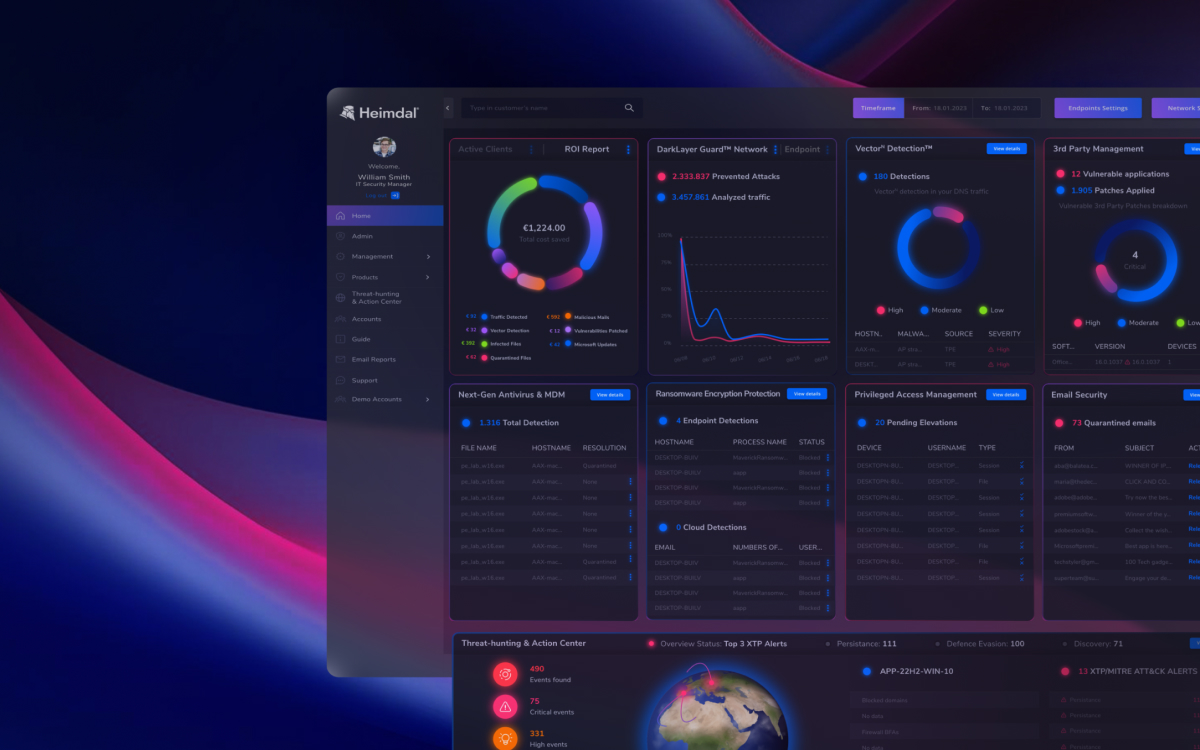
Heimdal® combines advanced threat prevention, detection, and response capabilities with automated patch management to offer a robust security posture for businesses of all sizes.
The main reason Heimdal® is a great Fortinet competitor, is that according to Gartner Peer Insights, Heimdal® excels in user satisfaction with its proactive security measures and real-time alerts.

While Fortinet is recognized for its robust endpoint protection and effective integration with other tools, it struggles with management complexity and lacks some critical functions, such as OS compatibility checks.
Heimdal®, on the other hand, offers straightforward, high-quality endpoint protection with minimal negative feedback, making it a strong choice for users who value ease of use and proactive threat detection.
Key Features:
- Threat Prevention: Uses advanced machine learning algorithms to detect and block malware, ransomware, and phishing attempts proactively.
- Endpoint Detection and Response (EDR): Offers real-time monitoring and deep analysis of endpoint activities, enabling rapid detection and response to potential threats.
- Patch Management: Automates the patching process for both operating systems and third-party applications, reducing vulnerabilities and ensuring systems are up-to-date.
- DNS Security: Provides protection against DNS-based attacks and ensures secure and filtered web traffic to prevent malicious activity.
- Ransomware Encryption Protection: Continuously monitors for ransomware-like behavior and blocks unauthorized encryption attempts to safeguard data.
- Email Security: Protects against email-borne threats, including phishing, spam, and malware, ensuring secure email communication.
- Threat Intelligence: Leverages a global threat intelligence network to stay ahead of emerging threats and deliver timely updates to its security solutions.
Pros:
- Strong focus on proactive threat prevention.
- Comprehensive endpoint and network protection.
- Automated patch management reduces administrative overhead.
- Robust DNS security and email protection features.
Cons:
- New users may need time to become proficient with the system.
- A stable internet connection is essential for optimal operation.
Pricing:
Heimdal® offers customized pricing that fits your specific business requirements and usage patterns. You can also book a demo to see Heimdal® in action before making any commitments.
I’ve gradually been moving all of my endpoints over to Heimdal®. Mainly just using the NGAV, Ransomware Encryption Protection, Patch Management and MXDR. I’ve had a very positive experience of both the software and the company. Heimdal® are very responsive to suggestions and there’s lots planned in the roadmap.
2. Cisco
Another Fortinet competitor is Cisco. Cisco Systems offers a vast array of products and services designed to enhance network security, ensure secure access, and provide robust threat intelligence.
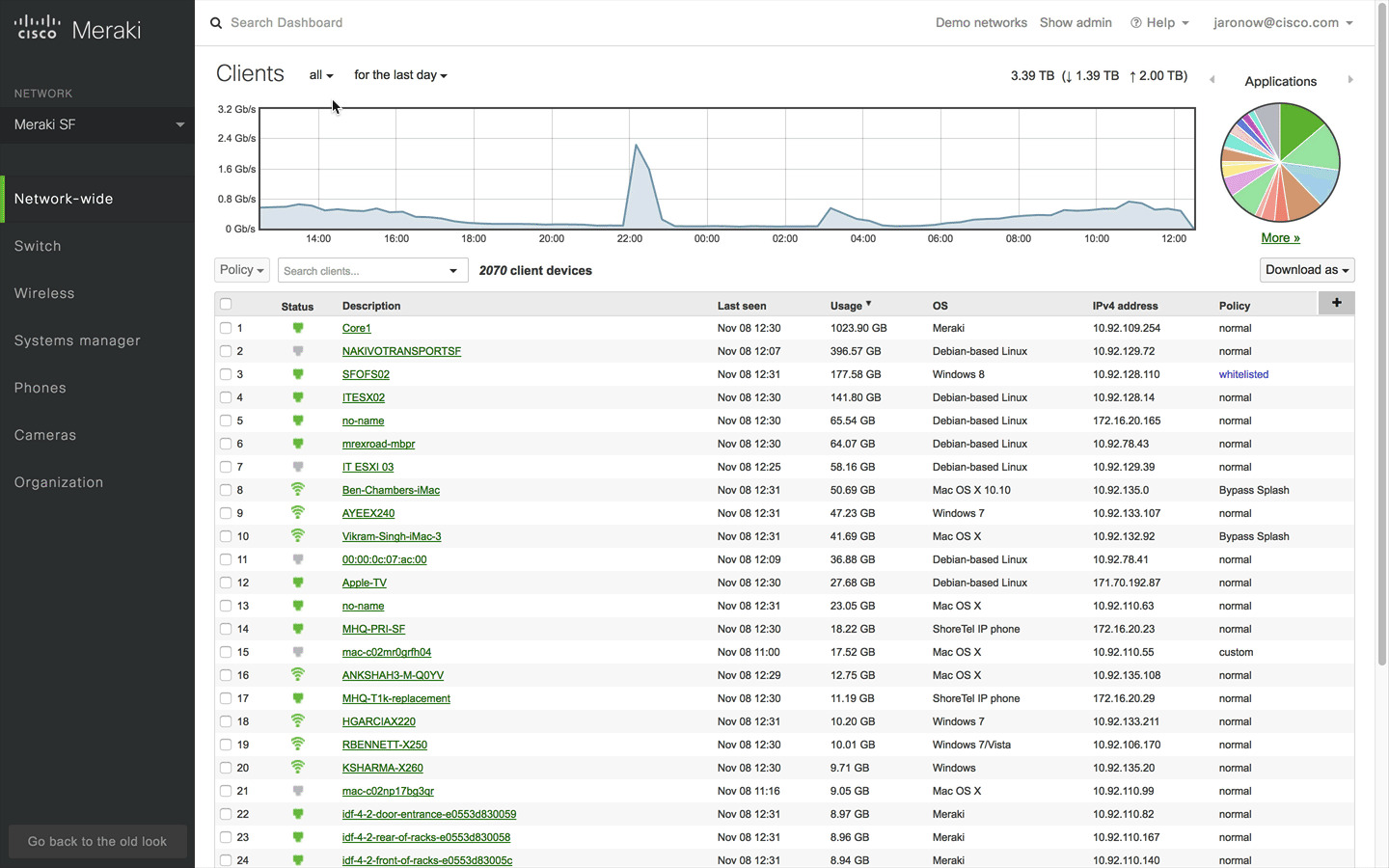
Cisco’s security portfolio includes next-generation firewalls, intrusion prevention systems, secure access solutions, and advanced malware protection.
Key Features:
- Next-Generation Firewalls (NGFW): High-performance firewalls with integrated threat intelligence and advanced threat prevention capabilities.
- Secure Access: Comprehensive VPN and Zero Trust solutions to ensure secure remote access for users and devices.
- Advanced Malware Protection (AMP): Multi-layered malware detection and remediation to protect against a wide range of cyber threats.
- Stealthwatch: Network visibility and security analytics to detect and respond to threats in real time.
- Identity Services Engine (ISE): Simplifies identity management and network access control, ensuring only authorized users and devices can access network resources.
Pros:
- Extensive range of security products and solutions.
- Strong integration with existing Cisco network infrastructure.
Cons:
- Can be expensive, especially for small to medium-sized businesses.
- Complex licensing structures can be challenging to navigate.
Pricing:
Cisco’s pricing varies widely based on the product and scale of deployment.
We have had issues where the DNS does not resolve and it also has interfered with the VPN of some of our users. It has provided a good DNS resolution solution for a lot of the time but the times it doesn’t work or affects a system has cost us crucial lost time.
Cisco produces great equipment, but there are areas in need of improvement. TAC, licensing, and cost are a few of them. Our recent experience and that of others, TAC, could be better.
3. Palo Alto Networks
Palo Alto Networks, a strong Fortinet competitor, specializes in advanced firewall and cloud security solutions. The company is known for its approach to security, combining machine learning, automation, and integration to deliver comprehensive protection across networks, clouds, and endpoints.
Palo Alto Networks offers a broad range of products, including next-generation firewalls, endpoint protection, cloud security, and extended detection and response (XDR) solutions.
Key Features:
- Next-Generation Firewalls: Industry-leading firewalls with advanced threat prevention, including intrusion prevention, application control, and URL filtering.
- Prisma Cloud: Comprehensive cloud security platform that provides visibility and threat prevention across multi-cloud environments.
- Cortex XDR: Extended detection and response solution that integrates endpoint, network, and cloud data to provide a unified view of threats and automate response actions.
- WildFire: Advanced threat intelligence and sandboxing service that analyzes suspicious files and URLs to detect and prevent zero-day threats.
- GlobalProtect: Secure remote access solution that ensures secure connections for remote users.
- AutoFocus: Threat intelligence service that provides insights into emerging threats and helps prioritize security efforts.
- Security Operating Platform: Integrates security solutions and leverages automation to streamline operations and improve security posture.
Pros:
- Strong cloud security offerings with Prisma Cloud.
- Continuous innovation and focus on cutting-edge security technologies.
Cons:
- Premium pricing can be a barrier for small businesses.
- Can be complex to deploy and manage, requiring skilled personnel.
Pricing:
Its pricing starts at $14,800.99 for a 3-year subscription license.
Although it provides the easiest and user-friendly web user interface, sometimes it asks too many questions to configure the complex countermeasures. Sometimes it does not give the required perimeters on the same window. We all know Linux is a highly customizable OS and we can customize in every manner so it’s hard to configure a guy to Palo Alto when any customization is required.
We looked at standardizing on PAN, but their SDWAN offering wasn’t up to the task. They tried to push the Cloudgenix stuff instead of the SDWAN that was built into the firewalls we already owned, but it became too expensive and too many devices. In addition to that, we’ve experienced that when it comes to renewals, PAN is extremely expensive. It seems like they are only interested in signing new business (and giving good discounts to new customers) and don’t care about existing customers.
4. Sophos
Sophos offers a wide range of products, including endpoint protection, firewall, encryption, and mobile security. The company emphasizes simplicity and effectiveness, making it easier for businesses to implement and manage robust security measures.
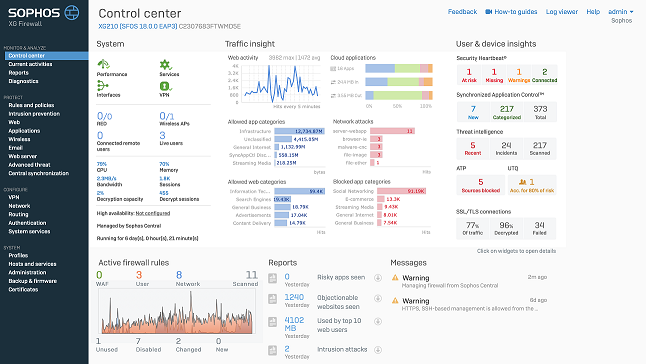
Sophos Central, the company’s unified management console, provides centralized control and visibility across all security products, enhancing operational efficiency and security posture.
Key Features:
- Intercept X: Advanced endpoint protection with deep learning AI for threat detection, exploit prevention, and anti-ransomware capabilities.
- Sophos Central: Unified cloud-based management console that simplifies security management and provides comprehensive visibility.
- XG Firewall: Next-generation firewall with deep packet inspection, intrusion prevention, and advanced threat protection.
- Synchronized Security: Integration between endpoint and network security products to share threat intelligence and automate responses.
- Email Security: Protection against email-borne threats, including phishing, spam, and malware.
- Mobile Security: Comprehensive security for mobile devices, including anti-malware, web protection, and device management.
- Encryption: Data encryption solutions to protect sensitive information and ensure compliance with regulations.
Pros:
- Strong endpoint protection with advanced AI capabilities.
- Centralized management through Sophos Central.
Cons:
- Some advanced features may require additional licensing.
- Can be less effective against highly sophisticated threats compared to premium competitors.
Pricing:
Sophos pricing varies based on the number of users and specific features. You need to contact their team for pricing.
Pretty much everything about uninstalling the existing EndPoint client and installing the new Sophos Central client. Even with an automated install, allow for at least 30 minutes per machine (and that’s if everything goes right). Often it doesn’t go right, and for Macs? It’s really a crap shoot whether you can get it on at all. And then to have it keep working? Most of the time Windows installs are OK. Macs? Eh, who knows? Again, not a lot of confidence in the product.
I’ve used them for the last 10 years. The first years were solid but in the last few years (this contract) I’ve seen your stated problem of systems stopping using it for no apparent reason and it has not been fixed. The other big problem is that it’s licensed by user name but administered by user name AND machine name. If you reissue a machine to a new user you now have two machine accounts for that machine. My other complaint is that it allows duplicate machine names on Macs. We’re looking for a replacement, too.
5. Check Point
Check Point Software is known for its advanced firewall technology and comprehensive security management capabilities. The company offers a broad range of products, including network security, endpoint protection, cloud security, and mobile security solutions.
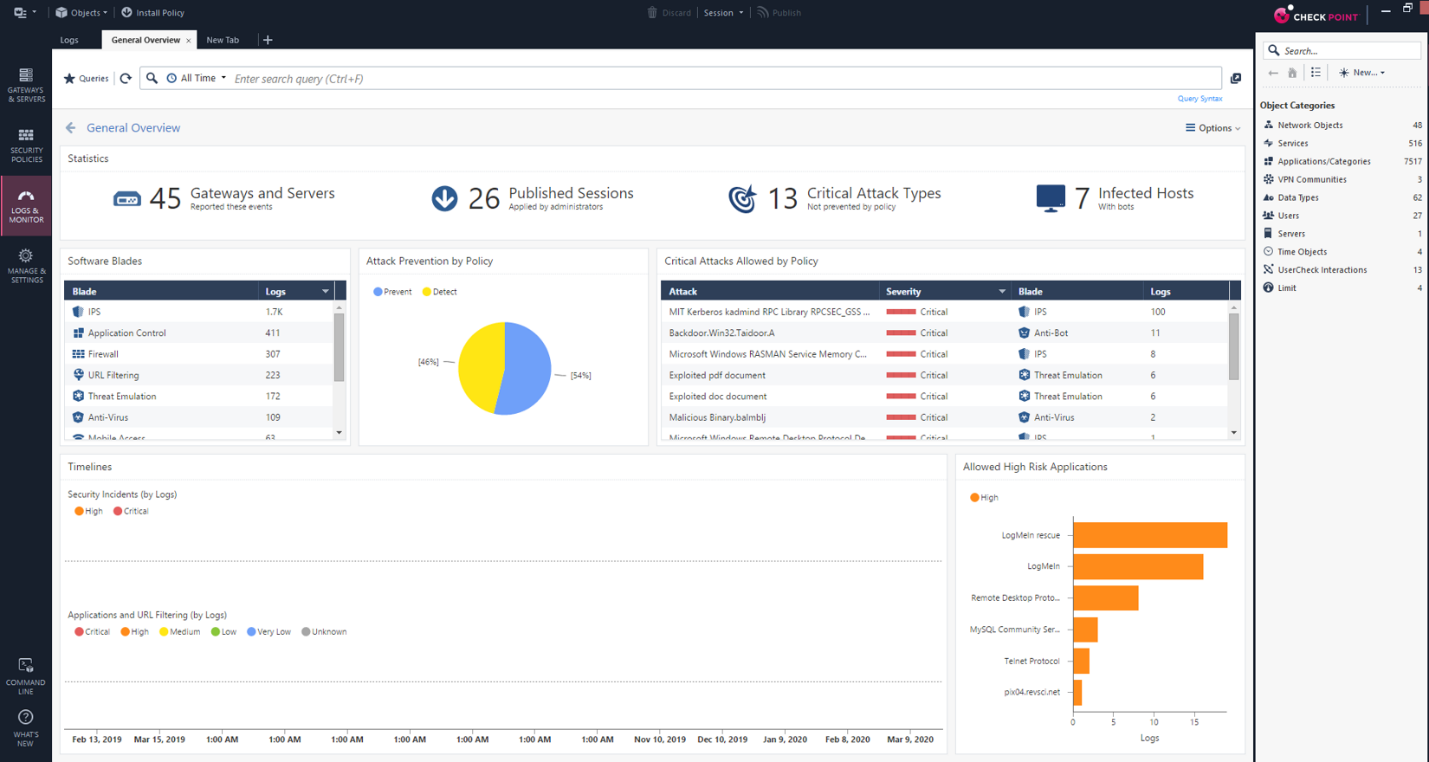
Check Point’s Infinity Architecture provides a unified security approach, integrating multiple security layers to protect against advanced threats.
Key Features:
- Next-Generation Firewalls: High-performance firewalls with integrated threat prevention, application control, and URL filtering.
- Infinity Architecture: Unified security architecture that integrates network, cloud, endpoint, and mobile security for comprehensive protection.
- CloudGuard: Advanced security for cloud environments, including public, private, and hybrid clouds.
- SandBlast: Threat prevention technology that provides advanced threat intelligence, sandboxing, and anti-ransomware capabilities.
- Endpoint Security: Comprehensive endpoint protection with anti-malware, firewall, and data protection features.
- Mobile Security: Protects mobile devices against malware, phishing, and network attacks.
- ThreatCloud: Global threat intelligence network that provides real-time updates and insights into emerging threats.
Pros:
- Unified security management through Infinity Architecture.
- Extensive range of security products for comprehensive protection.
Cons:
- Complex setup and configuration can be challenging for new users.
- Higher cost compared to some competitors, which may be a barrier for small businesses.
Pricing:
Its pricing is based on the number of features/services you use. It gives you an option to add the services you want to card and then you’ll see the final pricing.
Check Point Services offers huge antivirus and threat protection software that enables round-the-clock security for businesses and brings security compliance for businesses. It acts as the shield for IT systems from threat points and brings security strength to the IT system. Globally accepted and has immense good peer feedback. Its rating is quite good and well received by all kinds of clients”.
Support is lacking severely, TAC is nothing more than a human search robot looking for matching SK’s. There are exceptions. Also, if I got 10 cents each time the recommendation was to upgrade to the latest JHF, I’d be a rich man.
6. Juniper
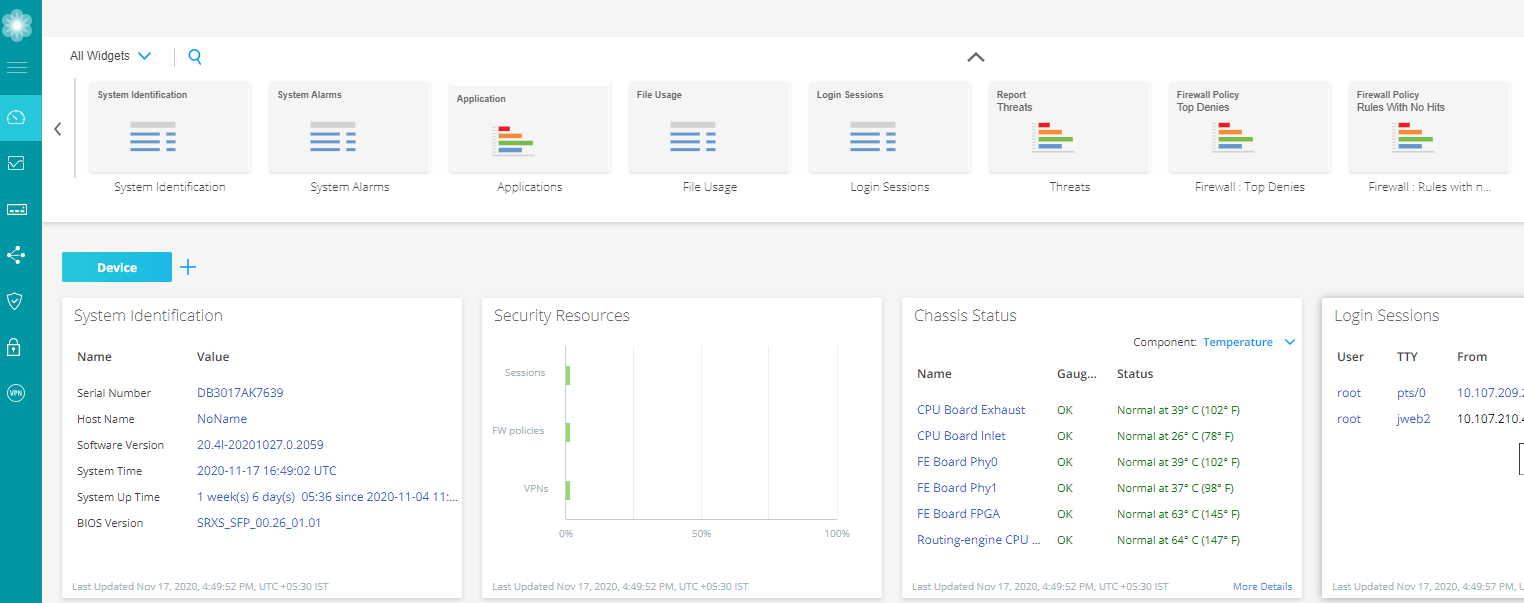
Juniper Networks is a provider of high-performance networking and cybersecurity solutions. The company focuses on simplifying network security and delivering high-speed protection.
Juniper offers a range of products, including next-generation firewalls, secure access solutions, and advanced threat prevention.
Juniper’s security solutions are designed to integrate with its networking products, providing comprehensive protection and streamlined management for enterprises and service providers.
Key Features:
- SRX Series Firewalls: High-performance firewalls with advanced threat protection, application control, and UTM capabilities.
- Advanced Threat Prevention: Integrated threat intelligence and security services to detect and block sophisticated threats.
- Contrail Security: Comprehensive security solution for cloud and virtualized environments, providing visibility and control over network traffic.
- Secure Access: VPN and Zero Trust solutions to ensure secure remote access for users and devices.
- Sky Advanced Threat Prevention: Cloud-based service that uses machine learning and threat intelligence to detect and block malware and other threats.
- Mist AI: AI-driven network management and security to enhance visibility, automate tasks, and improve overall security posture.
- Security Director: Centralized management platform for simplified administration and policy enforcement.
Pros:
- High performance and scalability for both small and large enterprises.
- Advanced security features, including next-generation firewalls and intrusion prevention.
- Integration with other networking and security tools.
Cons:
- Higher initial cost compared to some competitors.
- Complex configuration and management for less experienced users.
- Limited support for third-party applications.
- Occasional issues with software updates and patches.
Pricing:
There’s no concrete information about pricing available on their website.
What’s most helpful about Juniper products depends on the specific networking challenges you face and the goals you want to achieve. For example, security features like firewalls and intrusion prevention systems, which help protect networks from cyber threats. I believe their scope is quite specific. Their products are only available at the enterprise level, which makes them expensive for the consumer needs. In fact, they may not have consumer focused products suitable for Home Networks.
Juniper CLI is a big learning curve. It may be easy enough to get configurations in place searching Google and doing translator tools, but troubleshooting is a whole different ball game. The speed you have in your current environment will not be nearly the same as what you’ll be doing in Juniper for potentially years to come.
7. Barracuda
Barracuda Networks offers a wide range of security solutions, including email protection, network security, and data protection. The company focuses on providing security solutions for small to medium-sized businesses.
Barracuda’s products are quickly deployable and easily managed, ensuring protection without requiring extensive IT resources.
Key Features:
- Email Security Gateway: Comprehensive email protection against spam, phishing, malware, and other email-borne threats.
- CloudGen Firewall: Next-generation firewall with advanced threat protection, VPN capabilities, and SD-WAN functionality.
- Backup Solutions: Secure and reliable data backup and recovery solutions, including cloud-based and on-premises options.
- Web Application Firewall (WAF): Protects web applications from attacks, including SQL injection, cross-site scripting, and other vulnerabilities.
- Total Email Protection: Advanced email security suite that includes protection against phishing, account takeover, and data loss.
- RMM: Tools for managing and monitoring IT infrastructure, ensuring security and performance.
- Network Security: Comprehensive network protection solutions, including intrusion prevention, content filtering, and advanced threat detection.
Pros:
- Affordable pricing tailored to small and medium-sized businesses.
- Comprehensive protection with a broad range of security products.
Cons:
- Some advanced features may be limited compared to premium competitors.
- Can be less effective against highly sophisticated threats.
Pricing:
It offers customized pricing, you need to contact their team.
It’s really easy to go in and set up different backups, schedules, and appliances to be backed up. It is also pretty straightforward to go in and restore files. At one point, there were tutorials to go in and learn all kinds of stuff, but now it doesn’t seem like they have them anymore. There are a few details that are not as obvious that I can’t seem to find an answer for.
Barracuda has been releasing change after change without contacting us so we can be aware or let our customers know, but the big change they made over the weekend was the final straw. Proofpoint looks like the best option, though it sucks you pretty much have to get one of the two most expensive options for it to be decent and it’s a big jump in price from Barracuda.
8. SonicWall
SonicWall is a cybersecurity provider known for delivering a wide range of network security solutions. With a focus on protecting small to medium-sized businesses and enterprises, SonicWall offers advanced security features designed to safeguard against various cyber threats.
Key Features:
- Next-Generation Firewalls: SonicWall’s NGFWs provide deep packet inspection, intrusion prevention, and SSL decryption to defend against sophisticated attacks.
- Unified Threat Management: Comprehensive security combining multiple security functions such as antivirus, anti-spam, and content filtering in one integrated platform.
- Secure Mobile Access: Solutions that ensure secure remote access for mobile workers, allowing them to connect safely to corporate networks.
- Advanced Threat Protection: Real-time threat intelligence and sandboxing to detect and mitigate zero-day threats and ransomware.
- Wireless Security: Secure Wi-Fi solutions to protect against wireless vulnerabilities and ensure secure mobile connectivity.
Pros:
- Comprehensive security features, including NGFW and UTM, for robust protection.
- Easy to deploy and manage with user-friendly interfaces.
Cons:
- Higher cost compared to some competitors.
- Occasional issues with firmware updates and support response times.
Pricing:
It offers customized pricing. For that, you need to talk to their expert team.
I like using SonicWall for its strong network security. The ability to detect and prevent cyber threats, along with its intuitive interface, makes security management easy. Additionally, its reliable performance ensures effective protection for enterprise networks. The SonicWall interface can feel a bit complicated at times, especially for users less familiar with advanced security settings. More simplicity in the user experience would be beneficial, although the protection it provides is still solid.
I really like Sonicwall. Granted their support sucks. But you can find a lot more community support for Sonicwall than you can for, say, Barracuda. For small to medium sized businesses they’re just great. I love them and I throw them into my SMB clients all the time. The features are there and they are easy to configure and manage. There’s a learning curve, for sure, but two really good YouTube channels are “Jean-Pierre Talbot” and “FirewallsDotCom”. Overall they’re a great option for SMB.
9. WatchGuard
WatchGuard Technologies provides a comprehensive suite of security solutions tailored specifically for small to medium-sized businesses. Their products are crafted to deliver enterprise-level security while remaining accessible and manageable for organizations with varying levels of IT resources.
This approach ensures that even businesses without extensive IT departments can benefit from robust, multi-layered protection against a wide range of cyber threats.
Key Features:
- Unified Threat Management: Integrated security services, including firewall, VPN, antivirus, and intrusion prevention, delivered through the Firebox appliances.
- Multi-Factor Authentication (MFA): WatchGuard’s AuthPoint MFA solution adds an additional layer of security, ensuring that only authorized users access critical resources.
- Secure Wi-Fi: WatchGuard’s Wi-Fi solutions protect wireless environments from threats while providing reliable connectivity.
- Advanced Persistent Threat (APT) Blocker: Cloud-based sandboxing to detect and prevent zero-day malware and advanced threats.
- Network Visibility: WatchGuard Dimension, a cloud-based network visibility tool, provides deep insights and visualizations of network traffic and threats.
Pros:
- Strong multi-layered security with integrated UTM services.
- Simplified deployment and management ideal for SMBs.
Cons:
- Limited advanced features compared to some enterprise-level solutions.
- Higher renewal costs for subscription services.
- Hidden charges for additional features.
Pricing:
Its pricing starts at $3 per user per month.
While their support team is generally responsive, there have been instances where I felt the solutions provided were not as thorough as I had hoped. It would be great if they could offer more in-depth assistance for complex issues, as well as better documentation for troubleshooting common problems. Another aspect that has been a bit disappointing is the pricing transparency. While I understand that security solutions can be intricate, having a clearer pricing structure upfront would be beneficial. It can be frustrating to go through the sales process only to find out later about additional costs for specific features or services. Having a more transparent pricing model would save both customers and the sales team valuable time.
WatchGuard is awesome. The SSLVPN is rock solid and supports cloud MFA. Logging is excellent even without an addon Dimension device, but the Dimension allows you to keep more. The only two things I would change is 1. ability to take notes on the device and 2. WG would settle either being fully manageable via the web interface or by the client software known as WatchGuard System Manager. Some people like having the two options, though. Both are trivial compared to the annoyances and downright suckiness of some other products, though.
10. Netgate pfSense
Netgate pfSense is an open-source firewall and router software distribution based on FreeBSD. It is widely used by both small businesses and large enterprises to provide network security and management.
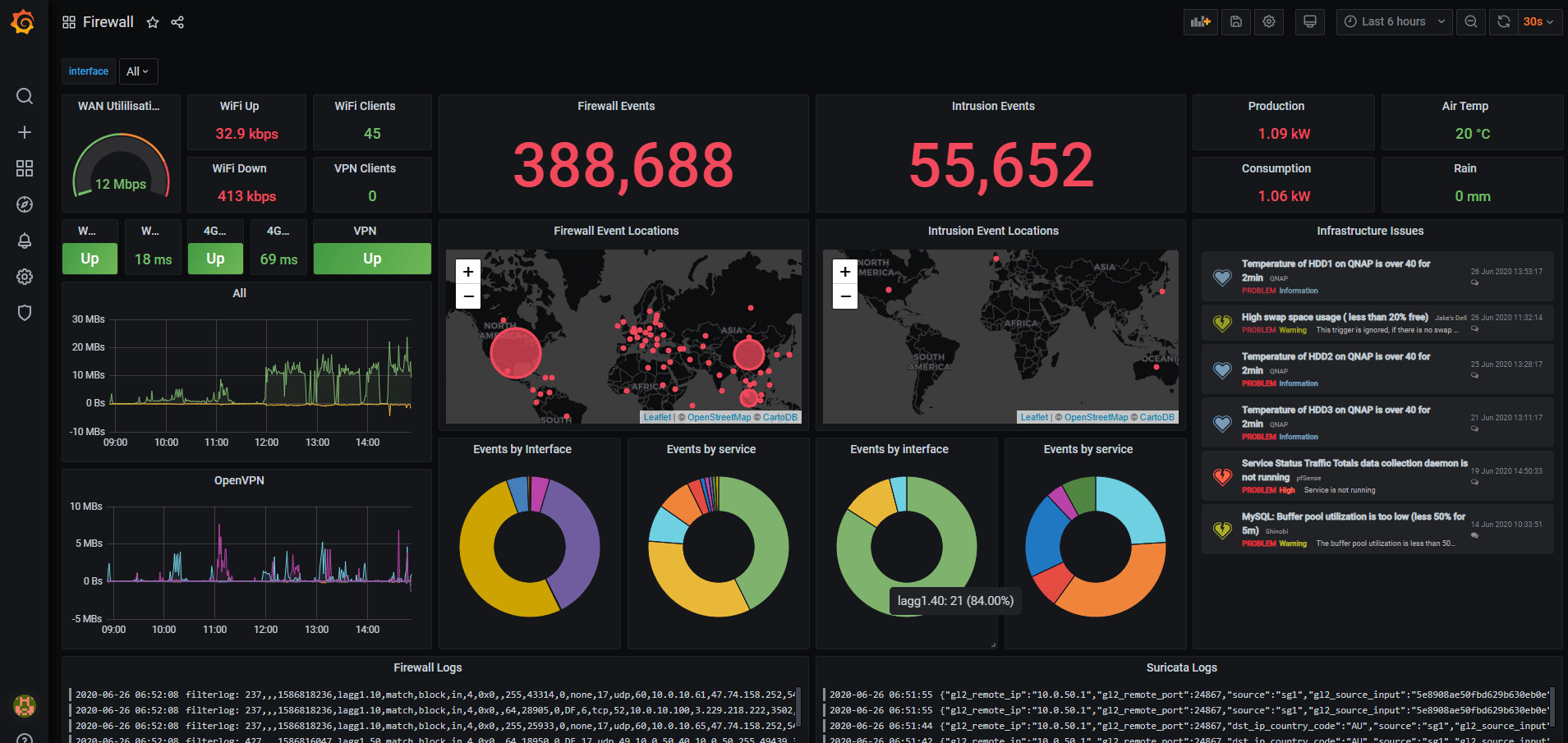
Key Features:
- Firewall and Router: Advanced firewall capabilities with stateful packet filtering, network address translation (NAT), and routing functionalities.
- VPN Support: Comprehensive VPN options, including IPsec, OpenVPN, and PPTP, to secure remote connections.
- Traffic Shaping: Bandwidth management and traffic prioritization to ensure optimal network performance.
- High Availability: Features like CARP (Common Address Redundancy Protocol) for failover and redundancy, ensuring network reliability.
- Extensible Platform: A modular design that allows users to add packages for enhanced functionality, such as intrusion detection systems (IDS), proxy servers, and more.
Pros:
- Highly customizable and flexible due to its open-source nature.
- Cost-effective solution with extensive feature set.
Cons:
- Steeper learning curve for less technical users.
- Requires more manual configuration and maintenance.
- Community support can be inconsistent, requiring reliance on forums and user communities.
Pricing:
Its business tier pricing starts at $349. However, it’s not declared if it’s a per month or one-time pricing.
Lower-end pfSense appliances from Netgate have shown themselves to be a bit flaky. They will lock up on updates, or sometimes lock up for no reason at all. When this happens, we’ve noted that even a reboot of the system doesn’t bring it back online and it must be accessed via emulated serial console (over USB) in order to manually walk it through a startup sequence. This is extremely problematic at remote/unstaffed locations.
I love Netgate. I use it at home. It does all the enterprise things. Though, in an enterprise environment , Netgate isn’t really in the conversation. But 500 devices is kind of in the in between and if budget is a concern, a higher end Netgate will be just fine. Though, you should really know what you’re doing. It doesn’t have guard rails built in.
Why Are Professionals Considering Fortinet Competitors?
Professionals are increasingly looking at Fortinet competitors due to several recurring issues that impact their operations.
Integration and Firmware Challenges
Users often struggle with the integration of Fortinet products, particularly after firmware updates. One user noted:
I really wish I can use Fortinet products for everything, single pane of glass and all. But the integration experience is bad. It’ll work after some serious effort, sure. The headache increases exponentially once we go into full Fortinet deployments, including switch and AP. It’s almost as if I need to find the magic combination of firmware for FGT, FSW, FAP.
This inconsistency in product integration and firmware reliability is a key reason professionals are exploring Fortinet competitors.
Support Deficiencies
The lack of direct support from Fortinet is another major concern. As one user pointed out:
I would rate Fortinet Wireless three out of 10… There is no direct person involved from the Fortinet side to give client support. They depend on the mediator or integrators or suppliers.
This reliance on third parties rather than direct support from Fortinet leads to dissatisfaction and drives users to seek alternatives that offer more direct and reliable customer service.
Stability and Performance Issues
Firmware stability is a critical issue for many users. One review highlighted:
New code takes a 1+ year to be stable and almost 2 years to be marked as mature. So you may not get those cool new features in production for a long time.
This delayed stability impacts productivity and is a significant factor in why professionals are moving away from Fortinet.
Security and Feature Limitations
Fortinet’s security features have also been criticized, particularly regarding their handling of Linux environments. A user shared:
Their Linux agent is running in Kernel space, which poses higher risk of instabilities… Top notch competitors are running in user-space and utilizing eBPF to monitor kernel space to have the same sight, yet be more stable.
These limitations, along with the lack of critical features like TAC-supported VPN-only options, push professionals to consider more comprehensive solutions from other providers.
Our Final Verdict?
Choosing the right security solution depends on your business needs.
- Heimdal® excels in proactive threat prevention and automated patch management, making it ideal for businesses seeking user-friendly, advanced protection.
- Cisco offers extensive, high-performance security products but can be costly for SMBs.
- Palo Alto Networks leads in cloud security and innovation but requires skilled management.
- Sophos provides simplified, centralized security management, while Check Point offers unified security with advanced threat prevention.
- Juniper Networks delivers scalable, high-performance solutions, and Barracuda is known for affordability and ease of use.
- SonicWall offers comprehensive features with straightforward management. WatchGuard stands out for multi-layered security tailored to SMBs, and Netgate pfSense offers highly customizable, cost-effective open-source solutions.
Understand and evaluate your specific needs, budget, and IT capabilities to find the best fit among these Fortinet competitors.
Frequently Asked Questions (FAQs)
Which is the best Fortinet competitor?
Heimdal® is a solid Fortinet competitor. It offers advanced threat detection and prevention using machine learning and behavioral analysis. Heimdal’s comprehensive endpoint protection secures all devices within an organization, and its robust DNS security blocks malicious websites, phishing attempts, and malware. Plus, with easy integration and a user-friendly interface, managing and monitoring security measures is straightforward. Heimdal’s proactive approach and versatile solutions make it a compelling choice for businesses looking for an effective Fortinet competitor.
Why is Fortinet falling?
Fortinet is falling because the shares of Fortinet fell as the company’s billings fell below Wall Street’s estimates, a potentially negative sign for future results. As more companies look at Fortinet competitors, the pressure is on Fortinet to remain competitive.
Has Fortinet been hacked?
Attacks by a China-linked hacking group in 2022 and 2023 led to the compromise of at least 20,000 Fortinet FortiGate devices, according to the Dutch military intelligence service. This incident highlights vulnerabilities that Fortinet competitors are eager to exploit in their pursuit of a larger market share.


