


 Network Security
 Vulnerability Management
 Privileged Access Management
  Endpoint Security
 Threat Hunting
 Unified Endpoint Management
 Email & Collaboration Security



Contents:
Last reviewed August 2026. Pricing, analyst placements and test results in this category go stale inside a year, so every figure below is dated. Verify against the source before you build a business case on it.
Disclosure. We are Heimdal. We sell one of the products in this comparison. That is exactly why every vendor here gets real weaknesses, including us, and why we do not claim to detect threats better than Sophos. Sophos scored at the top of the field in SE Labs’ Q4 2025 Enterprise Endpoint test. Any article telling you otherwise is selling.
Most people reading this are not looking for a cybersecurity lecture. You are looking at a Sophos renewal quote that came in higher than last year, or a helpdesk queue full of “my laptop is slow” tickets, or an insurance questionnaire asking whether your EDR is actually monitored by someone.
Something has forced the question, and now you need a shortlist you can defend in front of a budget holder.
This article gives you that shortlist of Sophos competitors and Sophos alternatives. Nine business endpoint platforms, including Sophos itself, for a fair comparison, plus one specialist service worth naming, what each one is genuinely good at, what breaks when you deploy it, and how to test the claims yourself. It is written for direct enterprise and mid-market buyers who run their own IT and security function. No consumer antivirus products. A Sophos business buyer will never seriously consider them.
The bottom line up front
If you only read one section, read this one. Match your situation to a name, then jump to that profile.
- Heimdal. Us. Pick us if your real exposure is unpatched software, standing local admin rights and web-borne threats, and you want fewer vendors to manage.
- Sophos. Stay if you want endpoint, firewall, email and a large managed service from one vendor, and your hardware is reasonably modern.
- CrowdStrike Falcon. Buy it if you have analysts who will actually use deep telemetry, and detection depth matters more to you than cost control.
- SentinelOne Singularity. Modern EDR with packaging clear enough to compare on a single page.
- Microsoft Defender for Endpoint. Microsoft-first estate, already licensed at E5? Your endpoint budget is effectively already spent.
- Bitdefender GravityZone. Cost-conscious mid-market teams that want top-tier prevention without enterprise XDR complexity.
- ESET PROTECT. Older hardware estates, and fleets where agent weight decides the deal.
- Trend Micro Vision One. Large hybrid and cloud workload estates that want endpoint and cloud under one platform.
- Palo Alto Networks Cortex XDR. Enterprises and MSSPs already invested in Palo Alto and running a mature SOC.
- Huntress. Lean teams who want a human security operations service on a deliberately light agent.
The category changed. Most comparison articles did not
The old version of this question was “which antivirus catches more malware”. It is a settled question in modern cybersecurity. If you want the category definition before diving in, see our guide to endpoint detection and response. It also stopped separating serious vendors a while ago, because prevention quality at the top of this market is close enough that in SE Labs’ Q4 2025 enterprise round, five products recorded 100% Total Accuracy in the same test.
Here is what the stack looks like as of 2026.
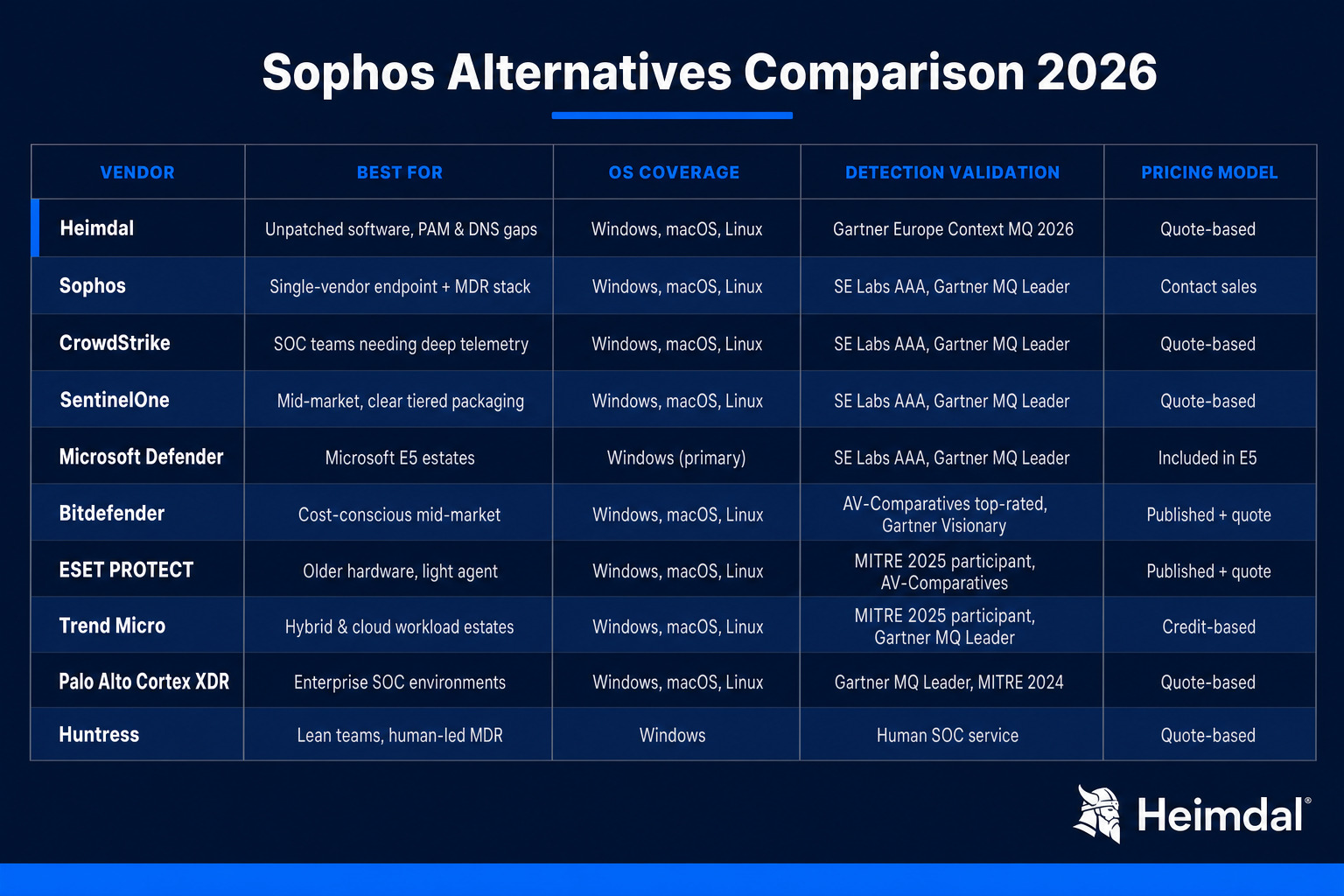
Not sure whether you need XDR or MDR? We have a full XDR vs MDR breakdown. Two forces drove that shape.
The first is consolidation, as organisations actively cut the number of security vendors they operate. The second is staffing. Very few mid-market teams can staff a 24/7 rota, so managed detection and response has grown faster than the EDR licences underneath it.
Sophos itself is the clearest illustration. It acquired Secureworks in an all-cash transaction reported at roughly $859 million, completed in February 2025, specifically to scale its managed detection and response business. Sophos states it has since folded the Taegis platform and the Counter Threat Unit into its security operations portfolio.
Trade press reported in 2025 that Sophos cut headcount by around 6% afterwards, described at the time as removing duplicative roles.
What outdated thinking looks like
“EDR replaced antivirus.” It did not. Every credible EDR product has a prevention engine underneath it, and that engine stops the overwhelming majority of commodity threats that should never reach a human.
“Vendor X won MITRE.” MITRE ATT&CK Evaluations does not rank vendors, declare winners or issue awards. It publishes per-vendor detection scorecards and leaves the interpretation to you. Every “we won MITRE” headline is a vendor reading its own scorecard.
“They skipped the test, so they must be weak.” Participation in the 2025 MITRE Enterprise round fell to 11 vendors. Microsoft, SentinelOne and Palo Alto Networks did not take part, citing different testing priorities. Non-participation is a question to ask a vendor, not a verdict to deliver.
“XDR is a product.” For a lot of vendors, XDR is a licence tier layered over the same agent. The question that matters is which telemetry sources are natively integrated and which arrive through a thin API connector.
“Norton and McAfee are alternatives to Sophos.” They are not. Consumer suites have no multi-tenant console, no EDR telemetry retention, no policy inheritance and no incident-response workflow. Where the McAfee lineage matters to an enterprise buyer, the correct entity is Trellix.
Where traditional approaches fall short
Four gaps show up again and again in real endpoint security environments, and none of them are fixed by buying a better detection engine.
Detection sits downstream of the actual entry point. Unpatched software and misused remote access credentials are persistent initial-access routes. An EDR agent watches what happens after that. Most EDR platforms will report a vulnerability. Comparatively few will remediate it. Patch management is a separate discipline — and a separate buying decision for most teams.
Standing local administrator rights are still normal. Removing them is one of the highest-return controls available to a mid-market team. It also sits outside almost every endpoint platform on this list, so in practice it means a separate privileged access management product and a separate project.
Nothing blocks before execution. DNS and HTTP or HTTPS traffic filtering stops command-and-control callbacks, malicious domains and drive-by downloads before a file ever lands. Classic EDR has no equivalent layer.
Alerts arrive whether or not anyone is available. EDR deployed without someone to triage it produces alerts nobody actions. That is a category-level failure, not a vendor flaw, and it is the structural reason MDR keeps growing.
Then there are the operational costs that never make it into a demo. Agent weight on older hardware turns into helpdesk tickets with your name on them. False positives on internal PowerShell and custom tooling turn into a manual exclusion backlog that somebody has to work through. Removing an incumbent agent cleanly, avoiding conflicts with Microsoft Defender and re-baselining exclusions take longer than the project plan says. Longer every time. Migration is where buyer’s remorse gets made.
How we think about this at Heimdal
We built our platform around a simple position. Detecting an intrusion matters, and reducing the number of ways an intrusion can start matters at least as much. Patching, privileged access and traffic filtering are where we put our engineering effort, because those are the doors attackers actually walk through.
You can buy that two ways, and we deliberately keep both open.
Heimdal Endpoint Security as a standalone product. Next-Gen Antivirus and Firewall with our Extended Threat Protection engine, Remote Access Protection, and Ransomware Encryption Protection X. REP X runs four complementary detection engines covering encryption, rename, shadow copy and canary behaviour, validated internally against more than 800 ransomware samples.
REP X works alongside whatever antivirus you already run, so you can test it without ripping anything out. If your problem is endpoint protection and nothing else, buy only that.
Or as part of our unified platform. One agent. One console. One contract. It extends into Patch and Asset Management, DNS Security, Privileged Access Management (PEDM, PASM and Application Control), Email Security, Unified Endpoint Management and our Threat-hunting and Action Center. More than ten integrated modules, all managed from the same place you already use for endpoint protection.
The figures below are our own, from our product documentation as of August 2026. Verify them in a trial rather than taking them from us.
What that buys you in practice, rather than in adjectives:
- Patching that closes the gap instead of reporting it. Automated deployment across Windows, macOS, Linux and more than 350 third-party applications, with rollback and full CVE and CVSS audit trails. We target repackaging and release inside four hours of a patch dropping.
- Local admin rights you can actually remove. PEDM elevates rights per task, per user or per application, then de-escalates automatically. Escalation is denied by default for applications carrying a CVSS score of 7 or above, and every approval is logged for audit.
- Blocking before execution. DNS Security filters DNS, HTTP and HTTPS traffic at both the network security layer and the endpoint layer, so command-and-control communication and malicious domains are stopped ahead of any file execution.
- Remote access closed by default. Remote Access Protection blocks unsolicited external remote access, including RDP, and permits only allowlisted IPs and ports.
On AI, we would rather be precise than loud. Two AI-driven capabilities are live today and predate anything we brand as AI Wingman. Predictive DNS applies AI and machine-learning analysis to identify suspicious destinations and likely attack activity before threats fully materialise.
AI-powered email fraud prevention uses outlier detection across inbound and outbound mail to surface impersonation, CEO fraud and out-of-character behaviour. Separately, AI Wingman is a cross-platform intelligence layer built on top of the platform and delivered in phases.
- AI Wingman Assist is generally available and provides guidance inside the dashboard.
- AI Wingman Triage uses multi-agent systems to validate incidents and accelerate triage, and is included with the Threat-hunting and Action Center.
- AI Wingman SOC is included with TAC plus MXDR.
Now the part most vendor articles skip.
We were named in the Gartner Europe Context Magic Quadrant for Endpoint Protection in May 2026. We are also in an analyst relationship with Forrester and expect a report to be published soon. Until then, the best evidence is your own proof of concept.
Two other things worth knowing before you talk to us.
Our breadth advantage depends on how many modules you actually license, so a single-module deployment is not the unified platform. And our pricing is quote-led rather than published, which means you have to ask.
Practical buyer guidance
Do you actually need to move?
Run through these before you start booking demos. If none of them apply, renewing is a legitimate answer.
- Your renewal quote rose materially and the vendor will not put uplift caps in writing.
- Agent performance on your oldest in-service hardware is generating helpdesk volume you can measure.
- You own EDR that nobody has time to watch, and your insurer now distinguishes between deployed and monitored.
- Your real incident pattern is unpatched software or misused admin rights, and your current platform reports both without fixing either.
- Your licensing unit does not match your device population, for example user-based licensing across shift workers, labs or kiosks.
- Requirements have outgrown the platform, and you now need raw telemetry access and hunting workflows it was never built for.
What to evaluate, in priority order
- Agent overhead on your worst hardware. Measure CPU, memory and boot time on your oldest in-service machines and busiest servers, not on a new laptop. Every vendor claims a light agent. Almost none of them are independently verified on it.
- Telemetry retention in the tier you can afford. Seven days and ninety days are materially different products. Ask about retention in the SKU you will actually sign, not the flagship.
- Response authority, not just monitoring. If you are buying MDR, ask in writing whether the provider can isolate a host without waiting for your approval, and what the contractual response SLA is at 3am on a Sunday.
- Year-three cost. Model renewal, not year one, with written uplift caps.
- Non-Windows parity. Verify Linux and macOS feature coverage module by module. Gaps here are common and rarely volunteered.
- Uninstall of your incumbent. Test it before you commit to anything. This is where migrations go wrong.
- Data residency. Confirm where telemetry is stored against your compliance obligations.
- Test participation. Check which independent tests the vendor takes part in. Treat absence as a question, not a verdict.
What mid-market teams consistently underestimate
- Exclusion tuning. Default policies are strict. Internal scripts and custom tooling will trip them, and someone has to own the exclusion list.
- Console learning curve. The person who knows the console is the person who makes the platform work. If that is one individual, you have a staffing risk, not a product risk.
- The gap between XDR marketing and XDR reality. Ask which telemetry sources are native and which are connectors.
- Compliance evidence. Very few frameworks name EDR. NIS2 is technology-neutral and asks for proportionate network security and cybersecurity risk management, including detection and incident handling. DORA raises operational-resilience and incident-handling requirements for EU financial entities. CMMC 2.0 and NIST SP 800-171 are the most direct, with control SI.L2-3.14.7 commonly satisfied using EDR. PCI DSS v4.0 requires anti-malware, logging and incident response in the cardholder data environment. The HIPAA Security Rule does not mandate EDR, but its audit-control and incident-procedure requirements are usually met with endpoint monitoring. What auditors want is coverage, monitoring, response and proof.
- Insurance. Underwriting guidance in the current market commonly treats EDR across all endpoints as a baseline, and several insurer checklists now separate EDR that is deployed from EDR that is monitored. For many buyers this is a more immediate driver than regulation.
What none of these products will fix
- A device inventory you do not trust. Unmanaged endpoints are not protected by any agent, however good.
- Identity attacks that never touch a managed device, including token theft and session hijacking.
- OT and IoT estates, which mostly sit outside every platform here.
- Missing process. Nobody sells you an incident-response runbook or a patch approval workflow.
- Backup and recovery. Rollback is not a backup strategy, and it will not undo the cost of a breach.
How to run a proof of concept without drowning in demos
Shortlist three. In practice that is the incumbent, one premium name and one value or specialist option. More than three and you will run out of patience before you run out of vendors.
Then run two to six weeks on real hardware, with a written test plan agreed before the first call. Include a representative sample of your oldest devices, your noisiest servers and at least one department that runs custom internal tooling. Record agent overhead numbers before and after. Trigger a controlled detection and time how long it takes for a human to reach you.
Attempt an uninstall at the end. Keep the results. In practice, buyers tend to trust their own proof-of-concept data over published lab results, peers, analyst reports, review platforms and vendor content, this article included. They are right to.
Vendor profiles
1. Sophos
What it is. A channel-led endpoint platform centred on mid-market and education, with XDR and MDR sold as ascending tiers. Sophos rebranded its Intercept X SKU structure to Sophos Endpoint in its 2025 portfolio refresh. Following the Secureworks acquisition, Sophos states it now defends 40,000 MDR customers and more than 600,000 organisations overall (Sophos, May 2026).
Best for. Mid-market and education organisations that want a single security solution combining endpoint, firewall, email and a managed service, running reasonably modern hardware.
Strengths. Detection results are genuinely top-tier. In SE Labs’ Q4 2025 Enterprise Endpoint Protection test, Sophos Intercept X recorded 100% Protection Accuracy, 100% Legitimate Accuracy and 100% Total Accuracy with a AAA award. CryptoGuard ransomware protection and rollback has a long operational record. Synchronised Security works well when firewall, endpoint and email are all Sophos. Sophos also holds consistently high user-satisfaction scores on peer-review platforms, among the stronger in the category, and states it was named a Gartner Magic Quadrant Leader for the 17th consecutive time in the 2026 EPP report.
Trade-offs. Agent resource consumption on servers and lower-specification endpoints is the dominant recurring complaint across G2, PeerSpot, TrustRadius and practitioner communities. In fairness, some administrators have traced apparent slowdowns to Microsoft Defender left in the wrong operating mode rather than the Sophos agent alone, and Sophos has shipped newer agent versions it states are designed to reduce CPU usage. Reviewers also describe a steep Sophos Central console learning curve with settings buried several levels deep. Support sentiment is mixed and reads better for small, straightforward environments than for large or persistently problematic ones. The platform’s value concentrates when you commit across the whole Sophos stack, which is precisely the dependency a heterogeneous-stack buyer is trying to escape.
Pricing. Undisclosed. Contact sales. User-based licensing creates friction in shared-device environments.
2. Heimdal
What it is. Our own platform. Endpoint protection and EDR or XDR available standalone, or combined with patch and asset management, DNS and traffic filtering, privileged access management, email security and threat hunting under one agent and one console.
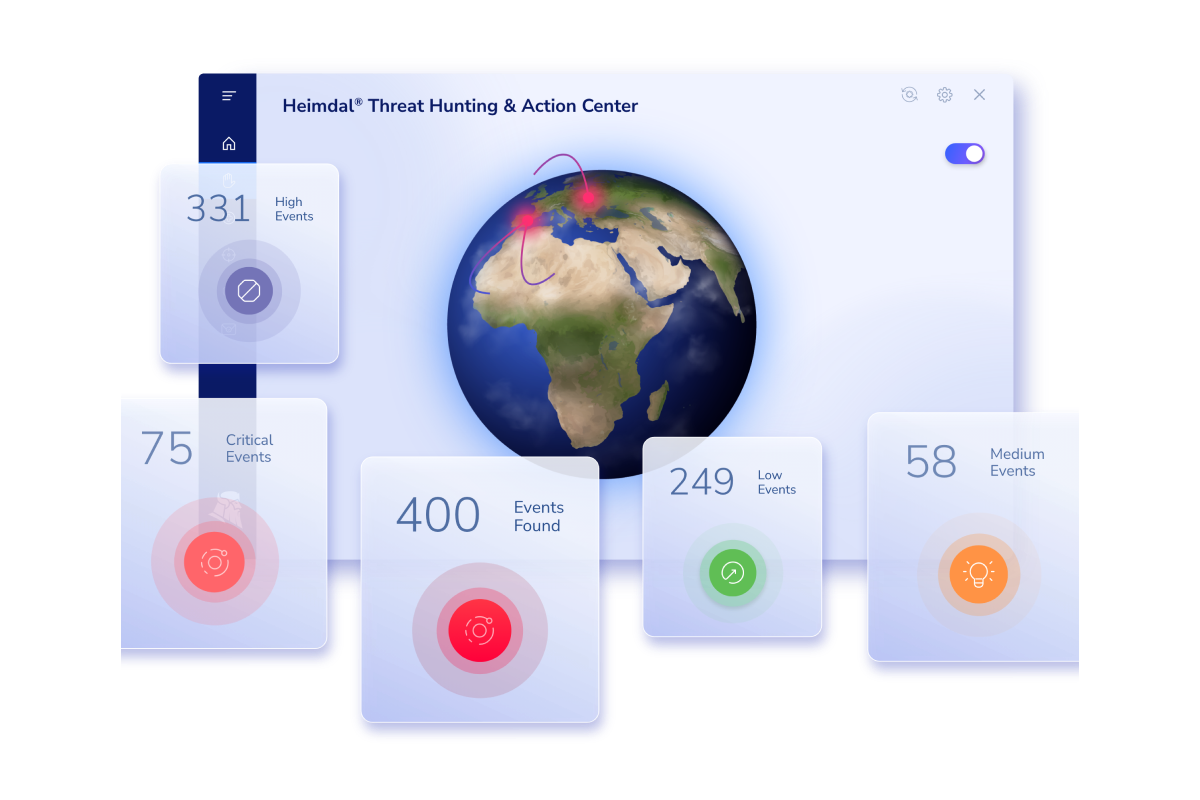
Best for. Enterprise and mid-market teams whose real exposure is unpatched software, standing local administrator rights and web-borne threats, and who treat vendor count as a problem in itself.
Strengths. The genuinely differentiated capabilities are the ones most EDR vendors do not offer at all. Automated operating-system and third-party patching across more than 350 applications. DNS, HTTP and HTTPS traffic filtering at the pre-execution layer, across network and endpoint. Endpoint privileged access management with automatic de-escalation and CVSS-based denial of escalation.
Those three address initial-access vectors that endpoint detection sits downstream of. For a lean team, consolidating patching, PAM, DNS filtering and endpoint protection into one agent and one commercial relationship is a real operational and cost argument rather than a marketing one.
Trade-offs. We have lower brand recognition in enterprise procurement than the vendors named as analyst Leaders, and less independent third-party validation of detection efficacy. We were named in the Gartner Europe Context Magic Quadrant for Endpoint Protection in May 2026, and we are in an analyst relationship with Forrester with a report expected soon. Until it publishes, your proof of concept is the evidence. The modular structure that produces the breadth advantage also means the unified platform argument only holds for the modules you license.
Pricing. Quote-led, though you get an instant estimate by completing our Pricing Calculator. Tiers vary by seat count, server count and commitment length across monthly, annual, three-year and five-year terms. Buying Threat Prevention for both perimeter and endpoint attracts a discount across the overlapping seat volume.
3. CrowdStrike Falcon
What it is. Premium cloud-native EDR and XDR for enterprises and mature security teams.
Best for. Organisations with a functioning SOC, or those buying CrowdStrike’s own managed service, that value detection depth over cost efficiency.
Strengths. Telemetry depth and detection quality are backed by independent data. Falcon recorded 100% Protection Accuracy and 100% Total Accuracy with zero false positives in SE Labs’ Q4 2025 test. Threat intelligence is strong and the module range is wide. CrowdStrike states it was named a Leader in the 2026 Gartner Magic Quadrant for Endpoint Protection Platforms. It also reports 100% detection, 100% protection and zero false positives in the 2025 MITRE Enterprise evaluation, which is CrowdStrike’s reading of its own scorecard rather than a MITRE conclusion.
Trade-offs. Cost is the recurring objection, and the structure is why. The entry SKU is not the product you see demonstrated. Threat hunting, identity protection, exposure management and extended log retention are separate line items, so total cost is routinely underestimated at first quote. This is a platform commitment, not a simple endpoint purchase.
Pricing. CrowdStrike publishes pricing for small-business tiers with a device minimum. Enterprise tiers are quote-based. Published figures move frequently, so check the current pricing page rather than any number quoted in an article, including this one.
4. SentinelOne Singularity
What it is. An AI-native endpoint platform built around machine learning models, with the clearest public packaging in the category.
Best for. Mid-market buyers who want modern EDR with predictable, explainable tiers and strong automated rollback.
Strengths. As of 2026 the tiering runs Core, Control, Complete, Commercial and Enterprise. That makes evaluation and internal comparison unusually straightforward. Automated response and rollback are strong. SentinelOne states it was named a Leader in the 2026 Gartner Magic Quadrant for Endpoint Protection Platforms, for the sixth consecutive year.
Trade-offs. The lower tiers sit closer to EPP than to full EDR, so the capability you are shortlisting for concentrates in Complete and above. If you compare an entry-tier SentinelOne price against a competitor’s full-featured tier, you will mis-compare, and add-on modules push effective cost up materially. SentinelOne recorded Total Accuracy in the 95% to 98% band in SE Labs’ Q4 2025 test, also with a AAA award, which is strong but sits below the group of products that recorded 100%. It did not participate in the 2025 MITRE Enterprise round.
Pricing. Quote-based by tier. Get pricing for the tier that contains the features you actually need, not the entry tier.
5. Microsoft Defender for Endpoint
What it is. The default option for Microsoft-centric organisations, and the economic baseline every other vendor gets priced against.
Best for. Microsoft-first organisations already licensed at E5, with the in-house skills to operate the Defender portal.
Strengths. Under current Microsoft licensing, organisations holding Microsoft 365 E5 already have Defender for Endpoint Plan 2 included, so marginal deployment cost is close to zero. It recorded 100% Protection Accuracy and 100% Total Accuracy in SE Labs’ Q4 2025 test. Microsoft states it was named a Leader in the 2026 Gartner Magic Quadrant for Endpoint Protection Platforms, and a Leader in the Forrester XDR Waves of Q2 2024 and Q2 2026. Because identity, email and cloud telemetry are native to the same estate, its XDR correlation is architecturally genuine rather than bolted on afterwards.
Trade-offs. Licensing complexity is a real operational burden. Plan 1 versus Plan 2, E3 versus E5, servers licensed separately, per-user entitlements covering a capped number of devices. Non-Windows coverage lags the Windows experience badly enough to notice. Outside a Microsoft estate, the standalone value falls away. Microsoft did not participate in the 2025 MITRE Enterprise round.
Pricing. Included in Microsoft 365 E5 under current licensing. Standalone Plan 1 and Plan 2 are published per user per month on Microsoft’s site, with server licensing priced separately. Verify against the current Microsoft pricing page.
6. Bitdefender GravityZone
What it is. A broad SMB and mid-market endpoint platform with one of the strongest channel programmes in the category.
Best for. Cost-conscious mid-market buyers who want top-tier prevention without enterprise XDR complexity.
Strengths. Independent results are consistently strong with an unusually good protection-to-false-positive ratio. In AV-Comparatives’ March to June 2025 Real-World Protection test, Bitdefender blocked 437 of 438 threats with a single false positive. Bitdefender was named a Strong Performer in The Forrester Wave: Extended Detection and Response Platforms, Q2 2024, where Forrester wrote that organisations with smaller teams wanting an easy-to-use, reliable XDR are best suited to Bitdefender. In the 2026 Gartner Magic Quadrant for Endpoint Protection Platforms, Bitdefender was named a Visionary. It also recorded the lowest average number of compromised systems across AV-Comparatives testing from March 2023 to November 2025. Value relative to premium-tier competitors is good.
Trade-offs. Less brand pull than CrowdStrike or Palo Alto Networks in enterprise procurement, which matters if you have to defend the choice upward. The XDR and MDR propositions are credible but are not the market’s primary reference point. The modular structure means patch management, full-disk encryption and integrity monitoring are sold separately, so the base SKU understates the cost of a full deployment.
Pricing. Published per-device pricing exists for small-business tiers. Mid-market and enterprise GravityZone tiers are quote-based. Price the modules you need, not the base SKU.
7. ESET PROTECT
What it is. Lightweight, efficient endpoint security for small businesses and mid-market.
Best for. Older hardware estates and organisations where agent performance is the deciding constraint.
Strengths. Low agent overhead, which matters here, because agent weight is the most common complaint about the incumbent. The stability record is strong. ESET took part in both the 2025 MITRE Enterprise round and the AV-Comparatives 2025 business series, so there is published data to read.
Trade-offs. The XDR and platform story is weaker than the market leaders’, and the threat-hunting workflow is less advanced. ESET does not sell this as an enterprise SOC tool, and a buyer with a detection-engineering function will find it thin.
Pricing. Published per-seat list pricing exists for smaller tiers, with volume and multi-year pricing quote-based. Verify current figures with ESET.
8. Trend Micro Vision One
What it is. A broad security platform spanning endpoint, XDR, cloud workload and network.
Best for. Organisations with substantial hybrid and cloud workload estates that want endpoint and cloud security under one platform.
Strengths. Genuine platform breadth for mixed environments, including substantial server and cloud workload coverage. Trend Micro participated in the 2025 MITRE Enterprise round and the Forrester XDR Wave, and states it was named a Leader in the 2026 Gartner Magic Quadrant for Endpoint Protection Platforms.
Trade-offs. As of 2026, the credit-based licensing model is difficult to forecast. Credits are allocated across modules and asset types, so budgeting is harder than under a per-seat model, and the cost climbs as you add modules.
Pricing. Credit-based and quote-driven. Model your credit consumption across a full year before signing, and ask what happens when you exhaust them mid-term.
9. Palo Alto Networks Cortex XDR
What it is. High-end XDR for SOC-led and MSSP environments.
Best for. Enterprises already invested in Palo Alto, operating a mature SOC.
Strengths. Strong XDR correlation and deep integration with the wider Palo Alto network and cloud portfolio. Palo Alto states it was named a Leader in the 2026 Gartner Magic Quadrant for Endpoint Protection Platforms and a Forrester XDR Wave Leader in Q2 2024, and reports 100% technique-level detection with the highest prevention rate and zero false positives in the 2024 MITRE round.
Trade-offs. Complexity and cost put it beyond most mid-market buyers searching for a Sophos alternative. Licensing combines per-endpoint charges with data-volume and retention components, which makes forecasting genuinely hard. It did not participate in the 2025 MITRE Enterprise round. This is not an endpoint-only purchase and should not be evaluated as one.
Pricing. Quote-based, with endpoint, data ingestion and retention priced separately. Ask for a three-year model at your projected data volume.
Also worth naming
- Huntress. A human-led security operations service on a deliberately light agent. Practitioners keep naming it as the destination for lean teams walking away from a mid-market endpoint platform. It is best known in the MSP channel, which matters if you are buying direct. Narrower in scope than the platforms above. See how Heimdal compares to Huntress.
- Kaspersky. Strong independent results, including 100% Protection Accuracy and 100% Total Accuracy in SE Labs’ Q4 2025 test. As of 2026, geopolitical restrictions materially limit its addressable market in the United States, the United Kingdom and parts of the EU. This is a procurement constraint rather than a technical one.
- Broadcom Symantec Endpoint Security. Recorded 100% Total Accuracy with a AAA award in SE Labs’ Q4 2025 test. Practitioners talk constantly about Broadcom’s post-acquisition commercial and support model, though nobody has independently measured its effect on the endpoint product.
- Trellix. The correct enterprise entity for the McAfee lineage. Recorded 98% Protection Accuracy and 99% Total Accuracy in SE Labs’ Q4 2025 test and participated in the AV-Comparatives 2025 business series.
- Elastic Security. 100% protection in both AV-Comparatives 2025 business rounds, with a notably higher false-positive count in one report, including 17 in a single Real-World report. Read protection rate and false-positive rate together, because false positives are paid for in analyst and helpdesk time. Of particular interest if you already run Elastic.
Choosing by situation
You have a SOC and analysts who hunt. CrowdStrike or Palo Alto Networks. Buy telemetry depth and retention, and budget for the modules that are not in the entry SKU.
You are already at Microsoft 365 E5. Start with Defender for Endpoint, because you have paid for it. Then price the specific gaps rather than the whole platform. Non-Windows depth, patch remediation, privileged access and DNS filtering are the usual ones.
Your problem is cost and you still want top-tier prevention. Bitdefender. Price the modules, not the base SKU.
Your problem is agent weight on old hardware. ESET, and measure it yourself on your worst machines before you sign anything.
Your problem is that nobody is watching the alerts. Buy an outcome, not a licence. Compare MDR offers on response authority and contractual SLA rather than on feature lists, and get the isolation-without-approval answer in writing.
Your problem is unpatched software and standing admin rights. Look at us, and look at Bitdefender’s patch module and Microsoft’s combination of Intune and Defender Vulnerability Management. Ask each one whether it remediates or only reports.
You want packaging you can explain to a budget holder in one slide. SentinelOne, at Complete or above.
You have a large hybrid and cloud workload estate. Trend Micro, with a credit consumption model built before signature.
Sophos is working and your hardware is modern. Renew, negotiate uplift caps in writing, and spend the saved effort on the gaps around the endpoint rather than on a migration.
FAQ
Is Sophos bad?
No. In SE Labs’ Q4 2025 enterprise test it recorded 100% Total Accuracy with a AAA award. In the subsequent Q2 2026 round it recorded 99% Total Accuracy, still AAA-rated and comfortably in the top tier of the field. The reasons people leave are operational rather than protective, and they cluster around agent overhead on older hardware, console complexity, renewal pricing, user-based licensing in shared-device environments, and the way value concentrates when you commit to the whole Sophos stack.
Why are Norton 360 and McAfee not in this list?
They are consumer identity and antivirus bundles. No multi-tenant console, no EDR telemetry retention, no policy inheritance, no incident-response workflow. They cannot replace a business endpoint platform. For the McAfee lineage in an enterprise context, look at Trellix.
Do I need EDR, or MDR?
If nobody on your team is available to triage alerts outside working hours, you need MDR. EDR that nobody watches produces alerts nobody actions. When you compare MDR offers, ask whether the provider can isolate a host without waiting for your approval, and what the contractual response SLA is.
We already pay for Defender in E5. Why would we spend more?
Only for a specific capability gap you can name. The gaps worth pricing are patch remediation rather than vulnerability reporting, endpoint privileged access management, DNS and traffic filtering before execution, and non-Windows depth. A generic claim that another product detects better is not a business case.
Does patch management really belong in an endpoint security decision?
Unpatched software is a persistent initial-access route, and endpoint detection sits downstream of it. Most EDR platforms report vulnerabilities. Fewer remediate them. If your incident history is dominated by known unpatched CVEs, then yes, it belongs in the same decision.
How long should a proof of concept run?
Two to six weeks is normal for mid-market, longer in enterprise. Run it on your oldest in-service hardware and your busiest servers, include a team that uses custom internal tooling, record agent overhead before and after, and test the uninstall of your incumbent agent before you commit.
A vendor says it won MITRE. Should I care?
MITRE ATT&CK Evaluations does not rank vendors or declare winners. It publishes detection scorecards. A “we won MITRE” claim is a vendor summarising its own results, so read the scorecard rather than the press release.
One vendor is not in any of the major tests. Is that disqualifying?
Not automatically, but it changes what evidence you have. Absence from a test means you cannot use published lab data to assess that product, so the burden shifts to your own proof of concept. Ask the vendor directly which tests it participates in and why it skipped the others.
Is Kaspersky a realistic option?
Its independent results are strong, including 100% Total Accuracy in SE Labs’ Q4 2025 test. As of 2026, geopolitical restrictions materially limit procurement in the United States, the United Kingdom and parts of the EU. Check your own regulatory and customer constraints first, because this is a procurement question before it is a technical one.
How much should I worry about vendor acquisitions?
Enough to ask about ownership structure, roadmap continuity and support organisation stability. Consolidation across this cybersecurity category is real, and buyer concern is well documented. Measurable service degradation attributable to any specific transaction is not, so treat it as a risk to question rather than a fact to assume.


