


 Network Security
 Vulnerability Management
 Privileged Access Management
  Endpoint Security
 Threat Hunting
 Unified Endpoint Management
 Email & Collaboration Security



Contents:
If you’re considering alternatives to CrowdStrike Falcon, the right pick depends on your environment, not a generic ranking.
CrowdStrike protects well against advanced threats, but it takes real configuration work to tune it, and it doesn’t flex much beyond that.
Here’s a look at the top CrowdStrike competitors in 2026, and which vendors are worth a closer look for your specific setup.
The bottom line
There’s no single best CrowdStrike alternative, and no single best fit for every team. It depends on what CrowdStrike isn’t giving you and how your team is set up.
- Heimdal: for teams that want one platform instead of stacking point tools for DNS, patching, privileged access, email, and endpoint security separately.
- Carbon Black: for SOC teams with offline or on-premises requirements.
- SentinelOne: for teams comparing cost against CrowdStrike at scale.
- Cylance (Arctic Wolf): for organizations already using, or open to, Arctic Wolf’s broader platform.
- Microsoft Defender for Endpoint: for Microsoft-heavy shops already licensed for Microsoft 365 E3 or E5.
- Symantec: for large enterprises already standardized on Broadcom tooling elsewhere.
- Trellix: for organizations consolidating legacy McAfee or FireEye deployments.
- Sophos: for teams that want firewall and endpoint protection from one vendor.
- Webroot (OpenText Core Endpoint Protection): for small businesses that want a lightweight agent.
Before we get into the alternatives, it helps to see how CrowdStrike stacks up against another major player. Here’s a video comparison of CrowdStrike versus SentinelOne covering strengths, differences, and use cases.
How to evaluate a CrowdStrike alternative
Every vendor here pitches itself as the complete cybersecurity platform, and most still leave blind spots somewhere across endpoint, identity, DNS, or email once you look past the pitch, even where a vendor has made real strides on one of those fronts. Vendor pages and review sites only get you so far. Before you commit to any of the nine below, run them against these checks in your own environment, not the vendor’s demo environment.
- Independent detection results, not vendor marketing. Read the MITRE ATT&CK evaluation results directly rather than the vendor’s summary of them, and check malware detection rates alongside broader detection capabilities, not just headline scores.
- Agent footprint. Vendor demos run in controlled conditions; your environment doesn’t. Test resource usage on your actual hardware mix, not a clean lab image.
- Offline detection. Can the tool still catch ransomware if the endpoint is offline, such as on a laptop at home?
- True multi-tenancy, if you’re an MSP. Check for genuine per-client isolation, not a shared console with filters bolted on. More on this in the MSP section further down.
- PSA and RMM integrations. Confirm it connects to the tools you already run day to day. More on this in the MSP section further down.
- Pricing transparency. Some vendors publish list pricing for their endpoint security tool; others quote everything. Neither is automatically better, but know which one you’re dealing with before you’re deep in a sales cycle.
- Managed detection and response availability. Decide up front whether your security teams want a self-managed endpoint platform or one with an included or add-on SOC handling threat detection and response for you. Some vendors bundle cloud services and additional threat response tooling into the license; others charge for each separately.
- A proof-of-concept in your own environment. Run one before you decide. A vendor demo tells you what the tool can do; a POC tells you what it does in your environment, with your traffic and your false-positive rate.
Best CrowdStrike Competitors and Alternatives in 2026
Check out the list below to see the best CrowdStrike competitors and alternatives.
1. Heimdal
Heimdal is a strong CrowdStrike alternative if you want to replace CrowdStrike’s heavy configuration with one unified command and control platform that pairs prevention and detection with patching, identity, and email in a single agent.
Heimdal offers a lineup of 10+ fully integrated cybersecurity solutions.
That covers most of your IT estate in one place, so you can stay proactive whether your team works remotely or on-site.
Best for: teams that want one platform instead of stacking point tools for DNS, patching, privileged access, email, and endpoint security separately.
Heimdal is a strong alternative to CrowdStrike if you’re looking for:
- A wider cybersecurity lineup. Threat Prevention, Patch and Asset Management, Privileged Access Management, and Email Security as extras.
- A proactive approach. Heimdal surfaces indicators of compromise and attack by watching network traffic, before an attack can reach your machine processes.
- Process layer detection. Heimdal also inspects activity at the process layer and uses traffic-layer data for added protection.
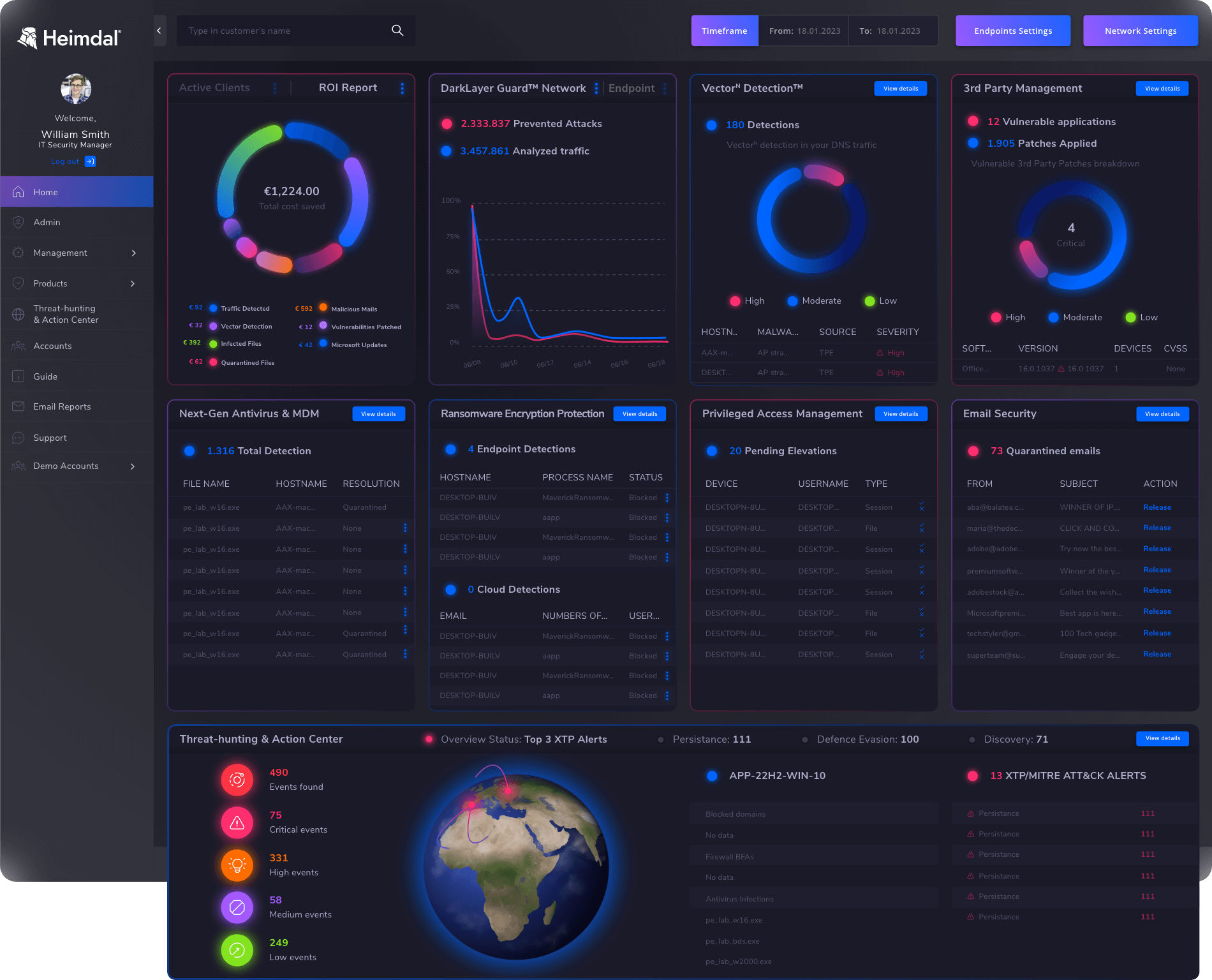
- Unification. With Heimdal, you get everything you need for XDR in one dashboard.
- Easy setup and deployment. You set up Heimdal® Patch and Asset Management cloud policies to match your Active Directory structure. Setup takes under an hour.
What customers say
It is a very able protection software at a very reasonable price. I don’t know any other option of the market that offers so much at this cost.
Iván C. CEO, SourceForge.
Excellent experience so far. I have been recommending Heimdal® to people for years now. Shame I wasn’t signed up as an affiliate.
Mike H. MD, SourceForge.
When our license expired for the expired antivirus solution that we were using from one of your competitors, the third-party IT consulting company that we employ, Extri:Co, recommended that we make the switch to Heimdal®’s services instead because it was a better fit for our infrastructure.
This was back in 2017, and we now benefit from the capabilities of multiple Heimdal® products that have beautifully rounded out our cybersecurity strategy.
Jonas Kjær Chief of IT Operations at Davidsens. Heimdal® Case Study.
Heimdal pros
- Unified platform with a user-friendly interface.
- Extensive endpoint management, including patching, remote desktop, and scripting, that covers much of what a standalone RMM does (no native ticketing).
- Customizable and modular, tailored to your organization’s needs.
- Expanded capabilities including patching, asset and access management, and security.
Cons
- Heimdal® currently lacks some functionality for hardware insight and alerting.
- Some G2 reviewers note the admin portal’s navigation can feel complex, which can slow initial setup.
Heimdal pricing (calculate here)
Our pricing is competitive for the range of security features you get. Heimdal lets you consolidate up to seven providers into one platform. That cuts complexity and reduces risk.
- Pricing covers Windows, macOS, and Android.
- Several price ranges exist by seat count (from one to 20,000-plus) and server count (from one to 100-plus).
- The licensing cost depends on subscription length (monthly, yearly, three-year, or five-year pricing).
- Buying Threat Prevention for both perimeter and endpoint gets you a discount on those products, based on your seat count for both.
2. Carbon Black
Carbon Black Pros
+ Customer interactive intuitive interface and easy handling through user savvy features.
The Antivirus is embedded with advanced security features which provide 24/7 workload protection from threats and all kinds of endpoints.
Next-gen AI-powered advanced security solution for businesses at the most affordable price and reduced cost.
Very stable software can integrate with all kinds of portals and IT systems without any issues.
Shyiam Lan N, Management Consulting.
Carbon Black Cons
– This tool really requires lot of customisation to be user friendly and should compatible with Microsoft operating systems, also lack of Dashboard is another major issue.
Shyiam Lan N, Management Consulting.
3. SentinelOne
SentinelOne’s deployment can take real time. It needs multiple agents, reboots, and manual exclusions to work smoothly. Sensor updates aren’t automatic, which adds to the workload, and its AI and automation sit mostly at the sensor level, which limits system-wide analysis and true XDR coverage.
SentinelOne Singularity is the platform’s real brand name, a cloud-native setup that folds endpoint detection and response, cloud security, and identity threat detection into one data layer. The SentinelOne Singularity Platform has been named a Leader in Gartner’s Magic Quadrant for Endpoint Protection Platforms for six consecutive years running, through the 2026 report, which is worth checking directly alongside CrowdStrike’s own placement in the same report.
Best for: teams comparing cost against CrowdStrike at scale, where SentinelOne’s published tiers give you a number to negotiate against instead of a quote.
Key features
- Detects high-velocity threats.
- One-click remediation and rollback.
- Customizable endpoint and detection dashboard.
Pricing
- Current published pricing spans roughly $5.83 to $17.50-plus per endpoint per month across tiers (Core, Control, Complete, Commercial), before add-ons like managed threat hunting or extended data retention.
- Some customers find it more cost-effective than competitors like CrowdStrike, depending on tier and deployment size.
SentinelOne Pros
+ Agent install – deployed to a PC – reboot and it’s working. Web console filtering allows identification of incidents and configuration in a fairly simple manner.
Dean R., Group Infrastructure Specialist
SentinelOne Cons
– Some upgrades of the product have introduced major issues.
eg One release broke some OS upgrades on certain models of laptop leaving them unable to boot.
Another version introduced crippling speed issues with Adobe products.
To their credit they do eventually fix these issues, but not quickly enough.”
Dean R., Group Infrastructure Specialist
4. Cylance (now Arctic Wolf)
BlackBerry sold Cylance to Arctic Wolf in a deal announced in December 2024 and closed in February 2025. Cylance’s AI and machine learning-based endpoint protection now ships as CylanceENDPOINT, part of Arctic Wolf’s Aurora platform.
CylanceENDPOINT is still built on Cylance’s original AI-based prevention model, designed to block threats without signatures, constant internet connectivity, or sandboxing, including offline. Arctic Wolf has added its own monitoring, reporting, and Concierge Security Team model on top since the acquisition.
Best for: organizations already using, or open to, Arctic Wolf’s broader Aurora platform and concierge security model.
Key features
- AI and machine learning-based threat prevention that works offline, without signature updates.
- Built into Arctic Wolf’s broader Aurora security operations platform.
- Concierge Security Team model for guided response and configuration support.
Pricing
- Arctic Wolf prices endpoint coverage per device per year, bundled with its broader platform and concierge tiers (Silver, Gold, Platinum) rather than sold as a standalone SKU. Expect a quote rather than public list pricing.
Cylance (now Arctic Wolf) Pros
+ We have used Cylance since 2017, before it became Aurora Endpoint Security… Arctic Wolf has done a great job bringing new life to the product by adding valuable features and monitoring tools while keeping the strengths that made Cylance effective.
Gartner Peer Insights reviewer
Cylance (now Artic Wolf) Cons
Endpoint coverage now ships as part of the wider Arctic Wolf platform rather than as a standalone product, which may not suit buyers who want Cylance’s AI engine on its own.
5. Microsoft Defender for Endpoint
Defender for Endpoint comes built into Windows, but you need the latest premium version for full features. It stays tied to OS management, so it needs frequent updates and reboots, and detection still leans on signature-based AV with daily updates. It’s also worth knowing where it stops.
Defender for Endpoint covers the endpoint, while SIEM duties sit in a separate product, Microsoft Sentinel, so a full Microsoft security stack usually means running both rather than one covering everything.
Defender for Endpoint is built into Windows, requiring the latest premium version for full features.
Tied to OS management, it demands frequent updates and reboots.
Detection relies on signature-based AV with daily updates.
Best for: Microsoft-heavy shops already licensed for Microsoft 365 E3 or E5 that want endpoint protection without adding a new vendor.
Key features
- Threat and vulnerability management.
- Attack surface reduction.
- Next-generation protection.
Pricing
- Microsoft prices Defender for Endpoint in two tiers, from $2.50 to $5.20 per user per month.
Microsoft Pros
+ The wealth of detail the product provides in the security.
Microsoft portal is impressive, as well as the ability to take action on most alerts, identities and hosts whenever I have the correct RBAC security roles activated.
Anonymous, Senior Security Engineer
Microsoft Cons
– You cannot install Microsoft Defender for Endpoint on all devices.
I think you can only use it on macOS and Windows 10 at the moment, which leads to limitations when using mobile or other devices.
It also tends to slow other programs, especially when scanning.
It might also seem complicated for starters.
Lena J B, Program Coordinator
6. Symantec
Symantec has been part of Broadcom since 2019. In March 2026, Broadcom announced Symantec CBX (Carbon Black XDR), which will unify Symantec’s prevention and data security technology with Carbon Black’s EDR into one platform once it reaches general availability later this year (see the Carbon Black entry above).
The two are converging rather than staying fully separate products.
Symantec’s enterprise-grade security system uses multiple agents across separate local and cloud consoles. It relies on traditional signatures and scans, so threat context stays limited. Full visibility and remote response need add-ons like Symantec EDR and DeepSight Intelligence. The console is slow and hard to configure, and it grows less effective over time.
Best for: large enterprises already standardized on Broadcom or Symantec tooling elsewhere in their stack.
Key features
- Proactive threat protection.
- Network and host exploit mitigation.
- Web and cloud access protection.
Pricing
- No free version.
- Broadcom doesn’t publish list pricing; it’s sold through Symantec resellers on a quote basis.
Symantec Pros
+ Generally, this item has functioned admirably, albeit a digit swelled, for the two servers and client machines.
Programmed protection without client intercession.
This software helps our test clients and designers stay away from any external or internal security worries while simultaneously furnishing quick recuperation with mechanization. I
t has helped us a ton to acquire clients in the business. We like the arrangement since it is exceptionally natural, cloud-oversaw, and simple to introduce.
The administration and scientific representation you give us are extremely useful in moderating a danger.
Kiara A., G2
Symantec Cons
– We have been involved in this item for a long time.
Since going to Broadcom, both help and item usefulness have tumbled off radically.
Clients appear to be very asset (memory) concentrated and earn a lot of grievances from our client base.
A fragile client, in the event of defilement, drives you to reinstall the PC. Moderately new and not incorporated with all designated spot items. Application and URL filtering highlights do not fulfill us that much.
Kiara A., G2
7. Trellix Endpoint Security
Installing endpoints can require a reboot, and some features need on-premises infrastructure. Full functionality means running multiple separate consoles, each with its own update process, for former McAfee and FireEye products.
Trellix carries performance issues, a heavy agent, and detection that still leans on outdated signatures with weak behavioral protection. Machine-learning support is limited on Mac and Linux, and offline EDR visibility is thin. Its threat intelligence lacks attribution, sandboxing, and MDR services.
Best for: organizations with legacy McAfee or FireEye deployments consolidating enterprise-grade protection under one vendor rather than starting fresh.
Key features
- Continuous real-time monitoring.
- Cloud-based analytics.
- AI-guided investigation.
Pricing
- Enterprise pricing is quote-based and scales with seat count and modules selected. Trellix doesn’t publish list pricing.
Trellix Pros
+ Trellix is a product with long history inherited from Mcaffee.
You can see this when using the software as it has all security components and functions you could imagine, and it provides complexed endpoint security.
The modules are very well integrated with each other which works very good in case some threats are present in the environment.
Przemek P., Infrastructure Specialist Lead.
Trellix Cons
– As I am also responsible for preparation of the product for installation and installation on end machines, I have struggled few times to do my job.
I have faced issues with configuration, updates and installation.
However, none of these issues stopped me from finishing my tasks but were just obstacles on my way.
Thanks to good documentation and vendor support all problem were quickly resolved.
Przemek P., Infrastructure Specialist Lead.
8. Sophos
Sophos retired its longtime Intercept X name in October 2025. It rebranded its endpoint lineup as Sophos Endpoint. The underlying engine, deep learning detection, and CryptoGuard ransomware rollback didn’t change, only the label did, so you’ll still see Sophos Intercept X referenced in older reviews and pricing sheets.
Sophos still integrates its firewall and endpoint products well, but its current gaps sit in identity and depth. It has no native privileged access management, its DNS protection is tied to the firewall rather than endpoint-native, and its vulnerability and patch management needs a third-party integration, such as Tenable, rather than coming built in.
Best for: teams that want firewall and endpoint protection from the same vendor and console.
Key features
- Data loss prevention.
- Attack surface reduction.
- Single management console for administration and reporting.
Pricing
- Sophos doesn’t publish list pricing; it’s sold through partners on yearly or three-year terms.
- No additional fees beyond the license.
Sophos Pros
+ We have been using Sophos in our company for ensuring data and network protection.
Our system administrators find it easy to use, customizable, and powerful enough to catch any rogue device or threats.
The built-in reporting and logging system is very useful to allow the administrators know exactly everything that’s happening, and it is best presented using easy to read graphs, and daily summaries.
We’ve tried their competitor and it seems to us that Sophos is more optimized and works much faster using the same hardware.
Clarwin C, IT Services Manager
Sophos Cons
– When it comes to complex networks, I have seen this product failing haplessly especially when it comes to routing protocols -URL filtering just works but doesn’t always behave as it ideally should behave especially when TLS/SSL is used. -Few advanced features (such as vpn with overlapping subnets) that aren’t supported with this box -Granular control over the applications is missing too; I believe this has to be accomplished masterly as nowadays there is very high risk of layer 7 attacks such as ransomware.
Tejas P., Technical Consultant
9. Webroot (now OpenText Core Endpoint Protection)
Webroot Business Endpoint Protection is now sold as OpenText Core Endpoint Protection. OpenText acquired Webroot and Carbonite in 2019. As an endpoint security platform, it still runs on the same cloud and AI threat-intelligence engine Webroot built its reputation on, with defense-in-depth features such as precision monitoring, post-breach rollback, and automatic restoration of infected files.
Best for: small businesses that want a lightweight agent with low day-to-day overhead.
Key features
- Automated remediation.
- Advanced incident reporting.
- Behavioral analysis.
- Round-the-clock monitoring.
- Application and web control.
Pricing
OpenText doesn’t publish an official list price for Core Endpoint Protection, and third-party listings disagree on the unit. Some show roughly $150 per user per year at entry level; others show the older per-five-seat bundle structure ($150/year for 5 seats, $690/year for 25) still in place; reseller quotes run closer to $30 to $40 per device annually before volume discounts.
Get a current quote rather than treating any single number here as the list price.
For a license that exceeds 25 seats, contact the company.
Webroot Business Endpoint Protection Pros
+ Webroot does not drain system resources like other protection suites I have used before. Somehow it still delivers better protection as well. It really is the whole package.
Webroot Business Endpoint Protection Cons
– To be honest sometimes we have some difficulties in understanding how to updated the software exception (false positive) and a lot of time with some dedicate software , especially in the health business, we till need to have the assistant of the support team.
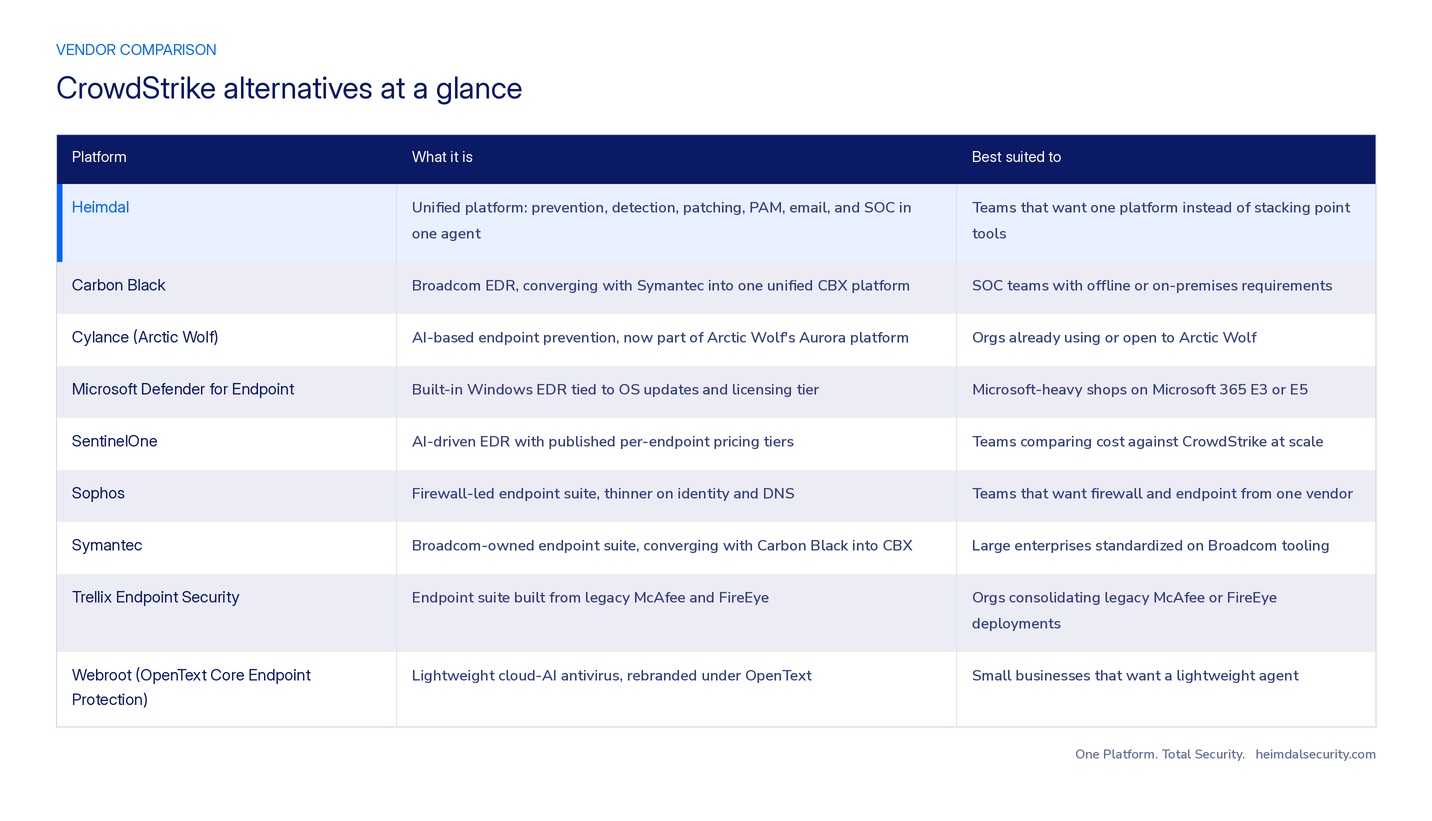
Crowdstrike competitor comparison table
What CrowdStrike actually costs
List price only tells you part of the story. CrowdStrike Falcon is the product name behind the pricing, and the Falcon platform’s published self-serve tiers run:
- Falcon Go: $59.99 per device per year.
- Falcon Pro: $99.99 per device per year.
- Falcon Enterprise: $184.99 per device per year.
- Falcon Complete (managed MDR): custom quote.
In practice, buyer-reported data puts the real all-in cost closer to $200 to $400 per endpoint per year at around 1,000 endpoints, once managed services and add-on modules get layered in. Identity, cloud, and SIEM modules are always quoted separately, regardless of tier. Benchmark data across completed deals shows an average discount of about 14%, with a typical annual contract landing around $53,500 (ranging from roughly $11,800 to $306,000 depending on size). If you’re negotiating, that average discount is a reasonable opening ask, not a ceiling.
What switching from CrowdStrike actually involves
Moving off the CrowdStrike endpoint agent isn’t a simple swap. A few things catch teams out:
- Uninstalling takes a token. CrowdStrike’s tamper protection blocks silent or remote removal. You need a maintenance or uninstall token from the console before the agent comes off cleanly.
- Coexistence has a real risk during cutover. Running the old and new agent side by side is normal during migration, but leaving the incumbent antivirus or EDR active alongside the new one can cause a blue screen. Disable it before you move to the next phase, not after.
- Policies don’t carry over. Detection rules, exclusions, and response policies are vendor-specific. Budget time to rebuild them rather than expecting an import.
- Detection history typically doesn’t survive the move. Whatever’s in the old console’s history and network telemetry generally stays there when you leave.
- Roll out in phases. Pick a pilot group, validate detection and false-positive rates before expanding, and set a clear go or no-go point at each stage rather than cutting the whole estate over at once.
Which alternative fits your situation
Match your situation to the right pick among these CrowdStrike Falcon competitors.
- Want one platform instead of several: Heimdal.
- Need offline or on-premises EDR: Carbon Black.
- Comparing cost against CrowdStrike at scale: SentinelOne.
- Already invested in Arctic Wolf: Cylance (Arctic Wolf).
- Already licensed for Microsoft 365 E3 or E5: Microsoft Defender for Endpoint.
- Standardized on Broadcom or Symantec elsewhere: Symantec.
- Consolidating legacy McAfee or FireEye deployments: Trellix.
- Want firewall and endpoint from one vendor: Sophos.
- Small business, want a lightweight agent: Webroot (OpenText Core Endpoint Protection).
Choosing an alternative as a managed service provider (MSP)
If you’re an MSP evaluating these tools for your own client base rather than a single environment, a few things matter more than they do for a direct buyer.
Multi-tenancy that’s actually multi-tenant. Look for genuine per-client isolation and management, not one shared console with filters bolted on. CrowdStrike’s own answer to this is Falcon Flight Control, its parent and child tenant layer, so it’s worth asking any alternative how its equivalent actually works before you assume it matches.
PSA and RMM integration. Confirm the tool has native integration with what you already run day to day. Heimdal integrates with ConnectWise RMM, Autotask PSA, and HaloPSA. That automates ticket creation and keeps alerts inside your existing workflow instead of a separate console.
Consolidated, consumption-based billing. You want one monthly invoice across all your clients, not a per-client reconciliation exercise every billing cycle.
Watch the endpoint-minimum problem. Some vendor pricing and partner programs are built around volume commitments that work at a few thousand seats and stop making sense at a few hundred. If you run a mix of small clients, check where the pricing curve actually bends before you commit.
Frequently asked questions (FAQ): top CrowdStrike alternatives and competitors
Who is CrowdStrike’s biggest competitor?
CrowdStrike’s biggest competitors span the wider endpoint and extended detection market. By install-base share among 6sense-tracked companies (a measure of how many organizations use each tool, not revenue), CrowdStrike itself currently leads at roughly 22%, ahead of Microsoft Defender for Endpoint (about 14%) and McAfee ePO (about 13%), with SentinelOne close behind. Beyond these, organizations evaluating CrowdStrike alternatives often look at vendors such as Palo Alto Networks (Cortex XDR, now positioned alongside its newer Cortex XSIAM platform), Fortinet, Trend Micro, and Heimdal, each taking a different approach to threat detection and incident response.
Is CrowdStrike overpriced?
CrowdStrike’s list pricing sits at the premium end of the endpoint security market. Its self-serve tiers run $59.99 to $184.99 per device per year, with real-world costs commonly landing at $200 to $400 per endpoint once managed services and add-on modules are layered in. Whether that’s overpriced depends on what you’re comparing it to. A platform like Heimdal that bundles prevention, detection, patching, email, and privileged access management into one license can come out meaningfully cheaper on total cost of ownership than stacking CrowdStrike with the point tools needed to match that coverage.
Is SentinelOne better than CrowdStrike?
On user sentiment, it’s close to a dead heat: Gartner Peer Insights puts both CrowdStrike and SentinelOne at a 4.7-star rating in the Managed Detection and Response market as of this writing (330 and 365 reviews, respectively; review counts climb steadily, so check the live page for the current tally before you cite them). Where they tend to differ in practice is deployment and cost. SentinelOne can take more hands-on setup, with multiple agents and manual exclusions; CrowdStrike is generally lighter to roll out but sits at a higher price point per endpoint.
Neither covers much beyond the endpoint on its own. If your security team needs identity, email, and DNS coverage too, both leave gaps that a broader platform like Heimdal is built to close, often without the third-party integrations CrowdStrike needs to match what Heimdal delivers natively through a single agent.
What is better than CrowdStrike?
It depends on what CrowdStrike isn’t giving you. If it’s cost, look at SentinelOne or Microsoft Defender for Endpoint. If it’s coverage beyond the endpoint, a unified platform like Heimdal closes gaps in DNS, email, and privileged access that CrowdStrike leaves to other tools. Match the gap to the alternative, not the other way around.
Is it hard to switch away from CrowdStrike?
Harder than swapping one agent for another. Tamper protection means you need an uninstall token to remove it cleanly, policies and exclusions don’t carry over to a new vendor, and detection history typically stays behind in the old console. See the migration section above for the full checklist, but plan for a phased rollout rather than a single cutover weekend.
Does CrowdStrike have a minimum deployment size?
Not a hard minimum, but its pricing and partner programs are built around volume, and the economics that work well at a few thousand endpoints don’t always hold up at a few hundred. Smaller organizations, and MSPs managing a mix of small clients, often find better pricing through pooled or platform-based licensing than buying CrowdStrike direct at low seat counts.
Should I still consider CrowdStrike after the July 2024 outage?
The outage was real and widely reported. It affected an estimated 8.5 million Windows devices worldwide, and it’s a fair question to ask any vendor about their update and rollout controls. It’s one input among several, not a disqualifier on its own. If it matters to your decision, ask every vendor on your shortlist, including CrowdStrike, how they test and stage content updates before they reach production endpoints.
What should MSPs check before picking a CrowdStrike alternative?
The same criteria as any direct buyer, plus three that matter more at scale. Look for genuine multi-tenant management rather than a single filtered console, real integration with the PSA and RMM tools you already run, and consolidated, consumption-based billing across your whole client base. See the MSP section above for the detail.


With over three years as a SOC Team Lead in the Heimdal MXDR department, Adelina is dedicated to sharing her knowledge and insights through her writing. Her articles and publications provide invaluable guidance on emerging trends, best practices, and effective strategies to combat cyber threats.


