


 Network Security
 Vulnerability Management
 Privileged Access Management
  Endpoint Security
 Threat Hunting
 Unified Endpoint Management
 Email & Collaboration Security



Contents:
Position stated as of August 2026.
Your Carbon Black renewal is probably what brought you here. Either the commercial terms have moved, or someone above you asked what happens to the product now that it sits inside Broadcom, and you need a defensible answer rather than a hunch.
What follows covers what has actually changed for Carbon Black customers, which of the leading Carbon Black alternatives and competitors in cybersecurity fit which situations, what the independent evidence does and does not support, and how to run an evaluation that tells you something useful in weeks rather than months.
Two things up front. First, Carbon Black is not dead. As of August 2026 we can find no Broadcom announcement of an end of life for Carbon Black Cloud, and Broadcom continues to publish life cycle documentation and service status updates for the product line.
The problem is commercial and organisational uncertainty, not product failure. Second, we publish this article and we sell one of the products in it. Our own entry is written to the same standard as the others, unflattering parts included.
The bottom line on Carbon Black alternatives
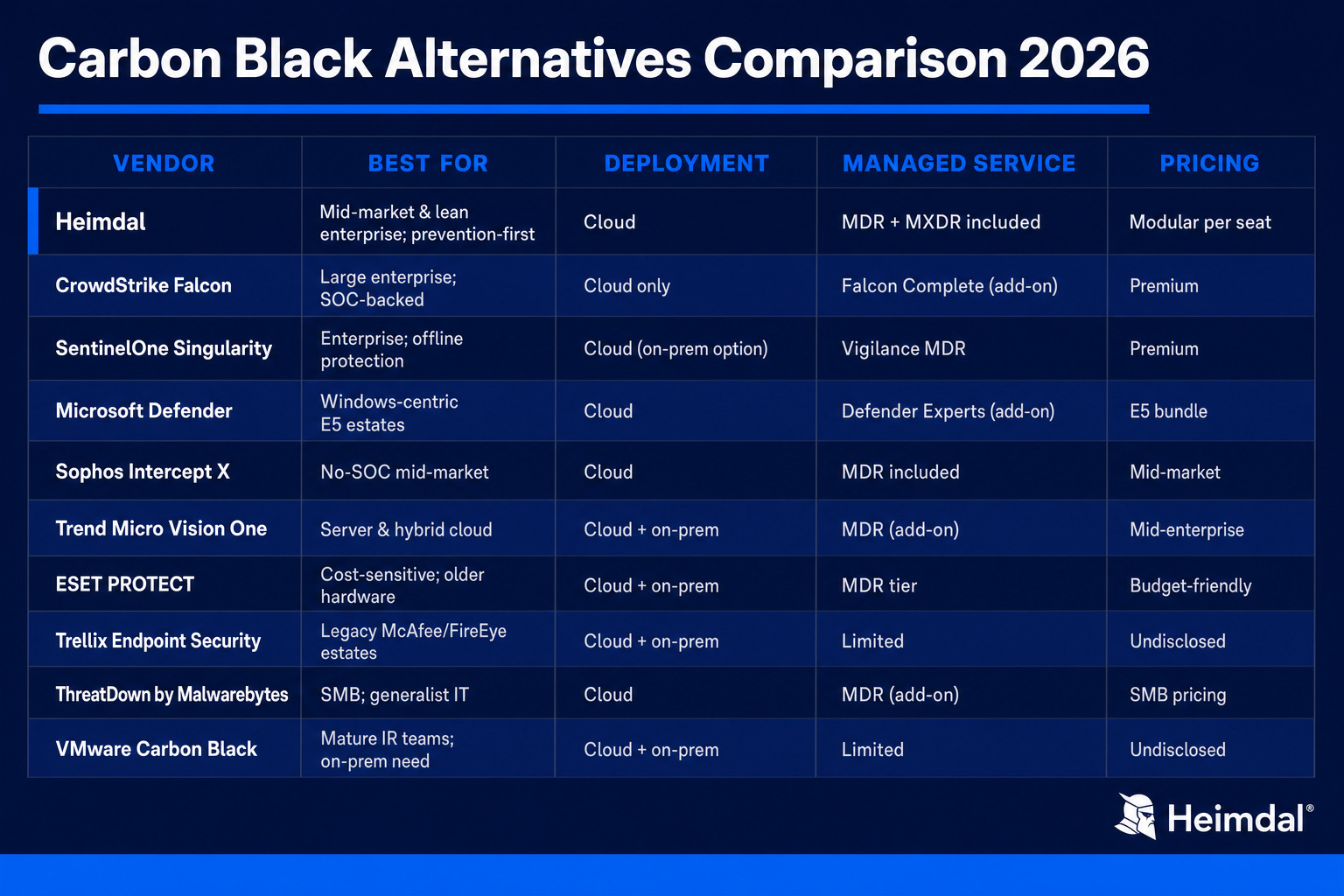
Read this section if you read nothing else. It is the fastest way through the top Carbon Black alternatives, and each line is a starting point for evaluation rather than a verdict.
- Heimdal. For mid-market and lean enterprise security teams that want EDR they can buy on its own, or as part of a platform that also removes their patching, DNS filtering, privilege management, and email security tools.
- CrowdStrike Falcon. Enterprises with a working SOC, or budget for a managed service that takes response actions on your behalf, where detection quality matters more than price.
- SentinelOne Singularity Complete. For enterprises that want leader-class detection with on-agent protection that keeps working offline, plus ransomware rollback on Windows.
- Microsoft Defender for Endpoint. Windows-centric estates already paying for E5, with a team that knows KQL and accepts single-vendor concentration.
- Sophos Intercept X. You have no SOC and need a credible 24-hour managed service at mid-market pricing. Doubly so if you already run Sophos firewalls.
- Trend Micro Vision One. Server-heavy and hybrid-cloud estates, and buyers who need virtual patching for systems that cannot be taken offline. Scope the Apex One to Vision One migration before you sign.
- ESET PROTECT Elite. For cost-sensitive buyers, older or constrained hardware, and European organisations with data residency requirements. EDR sits in the Elite tier, so compare tiers carefully.
- Trellix Endpoint Security. Large existing McAfee and FireEye estates with heavy ePolicy Orchestrator investment, on-premises requirements, and legacy operating system coverage needs.
- ThreatDown by Malwarebytes. Small organisations with generalist IT and no security staff, where simplicity and clean remediation matter more than depth.
- Carbon Black itself. Still a reasonable answer for mature incident response teams that value telemetry depth and application control, and for buyers who need on-premises EDR, if you are comfortable with the commercial trajectory.
What changed in endpoint security, and what outdated thinking looks like
“Which EDR should I buy” describes a search query more than a purchase. Almost nobody buys an EDR as a discrete product any more. They buy an endpoint platform tier that includes EDR capability, or a managed service in which EDR is the instrumentation underneath.
Gartner reflects this. There is no standalone EDR Magic Quadrant. Endpoint detection capability is assessed inside the Magic Quadrant for Endpoint Protection Platforms and in adjacent XDR and MDR research. Any comparison that treats EDR as a cleanly separable category is describing how buyers talk, not how products are built.
The category moved in four rough phases.
- Before 2013. Signature antivirus. A verdict at execution, no retained history, no remote response.
- 2013. Gartner analyst Anton Chuvakin coined “Endpoint Threat Detection and Response” to name tools focused on investigating suspicious endpoint activity rather than only blocking known malware. The term shortened to EDR, which is what most people now mean by endpoint detection and response.
- Roughly 2014 to 2018. EDR as a separate purchase, often from a different vendor than your antivirus, with two agents per endpoint.
- Roughly 2018 to now. Prevention and detection collapsed into one agent, then endpoint telemetry became one feed among several alongside identity, email, cloud, and network.
Four beliefs worth retiring
“MITRE ATT&CK Evaluations produce a winner.” They do not. MITRE publishes no ranking, no pass or fail, no composite score. What it publishes is a matrix of detection categories per attack sub-step. Every headline percentage in this market is a vendor’s own arithmetic applied to that raw dataset, and vendors pick their own numerator and denominator. Two vendors can both claim 100% while counting genuinely different things.
“High coverage means good outcomes.” Coverage and noise are separate axes. Forrester’s published commentary on the 2025 ATT&CK Enterprise round noted very wide variation in alert volume between vendors with comparable coverage. Some produced a handful of correlated detections per scenario. Others produced hundreds, some suppressed or deprioritised in the console.
“EDR replaces antivirus.” In single-agent products the distinction is academic, because the same agent does both. The misconception still causes damage when teams deploy in detect-only mode and leave prevention off because they fear false positives. What they end up with is a forensic recorder rather than a control.
“An agent is an agent.” Resource consumption, kernel footprint, update mechanism, and failure behaviour vary a lot, and the agent is itself an availability risk. The July 2024 CrowdStrike content update incident, which crashed Windows systems globally, is the clearest demonstration available. Staged rollout control and version pinning are now standard RFP items, and in our assessment they are the fastest-adopted new evaluation criterion in the category.
Where traditional approaches fall short
Alert fatigue is the dominant operational problem. The 2025 SANS Detection and Response survey found 73% of organisations ranked false positives as their single greatest threat detection challenge, with more than 60% encountering them frequently or very frequently. Estimates of how much analyst time goes to validating false positives vary between roughly a quarter and a half of total effort, and no single authoritative measurement exists.
Tuning is a real cost that nobody models. Peer reviews of every leading product return to the same two themes: noisy default policies, and sustained tuning by experienced staff before signal quality becomes acceptable. That labour almost never appears in a total cost comparison.
Capability the buying team cannot reach. Advanced hunting behind a proprietary query language is common. The capability exists on the datasheet and stays unused because nobody in the team writes that language.
Removal is harder than installation. Migration teams find the hard part is stripping out the incumbent agent. Tamper protection, uninstall passwords, and reboot requirements turn an agent swap into a project, and coexistence periods with two agents running generate performance complaints.
Endpoint-only visibility has a structural blind spot. Attacks that use valid credentials and native operating system tooling produce weak endpoint signal by design. That is the honest argument for extending into identity and email telemetry, and it is not an argument any endpoint product can win on its own.
Attackers now target the security tool. Bring-your-own-vulnerable-driver (BYOVD) techniques and dedicated utilities for disabling security tools appear routinely in incident response reporting on ransomware intrusions. So tamper protection quality matters, though we are not aware of a consistent public test of tamper protection resilience across vendors.
Telemetry costs money. Full-fidelity endpoint telemetry is expensive to retain and expensive to forward into a SIEM. Retention windows are one of the most common hidden downgrades between quoted tiers.
Where we fit, and how we would frame the choice
We built our platform on a different assumption than the detection leaders. They optimise for the best possible signal delivered to an analyst. We optimise for reducing the number of events that need an analyst at all.
That shows up in what sits next to our EDR. Patching closes the vulnerability before something has to detect the exploit. DNS filtering blocks command and control and phishing domains before a connection completes.
Privilege management removes the administrative rights an attacker needs, and takes them away automatically when we detect a threat on the endpoint. Every event prevented at those layers is an event your team never has to triage, which strengthens your overall security posture without adding headcount.
You can buy our EDR software on its own.
It is a standalone product, and plenty of customers run it that way. The EDR package covers Next Gen Antivirus with our Extended Threat Protection engine, firewall with brute force protection, Remote Access Protection, Ransomware Encryption Protection, DNS Security for the endpoint, and Patch and Asset Management. XTP ships with what we describe as more than 1,400 curated detection rules mapped to MITRE ATT&CK techniques, and remediation actions like quarantine, isolate, scan, and block run from one place.
Or you can use it as the endpoint layer of our unified security platform.
That adds DNS Security for the network, our Threat Hunting and Action Center (TAC) for managed threat hunting plus estate and user monitoring, Email Security including AI-powered fraud prevention, privilege elevation and delegation management, privileged account and session management, Application Control with AppFencing, and Remote Desktop. One console, one agent, and you pick the modules. If you want us to run it, MDR adds 24-hour SOC triage and guided remediation, and MXDR adds a 24-hour SOC with incident response. Both are delivered as managed detection and response services layered on the same platform, not sold separately.
This is not a bolt-on story. Two genuine purchase paths, and which one makes sense depends entirely on how many other tools you are paying for.
A word on our AI, because the category is full of noise here.
Two AI capabilities are live in the platform today and predate anything we have branded. Predictive DNS uses AI- and ML-driven analysis to identify suspicious destinations and likely attack activity before threats fully materialise.
AI-powered email fraud prevention uses outlier detection against normal organisational patterns to surface impersonation attempts, CEO fraud, and out-of-character emails. Both capabilities are built to flag threats in real time, before an analyst has to make a detection call.
- AI Wingman is something separate: a cross-platform intelligence layer built on top of those capabilities, and we are delivering it in phases.
- AI Wingman Assist gives platform guidance across the dashboard. AI Wingman Triage uses multi-agent systems to help validate incidents and accelerate triage, and is included with TAC.
- AI Wingman SOC brings that acceleration into our managed SOC, included with TAC and MXDR.
Where we are weaker, stated plainly.
We do not participate in the MITRE Engenuity Evaluations, which are a vendor-funded programme. Our MITRE ATT&CK coverage is publicly mapped on the Tidal Cyber Registry.
Search for Heimdal and you can see exactly which attack techniques and sub-techniques we detect and stop, down to the sub-technique level. Pull that mapping into your PoC scorecard and compare it directly against any other vendor you are evaluating.
On analyst coverage: we were named in the Gartner Europe Context Magic Quadrant for Endpoint Protection in May 2026. We are also working with Forrester and expect a published evaluation soon.
If your procurement process requires broader third-party coverage before a product reaches a shortlist, the honest answer is to run a PoC on your own estate in parallel. That will tell you more than any evaluation report.
Practical buyer guidance
Do you actually need to switch?
Ask this before you build a shortlist, because the answer is often no.
Carbon Black is still supported. Broadcom’s status pages show ongoing maintenance and incident activity for Carbon Black services through 2026, and life cycle documentation continues to be published against specific release versions. Broadcom previously merged Carbon Black with Symantec into a combined Enterprise Security Group, and trade reporting has repeatedly indicated it explored divesting the business, including reporting that a sale process was paused. No completed divestiture is confirmed by any Broadcom announcement we can verify.
So run the commercial assessment first and the technical one second. Look hard at your renewal terms and support trajectory, then test one alternative in parallel. That buys you a negotiating position and a fallback, without committing to a migration nobody has forced on you.
Signals that you genuinely should move
- Your renewal quote has moved enough that the switching cost is no longer the expensive option.
- You need capability your current licence does not cover, and the upgrade path is unclear or unpriced.
- Your team cannot operate what you have, and no managed service is available at a price you can defend.
- You need a managed provider that takes response actions rather than sending you advice.
- Support response times have changed materially since the ownership transition.
Warning signs on a shortlist
- A vendor quotes a MITRE percentage without naming the round, the metric, and the denominator.
- Retention is quoted in days at the tier you can afford and in months at the tier in the demo.
- The features that carry the value are all in modules priced separately from the per-endpoint figure you were given.
- Nobody can tell you exactly which response actions the managed tier will take without asking you first.
- No answer on staged agent rollout or version pinning.
What most teams underestimate
Signal-to-noise, not coverage. In our assessment this is the most consequential differentiator in the category and the most under-weighted criterion in most evaluations. Whether related detections arrive as one correlated incident or 300 discrete alerts decides your operational cost.
Who operates it. “MDR available” and “MDR included” are different propositions. “The provider advises” and “the provider acts” are more different still.
Deployment model as a hard filter. Cloud-only versus on-premises versus sovereign cloud eliminates otherwise leading vendors before capability is assessed. Establish your constraint first, not after you have fallen for a product.
Consolidation scope. Whether the platform removes other tools from your stack or adds to it. The value of this is inversely proportional to the size of your team.
Vendor stability. A live criterion in 2026 in a way it was not five years ago, driven by consolidation and private equity ownership across the sector. Carbon Black is the visible example, not the only one.
What EDR will not fix for you
- It will not make you ransomware-proof. It raises the cost and lowers the success rate, and rollback reverses some encryption. That is not immunity.
- Attacks that use valid credentials and native tooling will still produce weak signal. That needs identity and email telemetry.
- It will not run itself. Detect-only deployments with unattended alert queues are the most common failure mode we see described by practitioners.
- Patching, privilege reduction, and email filtering do not go away. Those reduce what EDR has to catch.
- It will not survive being deployed to 40% of your estate. Coverage gaps around contractor devices, unmanaged endpoints, and Linux servers are where incidents start.
How to run a proof of concept that tells you something
Nearly every serious endpoint protection software will detect your test cases. Independent lab testing shows prevention efficacy has converged tightly at the top of the field. So stop testing detection. Test operations.
- Scope it properly. 50 to 500 endpoints, two to six weeks, including your awkward machines. Old hardware, virtual desktops, your one legacy line-of-business application, a Linux server, a couple of macOS laptops.
- Measure false positives against your own applications. This is the single most predictive proof-of-concept metric, because it is the only figure that captures the ongoing operational cost of the product in your specific estate.
- Count alerts per incident. Run the same simulated intrusion on each candidate and record how many discrete alerts each one produced. That number is your future workload.
- Time a real removal. Uninstall the incumbent agent on ten machines and record how long it took and how many needed a reboot or a support ticket. That is your migration plan in miniature.
- Test the response path. Isolate a host, kill a process, pull a file, run a remote command. How long did it take, and how many clicks?
- Open a real support ticket. Not a sales question. Something ambiguous, on a Friday afternoon.
- Ask for the retention and export terms in writing. How long telemetry is kept at your tier, and how you get it out if you leave.
- Interrogate agent update control. Staged rollout, version pinning, and what happened the last time the vendor shipped a bad update.
The Carbon Black alternatives, compared
Analyst context first, because it frames what follows. In recent iterations of the Gartner Magic Quadrant for Endpoint Protection Platforms, third-party summaries place CrowdStrike, Microsoft, SentinelOne, Sophos, Trend Micro, and Palo Alto Networks as Leaders. Third-party summaries of the 2025 edition place ESET as a Challenger and Broadcom among Niche Players. The May 2026 Gartner EPP report moved Trellix from Challenger to Niche Player — confirm the current placement against the published report before relying on it. Placements change annually, and those for vendors other than CrowdStrike derive from third-party summaries rather than the Gartner document itself, so confirm them against the current published report before relying on them.
On pricing, we have deliberately not published per-endpoint figures for any vendor, including ourselves. List prices in this category are unreliable, discounting is heavy, and published figures go stale within months. Every entry below says what you should ask for instead.
1. VMware Carbon Black by Broadcom, the incumbent
What it is. Two product lines. Carbon Black EDR, formerly Cb Response, with deep forensic recording and an on-premises heritage. Carbon Black Cloud Endpoint in Standard, Advanced, and Enterprise tiers, delivered from the cloud. Application control lineage inherited from Bit9.
Best for. Existing customers with a mature incident response team that values telemetry depth and application allowlisting, and organisations with a hard on-premises requirement.
Strengths.
- Deep, granular endpoint telemetry and forensic detail, which is genuinely valuable in experienced hands.
- Application control and allowlisting heritage that few competitors match, still useful for fixed-function and high-assurance endpoints.
- On-premises deployment via Carbon Black EDR, verifiable in Broadcom’s product documentation. That option is increasingly rare among established vendors.
- A large deployed base with accumulated operational knowledge and an established integration set.
Trade offs.
- The dominant issue is commercial and organisational uncertainty rather than product capability. Broadcom acquired VMware in 2023 and combined Carbon Black with Symantec into an Enterprise Security Group. Divestiture reporting remains unconfirmed.
- Customers and channel partners across Broadcom’s acquired portfolios have widely reported changes to commercial terms, including larger minimum commitments and bundled portfolio licensing. That reported experience is the practical driver of renewal anxiety.
- Positioned among Niche Players in third-party summaries of the recent Endpoint Protection Platforms Magic Quadrant, a marked change from Carbon Black’s earlier standing as an independent vendor.
- Console and workflow modernisation lagged cloud-native competitors during the ownership transitions, and two overlapping product lines have created portfolio confusion.
- The managed service offering is less prominent than those of pure-play competitors.
Pricing. Undisclosed publicly. Ask for the renewal quote alongside minimum commitment terms and any portfolio bundling requirement, in writing.
2. Heimdal
What it is. Our platform delivers EDR and XDR, DNS filtering for network and endpoint, automated patch and asset management, privileged access management, next-generation antivirus and firewall, ransomware encryption protection, and email security through one agent and one console, with a managed XDR service on top. EDR is available as a standalone product or as the endpoint layer of the wider platform. We were founded in Copenhagen in 2014, are headquartered in Denmark, and are majority owned by Marlin Equity Partners. We flag this because ownership structure is a legitimate criterion for every vendor in this comparison.
Best for. Mid-market organisations and lean enterprise security teams that want to collapse four or five tools into one platform, that value prevention as highly as detection, and that are not building a SOC.
Strengths.
- Breadth through one agent. DNS-layer filtering, third-party patch automation, and privilege elevation sitting alongside EDR is unusual. Competitors typically need separate products or separate vendors for these.
- Patching that does real work. We patch operating systems and third-party applications automatically using pre-tested packages, with asset inventory and vulnerability severity views, and we deploy patches within hours of release, based on our own platform data. That addresses a root cause of compromise rather than a symptom, and it removes a tool from your stack.
- Privilege management wired into detection. We provide just-in-time administrative elevation with automatic de-escalation, session auditing, and application control. When we detect a threat on an endpoint, we can revoke administrative rights automatically. The link between detection and privilege state is a differentiated design, and it has not been independently evaluated.
- Prevention before adjudication. We block command and control and phishing domains at the DNS layer before a connection is established, which reduces the volume of events endpoint detection has to judge.
- Response from one place. Quarantine, isolate, scan, and block run as single actions against indicators of risk, with a full audit trail. Ransomware Encryption Protection X uses four detection engines covering encryption, rename, shadow copy, and canary files, works signatureless, and isolates an infected device automatically.
- EU headquartered with EU data residency options, which matters for GDPR and NIS2 obligations and for buyers who prefer a non-US vendor.
- Coverage across Windows, macOS, and Linux as documented in our product specifications, with multi-tenant management available for service providers.
Trade offs.
- We are absent from MITRE ATT&CK Evaluations and from publicly summarised Endpoint Protection Platforms Magic Quadrant coverage. For buyers whose process requires third-party efficacy validation, that is a material gap.
- Because that independent data does not exist yet, our detection depth cannot be compared directly against vendors that do participate. An absence of evidence rather than evidence of weakness, which does not help a buyer who needs evidence today.
- We are smaller than the market leaders, with a smaller threat research organisation and a smaller installed base.
- Our design centre is consolidation and prevention breadth, not deep detection engineering for a large SOC. Large-estate enterprise references are less publicly visible than those of the leaders.
Pricing. Per seat, tiered by number of seats and servers, with monthly, yearly, three-year, and five-year terms. Modular, so you pay for the modules you take. Ask us for a written comparison against what you currently spend on the tools the platform would replace. Use our pricing calculator to get an instant estimate.
3. Microsoft Defender for Endpoint
What it is. The default option for much of the market. Bundled into Microsoft 365 E5 and sold standalone as P1 and P2. It competes on economics and integration rather than on being the strongest standalone detection product.
Best for. Microsoft-centric, predominantly Windows estates already licensed for E5, with a team comfortable in KQL and Azure tooling.
Strengths.
- Economics. Where E5 is already licensed for other reasons, endpoint protection carries no additional line item. This is the most powerful commercial force in the category and it has reshaped competitive dynamics in every segment.
- Deep native Windows telemetry with no third-party agent to deploy on Windows.
- Cross-domain context through Entra ID, Defender for Office 365, Defender for Cloud Apps, and Sentinel that endpoint-only vendors cannot match natively.
- Advanced Hunting via KQL is a genuinely capable query interface for teams that already know the language.
- Consistent Leader placement in the Endpoint Protection Platforms Magic Quadrant, with strong published results in MITRE Enterprise evaluations.
Trade offs.
- Licensing complexity draws more complaints than anything else. Capability is spread across P1, P2, E3, E5, Business Premium, and add-ons, and buyers routinely find a needed feature sits one SKU above the one they hold.
- macOS and Linux support has improved considerably but has historically lagged the Windows experience.
- Some users report that poorly tuned default policies generate substantial noise and measurably increase analyst load.
- Concentration risk. Running detection, identity, email, and productivity on one vendor is now raised explicitly in regulated financial services under DORA.
- Managed response needs Defender Experts or a partner. It is not inherent to the licence.
Pricing. Undisclosed in any comparable form. Ask which SKU contains each capability on your requirements list, and price the gap.
4. CrowdStrike Falcon
What it is. The premium market leader, and the reference point most alternatives are measured against. Cloud-native, one lightweight agent, and a modular endpoint security platform extending into identity, cloud, exposure management, and next-generation SIEM.
Best for. Enterprises and upper mid-market organisations with a functioning SOC, or with budget for Falcon Complete, that want the strongest available detection and will pay for it.
Strengths.
- Coverage with signal quality. CrowdStrike states it achieved 100% detection coverage across all techniques tested in the configuration run of the 2025 MITRE ATT&CK Enterprise evaluation, which is a vendor-computed figure as all such figures are. More useful is Forrester’s independent commentary on that round, which placed CrowdStrike among vendors producing a small number of high-quality correlated detections per scenario rather than hundreds of discrete alerts. Coverage without noise is the harder result, and that observation comes from a third party.
- Falcon Complete is among the most established managed services attached to an endpoint platform, and it takes response actions on the customer’s behalf rather than only advising.
- A threat intelligence and incident response organisation of unusual depth.
- Strong API and integration breadth, with strong Linux and cloud workload support.
Trade offs.
- Price is among the most consistently cited dislikes in peer reviews. Modular pricing means a realistic production configuration costs materially more than the entry per-endpoint figure, and buyers frequently report the value-carrying modules are licensed separately.
- The July 2024 outage. A faulty content update caused widespread Windows crashes globally. CrowdStrike published a post-incident review and introduced staged content rollout with customer-controlled update options. The incident permanently changed enterprise scrutiny of agent update mechanisms and comes up in most evaluations.
- Cloud-only, with no on-premises option, which removes it from consideration in some regulated and air-gapped environments.
- Built for organisations with security maturity. Smaller teams often find the platform larger than they need.
Pricing. Undisclosed in any reliable form. Price the modules you actually need, not the entry tier, and get retention length in writing.
5. SentinelOne Singularity Complete
What it is. The principal challenger to CrowdStrike at the enterprise end. Emphasis on autonomous on-agent AI detection that works without cloud connectivity, with ransomware rollback as the signature capability.
Best for. Enterprises and upper mid-market organisations wanting leader-class detection with offline capability and rollback, frequently evaluated head-to-head against CrowdStrike. Strong for heterogeneous and Linux-heavy estates.
Strengths.
- SentinelOne states that in the 2024 MITRE ATT&CK Enterprise evaluation it achieved 100% detection at the major step level, 100% technique detections across Windows, macOS, and Linux, zero delayed detections, and 88% fewer alerts than the median vendor in that round. These are vendor-computed figures. The alert volume claim, if it holds, matters more operationally than the coverage claim.
- Storyline. Product documentation describes automatic correlation of related events into a single attack narrative. That is a direct architectural answer to alert fatigue and one of the better-designed features in the category, though its effectiveness has not been independently measured.
- Ransomware rollback on Windows is a genuine differentiator. It depends on Volume Shadow Copy and is not unlimited in scope, so test it rather than assume it.
- The vendor states protection continues when the endpoint is offline or disconnected from the cloud, which matters most for field, maritime, and intermittently connected estates.
- Multi-year Magic Quadrant Leader, with strong Linux and Kubernetes support and an available managed service.
Trade offs.
- Pricing sits close to CrowdStrike, so it does not compete on cost against the leader.
- Reviewers repeatedly flag a learning curve for deeper hunting, and policy tuning needed to control false positives from behavioural AI detections.
- Historical reports of agent resource consumption on constrained hardware persist in evaluations, though less prominently for current versions.
- A smaller threat intelligence and incident response organisation than CrowdStrike.
- Cloud-managed by default. On-premises management exists but is a less common path.
Pricing. Undisclosed in comparable form. Ask specifically what rollback covers and what retention you get at your tier.
6. Sophos Intercept X
What it is. Mid-market-focused endpoint protection with a large attached managed detection and response business. Sophos has effectively repositioned as a service vendor with a product underneath. Its acquisition of Secureworks, announced in October 2024 and completed on 3 February 2025 in an all-cash transaction valued at approximately $859 million, expanded its detection and response capability including the Taegis platform.
Best for. Organisations without a SOC that want strong prevention plus a credible 24-hour managed service, particularly those already running Sophos network products.
Strengths.
- Managed detection and response priced for mid-market. Sophos states it operates one of the largest MDR services by customer count. Independent of the count, a credible round-the-clock service at mid-market price points is a genuine differentiator for teams without a SOC.
- Intercept X combined with Sophos Firewall gives cross-product detection and automated response that is genuinely useful in a Sophos-first environment.
- Consistent Leader placement in the Endpoint Protection Platforms Magic Quadrant across many iterations.
- Strong anti-ransomware and exploit prevention, with defaults reviewers describe as workable without specialists.
Trade offs.
- The strongest value requires a Sophos-first architecture. Third-party integration breadth is narrower than platform-neutral competitors.
- Full managed response sits in the higher MDR tier while the entry tier is scoped more narrowly. Confirm exactly which response actions the provider will take under the tier you are quoted. Expectation mismatch here is a recurring source of dissatisfaction.
- Alert volume. Forrester’s commentary on the 2025 MITRE ATT&CK Enterprise round noted Sophos among vendors generating very high alert counts per scenario, some suppressed or low priority in the console. Coverage was not the concern. Noise was.
- Buyers see it as mid-market rather than large enterprise, which can be a procurement obstacle at the top end regardless of capability.
- Deep threat hunting and custom detection authoring are less mature than at the enterprise leaders.
Pricing. Undisclosed in comparable form. Get the MDR tier definition and the response action list in writing.
7. Trend Micro Apex One and Vision One endpoint security
What it is. A long-established endpoint vendor with one of the longest continuous runs of Leader placements in Gartner endpoint evaluations. As of 2026 the situation is a platform transition. Apex One is the established product, available on-premises and as a service. Trend Vision One is the destination, with Standard Endpoint Protection as the successor.
Best for. Existing Trend estates, server and hybrid-cloud environments, organisations needing virtual patching for systems that cannot be patched, and buyers with on-premises requirements.
Strengths.
- Trend Micro reports that in the 2024 MITRE ATT&CK Enterprise evaluation, Vision One achieved 100% analytic coverage across all major steps and 99% of sub-steps (79 of 80), with 100% sub-step coverage on Linux, macOS, and server platforms. These are vendor-computed figures against MITRE’s published data.
- Broad workload coverage across endpoints, servers, cloud workloads, and containers, with real strength in server and hybrid-cloud protection.
- Virtual patching and vulnerability shielding as compensating protection for systems that cannot be taken out of service.
- On-premises deployment remains available via Apex One on-premises, increasingly rare among Leaders.
- A long track record and strong presence in Japan, APAC, and manufacturing and industrial verticals.
Trade offs.
- Migration burden is the dominant near-term issue. Trend Micro’s current migration documentation describes moving Apex One on-premises to Vision One Standard Endpoint Protection as a manual exercise. Settings must be exported and policies imported before agents move, and the Product Instance app explicitly does not support updating on-premises Apex One into a Standard Endpoint Protection Manager. Environmental prerequisites include TLS 1.2, allow-listed URLs, and time synchronisation, and proxy servers requiring authentication may not be supported in all configurations — verify against current Trend Micro migration documentation before planning your deployment. Scope this as a project.
- High coverage with high noise. Trend Micro’s own published analysis of the 2024 round notes it blocked 70% of techniques in the protection portion, with three not blocked, which is a disclosure against interest and therefore more credible than most vendor benchmark commentary. Forrester’s commentary on the 2025 round placed Trend among the higher-alert-volume vendors.
- Portfolio and naming complexity across Apex One, Apex Central, Vision One, and Cloud One creates buyer confusion.
- Console modernisation lagged cloud-native competitors, though Vision One is a significant improvement.
Pricing. Undisclosed in comparable form. Price the migration effort alongside the licence.
8. ESET PROTECT
What it is. A European vendor headquartered in Slovakia with a long antivirus heritage, a light agent, and a clearly tiered product line. EDR and XDR capability comes from ESET Inspect, which sits in the upper tiers.
Best for. Cost-sensitive buyers, estates with older or constrained hardware, European buyers with data residency requirements, and buyers who need on-premises management.
Strengths.
- Low resource footprint. ESET has consistently performed well in independent performance impact testing, which matters for older hardware and virtual desktop infrastructure.
- Transparent tiering. Entry, Advanced, Complete, Elite, and MDR are relatively clear next to the SKU sprawl of several competitors.
- A strong independent test lab record in AV-Comparatives and AV-TEST prevention and false positive testing over many years.
- EU-based with EU data residency, and on-premises ESET PROTECT management available alongside cloud.
- Forrester’s commentary on the 2025 MITRE ATT&CK Enterprise round grouped ESET with vendors producing few detections per scenario with good context, meaning low noise.
Trade offs.
- EDR is not in the lower tiers. Under current packaging, ESET Inspect requires PROTECT Elite or the MDR package. Comparing an ESET Entry or Advanced quote against a competitor’s EDR quote compares different things. It is a common and costly evaluation error.
- Positioned as a Challenger rather than a Leader in third-party summaries of the recent Endpoint Protection Platforms Magic Quadrant.
- ESET documents that licensing differs by deployment model, and that some on-premises tiers cannot be used with cloud ESET PROTECT, which complicates hybrid deployments.
- Inspect’s detection engineering and hunting depth is less mature than the enterprise leaders, and its third-party integration set is smaller.
- ESET is more established in endpoint protection than in enterprise detection and response, which can affect shortlisting independently of current capability.
Pricing. Undisclosed in comparable form. Quote Elite or above if you want EDR.
9. Trellix Endpoint Security
What it is. The merged McAfee Enterprise and FireEye business, owned by Symphony Technology Group. The portfolio spans Trellix Endpoint Security from the McAfee lineage and Endpoint Security HX from the forensics-focused FireEye lineage, with ePolicy Orchestrator as the long-standing management plane.
Best for. Large existing McAfee and FireEye estates with substantial ePolicy Orchestrator investment, on-premises or sovereignty requirements, and legacy operating system coverage needs.
Strengths.
- A very large installed base and deep operational familiarity, and ePolicy Orchestrator remains a capable and highly granular management platform for large estates.
- Forensic depth in the HX lineage, backed by FireEye and Mandiant investigative heritage.
- Deployment flexibility. Trellix datasheets state HX can be deployed as a physical appliance, a virtual appliance, or a cloud instance, and is specified to protect estates of up to 100,000 endpoints. On-premises management is supported.
- Broad platform coverage including legacy operating system support that several cloud-native vendors have discontinued.
Trade offs.
- Detection coverage has measurably trailed the leading group in independent evaluation. In the 2023 MITRE ATT&CK Enterprise evaluation covering Turla, one third-party aggregation of vendor-reported figures recorded Trellix at 85% protection coverage across 13 protection scenarios, 78% visibility across 143 sub-steps, and 42% analytic technique coverage. Individual vendor-published figures for the same round vary and should be checked against each vendor’s own published reading before use in a procurement comparison. On the figures available, Trellix trailed the leading group — a pattern consistent with its Niche Player placement in the Magic Quadrant.
- Positioned as a Challenger rather than a Leader in third-party summaries of the recent Endpoint Protection Platforms Magic Quadrant.
- Two overlapping endpoint lineages, repeated rebranding from McAfee to McAfee Enterprise to Trellix, and private equity ownership raise the same viability questions buyers now ask about Carbon Black.
- The Endpoint Security and ePolicy Orchestrator stack is heavier to deploy and operate than cloud-native alternatives.
- Publicly disclosed vulnerabilities in the HX agent, including local privilege escalation issues, mean patch currency is an operational requirement. Disclosed CVEs are normal for all endpoint agents, but plan for the maintenance obligation.
Pricing. Undisclosed in comparable form. On the current independent detection evidence, this is harder to justify for a greenfield selection than for an existing estate.
10. ThreatDown by Malwarebytes
What it is. Malwarebytes rebranded its business portfolio as ThreatDown in November 2023. It sits at SMB and lower mid-market, increasingly aimed at organisations that want managed services because they have no security staff.
Best for. Small organisations with generalist IT and no security team, needing effective low-friction protection and remediation with an optional managed layer.
Strengths.
- Simplicity and speed of deployment. The clearest strength. Usable by generalist IT staff, light agent, short time to value.
- Remediation heritage. Malwarebytes says its Linking Engine removes malware artefacts and associated traces rather than only the primary file. The remediation capability is well established and traces directly to the product’s cleanup origins.
- Ransomware rollback is available in the EDR tier.
- Clear, appropriately scoped packaging with managed services at prices small organisations can absorb.
- Effective as a complementary or second-opinion layer, which is a real use case rather than a fallback position.
Trade offs.
- Limited enterprise depth. Reviewers return to limited reporting depth and limited customisation, with weaker fit for large organisations needing deep analytics. Threat hunting and detection engineering are shallow relative to the leaders.
- Does not appear among Leaders in publicly summarised Endpoint Protection Platforms Magic Quadrant coverage, and has limited presence in MITRE ATT&CK Enterprise evaluations. Buyers requiring third-party validation will find little to work with.
- Narrower breadth, with no significant identity, email, or cloud workload capability, so it cannot grow into a consolidation play.
- A smaller SIEM, SOAR, and API integration set than the leaders.
- ThreatDown’s service documentation notes that service effectiveness depends on agents being correctly deployed, healthy, connected, supported, and configured, which matters disproportionately in lightly managed estates.
Pricing. Published tiers exist but change frequently. Ask for a current written quote at your device count.
Which Carbon Black alternative fits your situation
You are a large enterprise with a mature SOC. CrowdStrike Falcon or SentinelOne Singularity Complete. Microsoft Defender for Endpoint if the estate is Windows-centric and E5 is already paid for. Decide on alert volume per incident and telemetry export terms, not on MITRE percentages.
You are mid-market with a small team and no SOC. Sophos Intercept X with MDR if a managed service is the priority. Us, if collapsing tools and preventing events matters more than deep hunting. ESET PROTECT Elite if cost and agent lightness dominate.
You have a hard on-premises or data residency requirement. Trend Micro Apex One on-premises, Trellix, or ESET PROTECT on-premises. This constraint eliminates the cloud-only leaders before capability is even assessed, so settle it first.
You need someone to run it. Evaluate the service before the engine. Ask whether the provider acts or advises, what the response action list is at your tier, and what the escalation path looks like at three in the morning.
Your estate is server and hybrid-cloud heavy. Trend Micro, with the Apex One to Vision One migration scoped as a project. CrowdStrike or SentinelOne if Linux depth is the deciding factor.
You are small with generalist IT. ThreatDown or ESET, with a managed option attached.
You are a Carbon Black customer and nothing is actually broken. Assess the renewal terms first. Then run one alternative in parallel on 100 endpoints for a month. That gives you a negotiating position and a fallback, and it costs you far less than a migration you were not forced into.
Frequently asked questions about Carbon Black alternatives and competitors
Is Carbon Black being discontinued?
Not as far as any published Broadcom announcement shows. As of August 2026 we can find no end of life announcement for Carbon Black Cloud, Broadcom’s status pages show ongoing service activity, and life cycle documentation continues to be published. Trade reporting about a possible divestiture remains unconfirmed. Treat the situation as commercial uncertainty, not product death, and check for new announcements before you decide.
What is the best Carbon Black alternative?
There is no single answer, and any article that gives you one is guessing about your estate. The right pick among the leading endpoint security solutions depends on matching capability to your constraints, not on a generic ranking. If detection quality decides it, CrowdStrike and SentinelOne are the reference points. If a managed service decides it, Sophos. If your Microsoft licence decides it, Defender. If you want to remove several tools at once and reduce the alert volume your team handles, that is where we compete.
Is Carbon Black similar to CrowdStrike?
In the broad sense, yes. Both are EDR platforms built to record endpoint activity and let a team investigate and respond. The CrowdStrike vs Carbon Black comparison keeps coming up because both trace back to the same generation of EDR pioneers, but they sit in very different places today. CrowdStrike is cloud-native, consistently placed as a Leader in third-party summaries of the Endpoint Protection Platforms Magic Quadrant, and priced at a premium for that position. Carbon Black carries deeper on-premises heritage and application control lineage, but its ownership now sits inside Broadcom’s Enterprise Security Group, which is the real source of buyer hesitation rather than any gap in the underlying product.
Can I keep Carbon Black and add prevention around it?
Yes, and for some teams that is the cheaper answer. Carbon Black handles forensics and remediation while a prevention layer such as DNS filtering and automated patching reduces what reaches the endpoint. Customers frequently run us this way alongside another vendor’s EDR, and our modules are built to run next to any antivirus.
Do MITRE ATT&CK results tell me which product is best?
No. MITRE publishes no ranking, no pass or fail, no composite score. It publishes a matrix of detection categories per attack sub-step. Every percentage you see is a vendor’s own arithmetic over that data, with a numerator and denominator the vendor chose. Read MITRE’s raw matrices, and pay more attention to independent commentary on alert volume than to coverage headlines.
What is the difference between EDR and XDR?
EDR exists to detect and respond to threats on the endpoint. It records endpoint telemetry, applies detection logic to it, and lets you respond by isolating a host, killing a process, or quarantining a file. XDR correlates that endpoint telemetry with signals from identity, email, cloud, and network. The practical reason to care is that attacks using valid credentials and native tooling produce weak endpoint signal, so endpoint-only visibility has a structural blind spot.
How long does an endpoint migration actually take?
Plan in months rather than weeks for a large estate, and expect removal of the incumbent agent to be the hard part. Tamper protection, uninstall passwords, and reboot requirements are what slow it down. Test uninstalls on a small group early so your rollout plan is based on measurement rather than optimism.
For a broader view of the field, see our best endpoint security software guide.
What single test tells me most during a proof of concept?
The false positive rate measured against your own applications. Nearly every serious contender will detect the test cases, because prevention efficacy has converged at the top of the field. What differs is how much of your team’s week the product consumes once it is live.
Position stated as of August 2026. The Carbon Black ownership position, current analyst placements, and our own third-party evaluation status are time-sensitive and should be reviewed before republication.


