


 Network Security
 Vulnerability Management
 Privileged Access Management
  Endpoint Security
 Threat Hunting
 Unified Endpoint Management
 Email & Collaboration Security



Contents:
If you manage security for a mid-market or enterprise organisation and you’re evaluating Huntress, you’re asking the right question at the right time. Huntress built a strong reputation as a focused managed endpoint detection and response platform. It does that job well.
But if your security needs extend beyond endpoints, if you need visibility into identity, email, cloud, and network threats from a single vendor, or if you’re trying to reduce the number of tools your team juggles daily, the gaps become hard to ignore.
This guide compares nine alternatives in the MDR and XDR market. Each profile covers what the platform actually does, where it fits best, real trade-offs, and what you’ll pay. No rankings based on sponsorships. Just practical comparison for direct buyers making a security decision in 2026.
The bottom line
A quick-reference shortlist if you already know what you need.
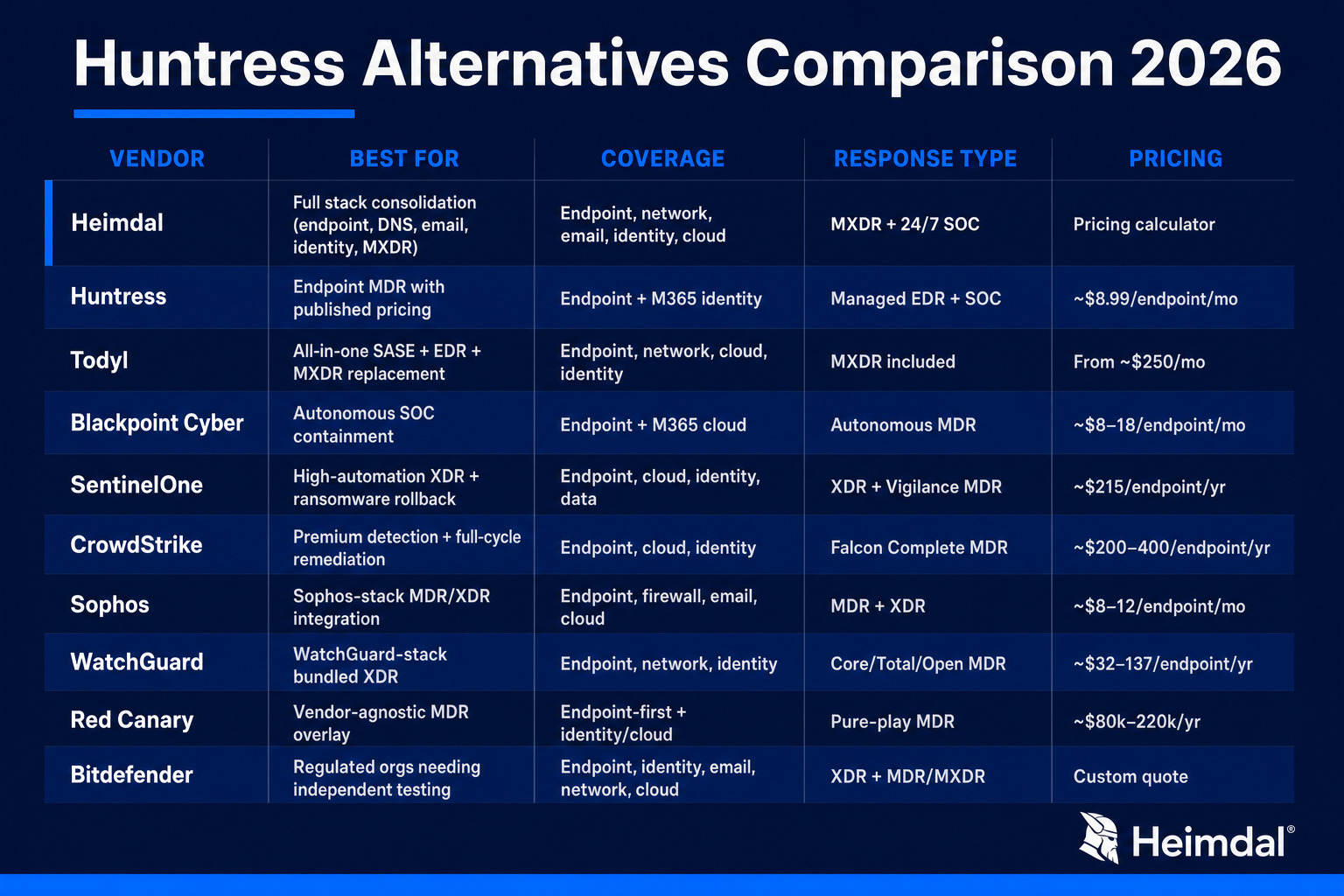
- Heimdal. For organisations that want to consolidate endpoint, network, email, identity, and vulnerability management into a single platform with optional MXDR.
- Todyl. Replaces your VPN, EDR, SIEM, and MDR with one agent. Best when you’re ready to go all-in.
- Blackpoint Cyber. Aggressive autonomous threat containment. SOC response measured in minutes.
- SentinelOne. For teams that prioritise high-automation XDR with AI-driven detection and ransomware rollback.
- CrowdStrike. Premium detection quality and full-cycle managed remediation. For teams with the budget.
- Sophos. For teams already running Sophos products that want integrated MDR/XDR without adding new vendors.
- WatchGuard. Already on WatchGuard firewalls and endpoints? Bundled XDR at low entry cost.
- Red Canary. For teams with existing EDR investments that want vendor-agnostic MDR overlay without replacing tools.
- Bitdefender. For regulated organisations that need strong independent testing validation with built-in compliance mapping.
How the MDR category has changed
Managed Detection and Response started as a service overlay on EDR tools. A vendor deployed an agent on your endpoints, a SOC watched the alerts, and if something looked bad, an analyst would call you. That model made sense in 2019.
It doesn’t hold up in 2026. Three shifts have reshaped the market.
Attack surfaces expanded beyond endpoints. Attackers now target identities, cloud workloads, email systems, and network infrastructure as readily as they target laptops. An MDR service that only watches your endpoints leaves blind spots everywhere else.
MDR became MXDR. The move toward Extended Detection and Response pushed MDR providers to ingest telemetry from multiple sources. Endpoint-only monitoring gave way to multi-surface correlation across identity, cloud, email, and network. As of 2025 and 2026, many providers now label their offering MXDR to reflect this broader scope. For a detailed breakdown, see our XDR vs MDR comparison.
Platform consolidation became a buying priority. Mid-market security teams are tired of managing five or six disconnected tools with separate consoles, billing, and support relationships. The buyer conversation has shifted from “which EDR is best” to “which platform reduces tool sprawl while still providing real detection and response.”
The market reflects these shifts.
According to estimates from multiple analyst firms (including Mordor Intelligence, MarketsandMarkets, Fortune Business Insights, and Grand View Research), the global MDR market sits in the range of approximately USD 4 to 6 billion under narrow scope definitions, or USD 8 to 11 billion when broader definitions include SOC-as-a-service and MXDR bundles. Multiple firms cite 17 to 25% CAGR through the early 2030s.
That growth is attracting every type of vendor, from pure-play MDR providers to platform vendors adding managed services to traditional MSSPs rebranding themselves. The result is a crowded market where labels tell you less than they used to.
Where traditional approaches fall short
If you’re comparing Huntress alternatives, you’ve hit at least one of these walls.
Agent fatigue is the real enemy. Heimdal’s 2025 research into security operations found that the problem isn’t usually the threat. It’s the tools. Security teams managing five, six, or seven separate products spend more time context-switching between dashboards than investigating actual incidents. According to the research, 1 in 4 security alerts are false positives, and only 11% of teams surveyed reported seamless integration across their security platforms.
The rest are doing manual correlation work that should never reach a human. The term “agent fatigue” captures what happens when your security stack becomes the operational burden it was supposed to prevent. The data behind the agent fatigue crisis confirms this is an industry-wide pattern.
Alert fatigue compounds the problem. When every tool generates its own alert stream with no shared context, the volume becomes unmanageable. Teams start missing real threats not because they lack skill, but because high-signal warnings are buried under noise. An MDR service layered on top of a fragmented stack often makes this worse, not better. It adds another alert source rather than reducing the total.
24/7 coverage is expensive to build internally. Most mid-market organisations cannot staff a security operations centre (SOC) around the clock. Hiring, training, and retaining SOC analysts is brutal. Internal 24/7 coverage costs multiples of what MDR services charge.
Endpoint-only detection misses too much. An attacker who compromises a user’s identity through a phishing email, moves laterally through Active Directory, and exfiltrates data from a cloud file share may never trigger an endpoint alert. Multi-surface visibility is no longer optional.
Tool sprawl creates operational drag. When your EDR, email security, patch management, identity monitoring, and network security all come from different vendors with different consoles, different alert formats, and different escalation paths, your team spends more time managing tools than managing threats.
Slow response times increase impact. Without dedicated MDR, detection-to-containment times can stretch to hours or days. Every hour of dwell time gives an attacker more room to move.
A different way to think about MDR
Agent fatigue is what we built Heimdal to solve. Not in theory. In practice. Most mid-market security teams don’t need another point product. They need fewer tools doing more, with managed detection and response available when your team can’t cover everything.
Our 2025 research found that teams who consolidated their security stack reported reduced complexity, faster response times, and teams that weren’t burned out. The 20% who had made the move described it as transformative. The 80% still juggling disconnected tools called it a crisis.
Our platform covers endpoint protection, DNS security (network and endpoint), email security, privileged access management, patch and asset management, ransomware encryption protection, and threat hunting through the Threat-hunting and Action Center (TAC). This isn’t a bundle of acquisitions stitched together after the fact. It’s a single platform, one agent, one console, with modules that share telemetry bi-directionally.
Why this matters for MDR buyers specifically. When you layer MDR on top of a fragmented stack, your SOC analysts burn hours correlating alerts across tools that don’t talk to each other. When detection, identity monitoring, email security, and endpoint protection live in the same platform, correlation happens natively. We report up to 80% reduction in alert fatigue and 70% faster incident response across our customer base (derived from internal platform data).
Our MXDR service adds a 24/7/365 SOC with incident response included. Our analysts work inside the same platform your team uses: full visibility, direct containment actions, no handoff delays. We also offer Managed ITDR for Microsoft 365 identity and mailbox signals, catching anomalies like risky behaviour, account abuse, and forwarding rule manipulation.
We build compliance reporting directly into the platform, mapped to NIS2, CIS 18, and NIST frameworks. Audit trails, incident documentation, and executive-ready summaries come standard. These aren’t separate add-ons or upsells.
We ship AI and machine learning inside the platform today. Predictive DNS uses AI/ML-driven analysis to identify malicious domains before threats fully materialise, giving teams earlier warning across network and endpoint activity. Our email fraud prevention uses AI-led outlier detection to surface impersonation attempts, CEO fraud, and anomalous email behaviour by analysing communications against normal organisational patterns.
These are live, shipping capabilities.
AI Wingman is our forthcoming cross-platform intelligence layer, built on top of these existing capabilities and coming soon. It will be delivered in phases: AI Wingman Assist (platform guidance), AI Wingman Triage (MAS-powered incident validation), and AI Wingman SOC (managed SOC acceleration).
We know our public review footprint is thinner than some established competitors. That’s a fair gap. As of August 2026, we’re working with Forrester on a published evaluation expected soon.
What to evaluate before you buy
Do you actually need MDR?
Not every organisation does. If you have a staffed 24/7 SOC with experienced analysts, established playbooks, and multi-surface telemetry, you may not need a managed service. MDR is most valuable when you lack round-the-clock coverage, when your team is drowning in alerts, or when you want detection and response expertise without hiring for it.
Signals that you’ve outgrown your current setup
- Your security team spends more time triaging alerts than investigating real threats
- You have endpoint coverage but no visibility into identity, email, or cloud activity
- You can’t staff security monitoring outside business hours
- You’re managing four or more separate security tools with no cross-correlation
- Your incident response process depends on one or two people who also handle other IT responsibilities
What mid-market teams frequently underestimate
Integration overhead. A vendor-agnostic MDR service works with your existing tools, but integration quality varies widely. Ask for specifics about which EDR platforms are fully supported versus partially supported.
Data retention costs. Some vendors include minimal data retention (14 days) at base pricing and charge significantly more for 90 or 365 days. If your compliance requirements or hunting needs demand longer retention, budget for it up front.
Response authority. “Active response” means different things to different vendors. Some will isolate a compromised endpoint without asking. Others will send you a recommendation and wait for your approval. Clarify what the SOC can do autonomously versus what requires your sign-off.
The rip-and-replace question. Platform-centric vendors (Heimdal, Todyl, Sophos, WatchGuard, Bitdefender) deliver the most value when you adopt the full stack. Vendor-agnostic providers (Red Canary, WatchGuard Open MDR) work on top of what you already have. Neither wins by default. It depends on whether you’d rather consolidate or protect what you already have.
What MDR won’t fix
MDR does not replace security fundamentals. If you have poor patch hygiene, weak identity controls, no employee security training, or unmanaged shadow IT, MDR will detect the resulting incidents faster, but it won’t prevent the root causes.
How to evaluate without drowning in demos
- Start by mapping your specific gaps. Write down what you’re missing today (24/7 coverage, identity monitoring, email security, faster response) and use this as your evaluation matrix.
- Ask for outcome-based evidence. Push vendors for MTTD (mean time to detect), MTTR (mean time to respond), false positive rates, and customer references in your industry. Our guide to threat detection and response covers what good looks like.
- Run a proof of concept in your actual environment. Generic demos show ideal conditions. A PoC shows how the platform handles your real alert volume, your real tool stack, and your real team’s workflow.
- Check pricing for your full scope, not just the base SKU. Ask about data retention costs, response tier upgrades, compliance module add-ons, and what happens when your endpoint count grows 20%.
- Talk to existing customers directly, not just vendor-provided references. Check community forums, G2, Gartner Peer Insights, and PeerSpot for unfiltered feedback.
Vendor profiles
Huntress
What it is. A channel-first managed endpoint detection and response platform with 24/7 human-led SOC monitoring.
Best for. Organisations whose primary need is endpoint-level detection and response with transparent, published pricing.
Key strengths
- Published pricing at approximately $8.99/endpoint/month (direct list price as of early 2026), making budgeting straightforward
- Lightweight agent across Windows, macOS, and Linux with simple deployment
- 24/7 SOC with a reputation for low false positives and fast containment, based on user community reviews
- Growing product stack that now includes endpoint EDR, Microsoft 365 identity threat detection (ITDR), managed SIEM, and security awareness training (SAT)
Trade-offs
- Primarily endpoint-focused. No native network detection, cloud workload protection, or email security. Organisations needing multi-surface coverage will need additional tools alongside Huntress.
- Costs scale as you add products. ITDR runs approximately $4.80/identity/month, SIEM approximately $4.00/source/month, and SAT approximately $2.08/learner/month (as of early 2026).
- Some users flag weak reporting and a steep learning curve for beginners.
- Does not offer XDR-level multi-surface correlation.
Pricing. Published. Managed EDR at approximately $8.99/endpoint/month (direct list price, early 2026).
Heimdal
What it is. We are a unified XDR platform with 10+ integrated security modules covering endpoint, network (DNS), email, identity (PAM), patch management, and cloud protection, with optional MXDR managed service.
 Best for. Mid-market and enterprise organisations looking to consolidate their security stack into a single platform, particularly those subject to NIS2, NIST, or CIS compliance requirements.
Key strengths
- Single agent, single console covering:
- Endpoint protection (NGAV with Extended Threat Protection engine, 1,400+ curated detection rules as of 2026)
- DNS security across network and endpoint
- Email security with AI-powered fraud prevention
- Privileged access management (PEDM and PASM)
- Application control with AppFencing
- Patch and asset management
- Ransomware encryption protection (REP X, four detection engines validated against 800+ ransomware samples as of 2026)
- MXDR service includes 24/7/365 SOC with incident response. MDR adds SOC triage and guided remediation. Managed ITDR is available for Microsoft 365 identity and mailbox monitoring, covering anomalies, risky behaviour, and account abuse.
- Bi-directional telemetry across all modules. A detection in one layer immediately enriches investigation across the rest of the platform.
- Compliance-ready reporting mapped to NIS2, CIS 18, and NIST with audit trails and executive summaries built in
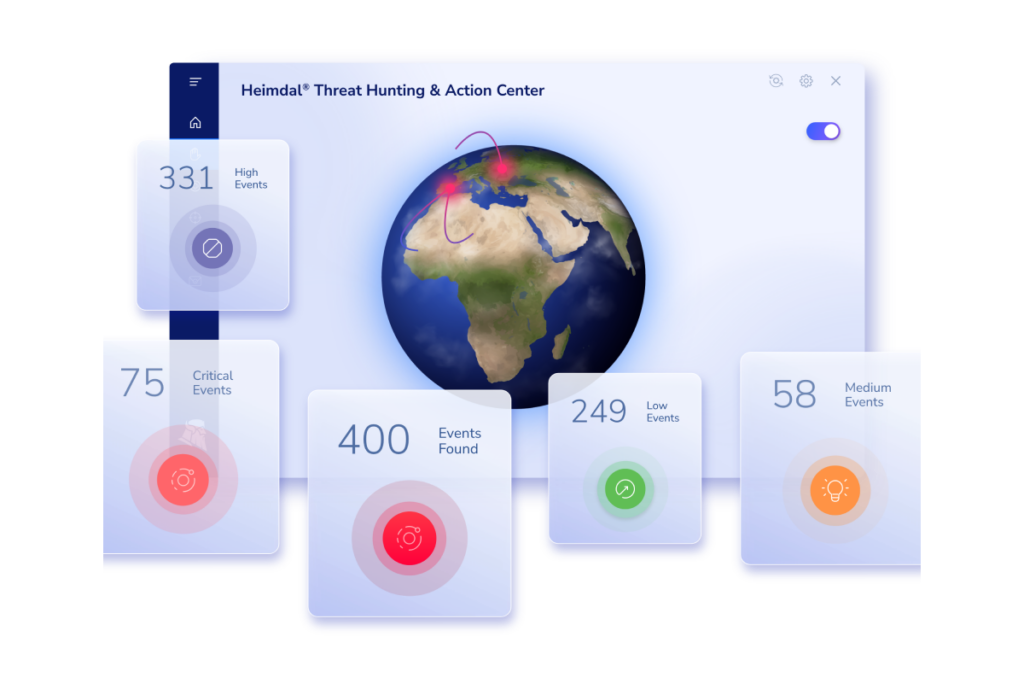
- Threat-hunting and Action Center (TAC) provides visual threat hunting across your entire IT environment with MITRE ATT&CK classification, risk scoring, and single-click remediation
- Predictive DNS (live, AI/ML-driven threat identification before domains host malicious content) and AI-powered email fraud prevention (live, outlier detection for impersonation and anomalous behaviour) are production capabilities today
- AI Wingman (coming soon): a cross-platform intelligence layer delivered in phases. Assist (platform guidance), Triage (MAS-powered incident validation), and SOC (managed SOC acceleration).
- Remote Access Protection blocks all external remote access by default, preventing unauthorised RDP abuse before compromise
- Zero-Trust Application Control and AppFencing prevent untrusted applications from executing and stop approved AI entry points from spawning risky tools or crossing into unsafe actions
Trade-offs
- Pricing is not published as standard per-endpoint rates. Use our pricing calculator to select products and get an instant estimate; final pricing is confirmed with a sales representative.
- The platform’s breadth means a real learning curve, though onboarding support and a dedicated CSM help.
- According to an independent review (FitGap, 2025), our threat detection and response capabilities are less specialised than dedicated EDR platforms like CrowdStrike or SentinelOne. We offer breadth across the security stack rather than maximum depth in any single detection domain.
- Public user review volume on major platforms remains lower than established competitors. As of August 2026, we are working with Forrester on a published evaluation expected soon.
- Stronger brand recognition in European markets than in North America.
- We do not currently offer a breach warranty or security awareness training module.
Pricing. Use our pricing calculator to select your products and get an instant estimate. Final pricing is confirmed with a sales representative.
Todyl
What it is. A cloud-native unified security platform combining SASE, endpoint security (EDR/NGAV), SIEM, SOAR, MXDR, and GRC in a single-agent architecture.
Best for. Organisations ready to standardise on a single platform that replaces their VPN/SASE, EDR, SIEM, and MDR tools simultaneously.
Key strengths
- Strong consolidation play designed to replace 3 to 5 separate products with one agent and console
- Bundled 24/7 MXDR across all package tiers (Essentials, Advanced, Complete), not gated behind premium pricing
- According to vendor documentation, each MXDR customer gets a named Detection and Response Account Manager (DRAM) with at least 5 years of cybersecurity experience
- Built-in GRC capabilities with audit-ready reports for CIS, HIPAA, and CMMC
Trade-offs
- Adopting Todyl typically requires replacing existing EDR, VPN, and SIEM. This is a significant rip-and-replace commitment that not every organisation can absorb at once.
- According to third-party comparison sources, Todyl has no published response SLAs for MXDR and does not bundle DFIR in its standard MXDR service
- No OT/IoT coverage, according to the same comparison sources
- Younger than established MDR providers
- Community feedback from mid-2025 mentions weaker support for headless Linux and performance issues on non-SSD devices.
Pricing. Contact Todyl for current pricing. One review source cites platform subscriptions starting around $250/month as of late 2025.
Blackpoint Cyber
What it is. A channel-first MDR provider with emphasis on real-time autonomous threat containment and tradecraft-focused detection, expanded into a broader platform (CompassOne) in 2025.
Best for. Organisations that want aggressive, autonomous threat containment where the SOC acts immediately on high-confidence threats without waiting for customer approval.
Key strengths
- SOC autonomously contains threats without waiting for your approval
- According to Blackpoint, average response times are approximately 16 minutes for on-premises incidents and approximately 7 minutes for cloud incidents
- Patented SNAP-Defense detection engine with Live Network Map tracks lateral movement and identity-linked threats beyond basic per-endpoint EDR
- CompassOne platform (launched 2025) consolidates MDR, ITDR, vulnerability management, cloud posture management, SIEM/logging (LogIC), and application control (ZTAC)
Trade-offs
- Pricing sits above bare-bones MDR options, with community-reported range of approximately $8 to $18/endpoint/month depending on tier and volume (2025 to 2026 estimates)
- Cloud posture management capabilities are primarily Microsoft 365-focused. Coverage for non-M365 SaaS applications is more limited.
- CompassOne increases lock-in risk as the platform expands
- Primarily built for the MSP/SMB channel. Direct enterprise buyers should verify that support, onboarding, and account management match their needs.
- Pricing is mostly community-reported and requires a custom quote rather than a fully transparent public rate card
Pricing. Contact Blackpoint Cyber for current pricing. Community-reported range is approximately $8 to $18/endpoint/month (2025 to 2026 estimates).
SentinelOne (Singularity XDR and Vigilance MDR)
What it is. An AI-driven XDR platform with optional MDR service (Vigilance/Singularity MDR), covering endpoints, cloud, identity, and data with a unified data lake and Storyline attack visualisation.
Best for. Mid-to-large organisations that want high-automation XDR with strong ransomware recovery capabilities and AI-driven investigation tooling.
Key strengths
- Patented one-click rollback for ransomware recovery, the feature users mention most
- True XDR architecture with unified data lake, Storyline context across attack chains, and 10 GB/day of included third-party data ingestion (upgradable)
- According to vendor and third-party comparison sources, Vigilance MDR reports typical response times around 18 to 20 minutes, with up to 99% alert noise reduction reported in some deployments
- Purple AI (Gen-AI assistance) accelerates investigations and response workflows
- RemoteOps enables response actions across thousands of endpoints on mixed OS fleets
- Strong track record in independent testing through MITRE Engenuity evaluations
Trade-offs
- Combined platform plus MDR costs are in the mid-to-high range. Depending on tier and configuration, estimates range from approximately $7 to $23/endpoint/month. Third-party pricing sources place Singularity Complete plus Vigilance at approximately $215/endpoint/year.
- Default 14-day data retention for some telemetry. Upgrading to 365 days or longer adds meaningful cost.
- MDR tier structure (Vigilance Respond vs. Respond Pro vs. Singularity MDR vs. WatchTower) can be confusing and requires careful scoping to avoid over- or under-buying
- Getting full value from XDR requires mature processes and staff who can use the platform’s depth
Pricing. Varies by tier. Full XDR plus MDR bundles are custom-quoted, with third-party estimates around $215/endpoint/year for Singularity Complete plus Vigilance.
CrowdStrike (Falcon XDR and Falcon Complete MDR)
What it is. A premium, AI-native cloud platform with strong detection capabilities, OverWatch threat hunting, and Falcon Complete MDR for full-cycle managed detection and response.
Best for. Organisations with budget for top-tier detection quality and full-cycle managed remediation, where detection speed and independently validated response capability are the primary decision factors.
Key strengths
- Strong detection quality across independent tests (MITRE Engenuity, SE Labs), backed by OverWatch human threat hunters
- CrowdStrike reports approximately 4-minute MTTD and approximately 36-minute MTTR based on MITRE-aligned evaluation results. The vendor cites these results to support claims of significantly faster detection, though direct vendor-to-vendor comparison methodologies vary across testing frameworks.
- Full-cycle remediation where CrowdStrike analysts remotely isolate, remove persistence, and restore systems without requiring customer involvement
- Falcon Complete Hub (introduced 2025) provides unified MDR visibility and executive-grade dashboards
- Some Falcon Complete packages include up to $1M breach warranty
- Single lightweight agent with minimal performance impact and cloud-native architecture
Trade-offs
- Among the highest total cost of ownership in this comparison. Falcon Complete MDR realistically sits in the $200 to $400/endpoint/year range as of 2025 to 2026, depending on bundling and add-ons.
- Per-endpoint modular pricing is complex. Each customer often requires a custom quote with multiple modules, making it difficult to compare apples-to-apples before deep sales engagement.
- The July 2024 Falcon-related outage is still relevant. Any agent-level issue can hit all managed endpoints at once.
- Too complex and too expensive for many mid-market teams
Pricing. Custom-quoted. Third-party estimates put Falcon Complete MDR in the $200 to $400/endpoint/year range (2025 to 2026).
Sophos (Intercept X, XDR, and MDR)
What it is. A mid-market MDR/XDR platform with “Synchronized Security” providing cross-product correlation across endpoints, firewalls, email, cloud, identity, and NDR, managed through Sophos Central.
Best for. Organisations already running Sophos endpoint and/or firewall products that want integrated MDR/XDR without introducing a separate SIEM or adding new vendors.
Key strengths
- According to Sophos, its MDR was rated around 4.7 to 4.9 out of 5 on Gartner Peer Insights as of late 2025, and ranked number 1 Overall MDR in G2’s Fall 2025 reports including Best Results and Best Usability for enterprise customers.
- Strong native cross-product correlation (“Synchronized Security”) when the environment is largely Sophos
- MDR pricing at approximately $8 to $12/endpoint/month (2025 to 2026 third-party estimates), below CrowdStrike and most comparable managed hunting services on a per-seat basis
- MDR Complete tier includes unlimited response handling and a breach protection warranty of approximately $1M
- CryptoGuard anti-ransomware with built-in rollback
- ITDR add-on for identity threat detection with dark web credential monitoring
Trade-offs
- Strong product-stack dependency. The XDR correlation works best when your environment is mostly Sophos. Multiple independent reviews confirm that multi-vendor stacks get less value.
- Third-party integrations are limited and cumbersome, according to reviews
- Threat hunting uses SQL-like queries (Live Discover), which creates a learning curve for less technical teams
- Some users report installation issues, especially on Mac, and resource intensity during heavy VPN traffic
Pricing. Approximately $8 to $12/endpoint/month for MDR (third-party estimates, 2025 to 2026).
WatchGuard (ThreatSync XDR and MDR)
What it is. An integrated network and endpoint security platform with tiered MDR offerings (Core MDR, Total MDR, Open MDR) and ThreatSync XDR, designed for organisations already using WatchGuard infrastructure.
Best for. Organisations already using WatchGuard firewalls and endpoints that want bundled XDR at minimal additional cost, with the option to add MDR as needed.
Key strengths
- ThreatSync Core XDR is included at no additional cost with qualifying WatchGuard products and Total Security Suite, zero-cost XDR if you’re already in the stack
- Tiered MDR lineup provides flexibility. Core MDR is WatchGuard-centric and lower cost. Total MDR covers the full WatchGuard stack. Open MDR supports third-party tools for vendor-agnostic environments.
- WatchGuard Open MDR is designed to cut false positives to fewer than one per month and handle critical threats in under six minutes, according to vendor marketing materials
- Compliance reporting mapped to NIST 800-53, ISO-27001, and Cyber Essentials
Trade-offs
- ThreatSync Core and Total MDR deliver the most value when you use WatchGuard endpoints, firewalls, and identity (AuthPoint). Value drops in heterogeneous environments unless you opt for Open MDR at a higher price point.
- Feature fragmentation across licences. XDR splits into Core versus ThreatSync+ versus Suite. MDR splits into Core versus Total versus Open. Compliance reporting is a separate licence.
- As of early 2026, third-party sources indicate Core MDR approximately $32.50 to $75/endpoint/year and Open MDR approximately $82.80 to $136.80/endpoint/year. These figures could not be independently confirmed from current distributor listings and are subject to change — contact WatchGuard for verified current rates.
- WatchGuard targets SMBs. Larger enterprises needing deep customisation should look elsewhere.
Pricing. Varies by tier. Contact WatchGuard for current rates. Third-party estimates indicate Core MDR approximately $32.50 to $75/endpoint/year and Open MDR approximately $82.80 to $136.80/endpoint/year (early 2026, unconfirmed).
Red Canary
What it is. A vendor-agnostic, detection-focused pure-play MDR service built on high-fidelity behavioural analytics and continuous threat hunting, designed to work with customers’ existing EDR tools.
Best for. Organisations that already have EDR investments (CrowdStrike, SentinelOne, Microsoft Defender, Carbon Black) and want top-quality detection overlay without replacing existing tools.
Key strengths
- Vendor-agnostic MDR that sits on top of your existing EDR. No agent swap required
- Detection-as-code methodology with thousands of behavioural analytics mapped to MITRE ATT&CK. Red Canary claims 99% threat accuracy, though accuracy definitions vary across vendors, so press them on methodology.
- Continuous threat hunting included by default in all tiers, not an upsell
- AI Investigation Agents handle Tier-2 analyst workflows to accelerate triage
- Proprietary Linux EDR sensor based on eBPF/Audit for environments where third-party agents are impractical
- Collective threat intelligence, where a detection in one customer environment generates shared detection logic across all customers while preserving privacy
Trade-offs
- Endpoint-first heritage. Red Canary’s identity and cloud telemetry capabilities are less mature than competitors focused specifically on those domains.
- Expensive. One external analysis puts mid-market costs at approximately $80,000 to $220,000/year, depending on environment size.
- No bundled full incident response retainer. Full IR services may require a separate engagement.
- Some users request stronger on-premises options and more streamlined summary reporting
Pricing. Premium, custom-quoted. External analysis suggests mid-market customers commonly pay approximately $80,000 to $220,000/year depending on environment size.
Bitdefender (GravityZone XDR and MDR/MXDR)
What it is. A full-stack XDR and MDR/MXDR platform powered by GravityZone, with native sensors for endpoints, identity, email/productivity, network, and cloud.
Best for. Regulated organisations that want a single vendor for EPP/EDR/XDR plus MDR, particularly those needing strong independent testing validation and built-in compliance mapping.
Key strengths
- Consistently high scores in independent testing. According to Bitdefender, it was recognised as “Best Overall Solution” in the 2025 AV-Comparatives Endpoint Prevention and Response test. AV-Comparatives is a well-established independent testing organisation.
- Native XDR sensors for Active Directory, Azure AD, Microsoft Intune, Office 365, Google Workspace, and network traffic. Broad coverage without heavy integration work.
- PHASR (Proactive Hardening and Attack Surface Reduction) dynamically tightens endpoint controls to prevent “living off the land” attacks
- Built-in compliance mapping for GDPR, HIPAA, NIS2, ISO, PCI, and NIST, plus EASM and CSPM+
- A November 2025 Data Lake release added ingestion of third-party firewall telemetry from Palo Alto, Check Point, Fortinet, and others
- MXDR/MXDR Plus licences include optional breach warranty add-on
Trade-offs
- Enterprise XDR/MDR pricing is largely custom-quoted, making budgeting and comparison harder versus vendors with published per-endpoint rates
- Lots of features, steep learning curve. Organisations without dedicated security staff will likely need MDR/MXDR to get full value.
- XDR and MDR value is highest when your stack is mostly GravityZone. Heterogeneous environments will need extra integration work.
- Multiple service tier choices (Secure vs. Secure Plus vs. Secure Extra at the MSP level, plus enterprise tiers) add evaluation complexity
Pricing. Custom-quoted for enterprise XDR/MDR tiers.
Which alternative fits your situation
You want to consolidate your entire security stack into one platform.
Look at Heimdal, Todyl, or Bitdefender. All three can replace multiple point products. Heimdal and Bitdefender go widest on module count. Todyl bundles SASE into its consolidation play. The trade-off: vendor dependency for operational simplicity.
You want MDR without replacing your existing tools.
Red Canary is the strongest option here. WatchGuard Open MDR also supports third-party tools.
You want the fastest autonomous threat containment.
Blackpoint Cyber’s model is built around SOC-autonomous response, with reported containment times measured in single-digit minutes for cloud incidents. CrowdStrike Falcon Complete does the same. It costs more.
You want the strongest independent testing validation.
CrowdStrike, SentinelOne, and Bitdefender have the most extensive track records in independent testing through MITRE Engenuity, AV-Comparatives, and SE Labs.
You want transparent, published pricing.
Huntress is the clear leader here with published per-endpoint rates. WatchGuard and SentinelOne also offer more pricing visibility than most competitors. Most other vendors in this comparison require custom quotes.
You have regulatory compliance requirements (NIS2, HIPAA, NIST, CIS).
Heimdal, Bitdefender, Todyl, and WatchGuard include compliance reporting mapped to specific regulatory frameworks as part of their platforms. Check that your specific frameworks are covered before you sign.
You’re already running a particular vendor’s products.
If you’re running Sophos endpoints and firewalls, Sophos MDR gives you the strongest cross-product correlation. If you’re on WatchGuard infrastructure, ThreatSync Core XDR comes at no additional cost. Switching means a full migration. Staying avoids the overhead, but locks you in if the vendor’s detection quality isn’t good enough.
You need ransomware recovery, not just ransomware prevention.
SentinelOne’s one-click rollback is the most widely cited capability for post-encryption recovery. Sophos CryptoGuard also provides anti-ransomware with rollback. We built Heimdal’s REP X to focus on preventing encryption before it starts, using four complementary detection engines validated against 800+ ransomware samples.
Frequently asked questions
Is Huntress an EDR or MDR?
Huntress functions as both. It deploys EDR technology on endpoints and provides a managed detection and response service with 24/7 human SOC monitoring on top. However, Huntress does not offer XDR-level multi-surface coverage. It monitors endpoints and Microsoft 365 identities (through its ITDR product) but does not natively cover network traffic, cloud workloads, or email content.
What is the difference between MDR and MXDR?
MDR (Managed Detection and Response) is a managed service that provides detection and response, historically focused on endpoints. MXDR (Managed Extended Detection and Response) extends that service across multiple telemetry sources including endpoints, identity, cloud, email, and network. In practice, the line is blurring. Most providers now cover more than endpoints. When evaluating vendors, look at what telemetry sources they actually ingest rather than which label they use.
Can MDR replace my internal security team?
MDR augments your team rather than replacing it. It covers 24/7 monitoring, triage, investigation, and response so your internal staff aren’t pulled into constant alert management. But MDR doesn’t replace the need for someone internal to manage security policy, handle vendor relationships, oversee compliance, and make strategic security decisions.
How much does MDR cost for a mid-market organisation?
Costs vary widely depending on the vendor, the scope of coverage, and your environment size. At the lower end, basic MDR services start around $3 to $9/endpoint/month. Enterprise-grade MXDR with full incident response can run $15 to $35/endpoint/month or higher. Vendors with published pricing include Huntress (approximately $8.99/endpoint/month for managed EDR as of early 2026) and WatchGuard (Core MDR from approximately $32.50/endpoint/year — contact WatchGuard to confirm current rates). Most other vendors require a custom quote. Budget for the full scope of what you need, including data retention, response tier, and any compliance add-ons.
What should I prioritise when evaluating MDR providers?
Focus on five things. First, detection quality. Ask for MTTD and MTTR data backed by independent testing or verifiable customer outcomes, not just marketing claims. Second, coverage breadth. Verify whether the service covers your actual attack surface, not just endpoints. Third, response authority. Clarify whether the SOC can act autonomously on high-confidence threats or requires your approval for every action. Fourth, pricing transparency. Get a full-scope quote that includes data retention, response tier upgrades, and growth scenarios. Fifth, operational fit. Determine whether the platform works with your existing tools and processes or requires a full migration.
All vendor claims are attributed to their sources. Market sizing reflects ranges from multiple analyst firms as of 2025 to 2026. Pricing data represents estimates as of early to mid-2026 and is subject to change. Independent testing results reflect specific methodologies and points in time.


