


 Network Security
 Vulnerability Management
 Privileged Access Management
  Endpoint Security
 Threat Hunting
 Unified Endpoint Management
 Email & Collaboration Security



Contents:
If you are evaluating Arctic Wolf, you have probably already decided that building an in-house SOC is not realistic for your team.
That is the right call for most mid-market and enterprise organisations. The harder question is whether Arctic Wolf’s specific model fits your environment, your budget, and your operational preferences, or whether one of the other credible MDR and MXDR providers would serve you better.
This guide breaks down ten Arctic Wolf competitors across pricing, response models, detection quality, and real trade-offs. Every vendor claim is sourced, and gaps in independent data are flagged. The point is to get you to a shortlist of two or three for a focused evaluation.
The Bottom Line
If you want the short version, here is who fits where.
- Heimdal MXDR. For teams that want MDR and security tooling (endpoint, DNS, PAM, patching, email) consolidated under one vendor, purchased as a standalone managed service or as part of a unified platform
- CrowdStrike Falcon Complete. For organisations with budget for premium MDR that want top-tier endpoint detection, fully managed response, and a breach warranty
- Sophos MDR. For mid-market teams already using Sophos or looking for cost-effective MDR with clear tiering
- Rapid7 Managed Threat Complete. For organisations that want MDR and vulnerability management bundled in a single contract
- Red Canary. Already running CrowdStrike, Carbon Black, or Microsoft Defender? High-fidelity detection layered on top of your existing EDR, without replacing it
- SentinelOne Singularity. For organisations that value automation-first response and ransomware rollback, with analyst coverage as a secondary layer. For large enterprises with substantial budgets that want AI-driven anomaly detection across network, email, and cloud
- Bitdefender MDR. Solid MDR at a lower price point, aimed at budget-conscious buyers. Straightforward, transparently priced managed EDR with strong ransomware detection, built for smaller organisations under 500 endpoints
How the MDR Market Has Changed
The MDR market has gone through three phases, and where each vendor entered shapes what they do well and where they fall short.
Phase 1 (pre-2018) was the MSSP era. Providers monitored SIEM logs and forwarded alerts. Customers got dashboards full of noise and no actual response.
Phase 2 (2018 to 2022) brought endpoint-centric MDR. Vendors like Arctic Wolf and CrowdStrike combined EDR tooling with human analyst triage. The focus was almost entirely on endpoint telemetry.
Phase 3 (2023 to present) is where things stand now. The market is converging around multi-domain telemetry covering endpoint, network, cloud, identity, and email. AI-assisted triage, automated containment, and outcome-based SLAs have become expected. Vendors increasingly bundle vulnerability management, compliance reporting, and co-managed SOC models.
The label matters less than the substance. Some vendors marketing “MXDR” provide shallow coverage across many domains. Others marketing “MDR” deliver deep, multi-domain detection. Ask what telemetry sources are actually monitored and how the provider responds, not what acronym they use.
Where Traditional Approaches Fall Short
Most mid-market security teams hit the same walls, regardless of what tools they run today.
Alert fatigue without investigation. Legacy MSSPs and in-house teams generate thousands of alerts. Without dedicated analysts triaging each one, real threats get lost in the noise.
No 24/7 coverage. Threats do not wait for business hours. An incident at 2 AM on a Saturday sits unaddressed until Monday unless someone is watching. For many organisations, staffing a 24/7 SOC would require multiple full-time analysts across shifts, and industry estimates put the total annual cost at $1.2 to $2.5 million for a US-based operation.
Tool sprawl with no correlation. Running separate products for endpoint, email, DNS, patching, and identity creates blind spots between them. Multi-stage attacks that cross domains are harder to detect when each tool operates independently.
Guided response with no one to execute. Some MDR providers detect and advise. But if your team is already stretched thin, a recommendation to “isolate this endpoint and rotate these credentials” still requires someone with the access and context to act.
Compliance gaps. Regulatory requirements like NIS2, ISO 27001, and NIST demand documented detection and response processes. An ad hoc approach rarely survives an audit.
How We Built Heimdal MXDR to Address These Gaps
We built Heimdal MXDR on a simple premise: detection and response work better when the provider owns the technology stack underneath.
Most MDR vendors either monitor third-party tools they did not build, or they focus on one domain (usually endpoint) and bolt on integrations for everything else. We took a different approach. Our MXDR service runs on our own unified platform, which natively covers endpoint protection, DNS security, email security, privileged access management, patch management, and ransomware encryption protection, all managed through a single console and agent.
Two ways to buy it. You can purchase Heimdal MXDR as a standalone managed service, where our SOC team handles 24/7 monitoring, investigation, threat hunting, and incident response across whatever modules you need. Or you can adopt our unified security platform and add MXDR as the managed service layer on top. Both paths give you the same SOC coverage. The difference is whether you also want to consolidate your underlying security tooling.
What this means in practice. When our analysts detect a threat, they are not handing off to a separate tool or waiting for a third-party integration to fire. They can isolate endpoints, block malicious DNS communication, revoke privileged access, and push emergency patches from the same platform, in the same workflow. As of August 2026, we deliver, test, and deploy patches for over 350 applications in under 4 hours.
Where this matters most. Our platform is built for teams that are tired of managing six or seven different security vendors. If your endpoint, email, DNS, patching, and identity tools all come from different providers, each with its own console, every investigation requires tab-switching and manual correlation. We built our Threat-hunting and Action Center (TAC) to bring all of that telemetry into a single operational view with pre-analysed risk scores, indicators of attack, and single-click remediation.
AI and ML are already embedded in the platform. Predictive DNS uses AI-driven analysis to identify suspicious destinations and malicious patterns before threats fully materialise. Our email security applies AI-led outlier detection to surface impersonation attempts, CEO fraud, and anomalous behaviour across inbound and outbound communications.
AI Wingman goes broader. AI Wingman Triage, included with TAC, uses a multi-agent system (MAS) to help teams validate incidents and accelerate triage decisions across both customer-led and analyst-led workflows.
The honest trade-off. Owning the stack creates deeper integration but also deeper dependency. If you adopt Heimdal across endpoint, email, PAM, and patching, you are making a platform commitment. For teams that want to keep their existing EDR and layer MDR on top, a tool-agnostic provider like Arctic Wolf or Red Canary may be a better fit. We are upfront about that.
Practical Buyer Guidance
Do you actually need MDR?
Not every organisation does. If you have a staffed, 24/7 internal SOC with mature runbooks and low analyst turnover, MDR may add cost without proportional value.
Signals that you do
- You have no one monitoring your environment outside business hours
- Your team spends more time on alert triage than on investigation and response
- You are running multiple security tools that do not talk to each other
- Compliance requirements demand documented detection and response processes you cannot currently demonstrate
- A recent incident exposed gaps in your response capability
What most buyers underestimate
Integration depth varies wildly. “We integrate with your tools” can mean anything from deep API-level telemetry ingestion to a surface-level webhook. Ask for a live demo of how the provider investigates an incident involving your specific stack.
Guided response is not the same as managed response. Arctic Wolf’s Concierge Security Team advises and walks you through response steps, but your team typically executes the actual remediation. If your internal team is small and already stretched, this creates a bottleneck during incidents.
Pricing models create hidden costs. Per-endpoint, per-user, and per-asset pricing all look similar on a spreadsheet but scale differently. Ask about minimums, onboarding fees, and what happens when you add cloud workloads or identity sources.
How to run a focused evaluation
- Define your response model requirement first. Do you want the provider to take direct action, or advise while your team executes?
- Map your telemetry sources. List every tool and data source you need monitored. Ask each vendor which ones they ingest natively and which require custom integration.
- Request a 2 to 4 week proof of concept. Most credible MDR providers offer trial periods. Use real production data, not a sandbox.
- Test off-hours response. Submit a simulated incident at 2 AM on a weekend. Measure how quickly the provider responds and what the investigation quality looks like.
- Ask for sample incident reports. The depth and clarity of investigation summaries tells you more about service quality than any sales demo.
What MDR will not fix
MDR does not replace security fundamentals. If your patching cadence is months behind, your privileged accounts are unmanaged, and your users have no security awareness training, MDR will detect the problems those gaps create but will not eliminate the root cause. The best MDR engagement is one where the provider helps you improve your security posture over time, not just monitor it. For organisations building out their response playbooks in parallel, our guide to incident response covers the process end to end. If your patching cadence is months behind, your privileged accounts are unmanaged, and your users have no security awareness training, MDR will detect the problems those gaps create but will not eliminate the root cause. The best MDR engagement is one where the provider helps you improve your security posture over time, not just monitor it.
Arctic Wolf Competitors: Vendor Profiles
Arctic Wolf
Arctic Wolf is the reference point for this comparison. It is a dedicated managed SOC service built around a “Concierge Security Team” (CST) model, targeting mid-market organisations that want a named external security team rather than a pooled analyst model.
What it does well. Each customer gets a named Concierge Security Team that provides continuity and personalised service. This is a genuine differentiator in an industry where most providers assign pooled SOC analysts. Arctic Wolf is also tool-agnostic, monitoring third-party EDR tools including CrowdStrike, SentinelOne, and Microsoft Defender without requiring replacement.
Pricing is per-user or per-endpoint with no per-GB log ingestion fees, which makes costs predictable. Arctic Wolf scores well in Gartner Peer Insights Voice of the Customer for MDR.
What to watch for. Arctic Wolf’s response model is guided containment. The CST advises and walks you through response steps, but your team typically executes the actual remediation. If your internal team is small and already stretched, this creates a bottleneck during incidents.
Pricing is at the premium end of the mid-market. Public sector price lists (such as TX DIR 2025) show Silver tier at approximately $192 per user per year, Gold at approximately $218, and Platinum at approximately $257, plus a roughly $15,000 per year Aurora Platform base fee. Commercial pricing may differ but directionally confirms the premium positioning. Organisations under approximately 150 users are generally priced out due to minimums and onboarding fees, according to independent MDR reviews.
Some users report uneven service during the first year, with quality improving once onboarding settles. Independent reviews flag alert noise and inconsistent investigation detail.
Best for. Mid-market organisations (150 to 2,500 users) with lean security teams that want a dedicated external SOC team, are comfortable executing remediation themselves, and value predictable pricing without log-volume charges.
Heimdal MXDR
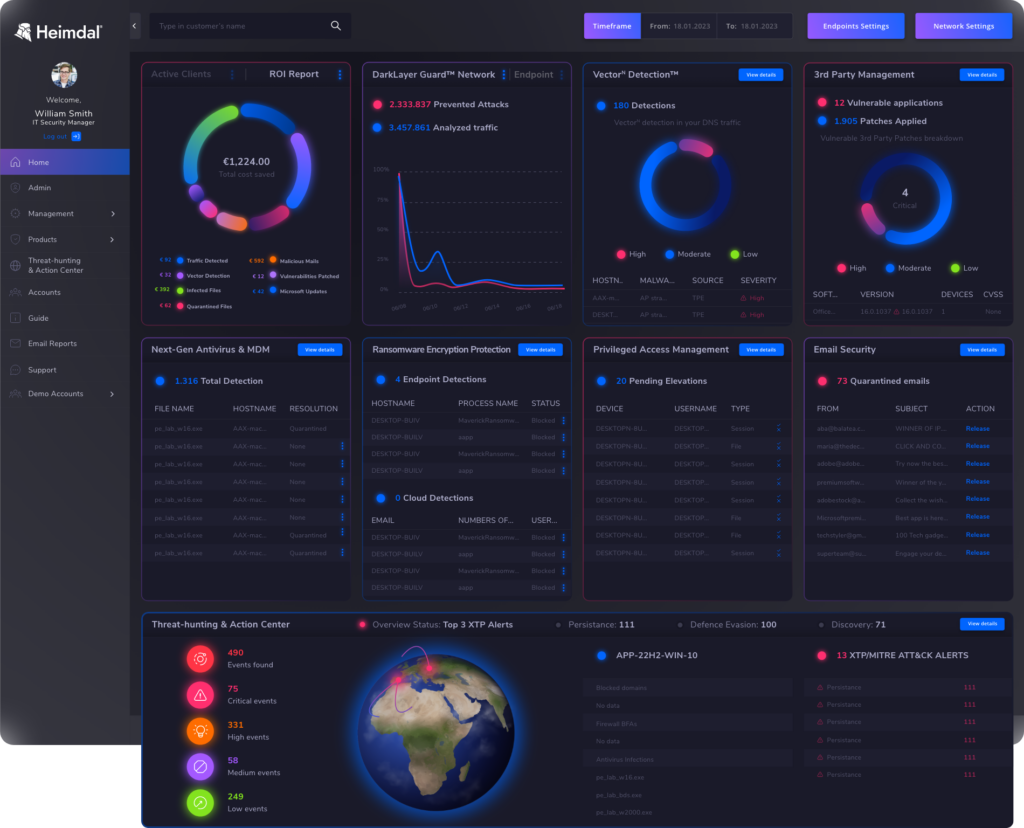
We covered our approach in detail in the framing section above, so here is the summary version.
We offer MXDR as a standalone managed service or as part of our unified security platform. Our SOC provides 24/7 monitoring, investigation, threat hunting, and incident response across endpoint, DNS, email, identity, PAM, and patching. The key differentiator is that we built the technology stack underneath.
Our analysts work inside the same platform you manage, and they can take automated and manual response actions across all modules from a single console.
What we do well. Broadest native capability set in this comparison. Modular architecture means you adopt only what you need. Compliance-ready reporting aligned with NIS2, CIS18, and NIST frameworks. Our REP X ransomware protection uses four detection engines (encryption, rename, shadow copy, and canary) and operates signatureless, so it catches ransomware variants that signature-based tools miss.
What to watch for. The breadth of the platform can create a learning curve. Some users report the interface can feel dense in complex deployments. We have less brand recognition in the MDR-specific market compared to Arctic Wolf or CrowdStrike, and fewer independent third-party evaluations to date. That is changing. As of August 2026, we are working with Forrester and expect a published evaluation soon. Pricing is finalised with a sales representative, but you can get an instant estimate by selecting your products and endpoint count using our pricing calculator.
Best for. Mid-market and enterprise organisations looking to consolidate multiple security functions (endpoint, email, DNS, patching, PAM, MDR) into a single vendor relationship.
CrowdStrike Falcon Complete XDR
CrowdStrike Falcon Complete is the premium, fully managed MDR service, built on CrowdStrike’s endpoint platform. The pitch: breach prevention, backed by a financial warranty.
What it does well. Consistently top-tier endpoint detection quality. According to CrowdStrike, Falcon Complete achieved 99% detection coverage (75 of 76 techniques) in MITRE ATT&CK Security Service Provider evaluations. CrowdStrike analysts take direct remediation action on endpoints, not just guided response.
The XDR coverage extends via the CrowdXDR Alliance across email, web, network, cloud, and identity. A breach prevention warranty (commonly cited around $1M to $2M, with exact terms varying by contract) provides financial backing. Independent reviews report deployment across thousands of endpoints in hours.
A vendor-commissioned Forrester Total Economic Impact study cited approximately 403% ROI over 3 years for a modelled 7,500-endpoint deployment. As with all vendor-commissioned studies, these results should be interpreted with their methodology in mind.
What to watch for. Typically the most expensive per-endpoint MDR option on the market. No public pricing, but buyer-reported ranges suggest $15 to $30 per endpoint per month after volume discounts. Not a SIEM replacement, with limited native long-term log retention. XDR beyond endpoints often requires additional Falcon modules (identity, cloud), adding cost. Minimums (commonly 50 to 200+ endpoints) make it inaccessible for very small organisations.
Best for. Mid-market to large enterprises (500 to 10,000+ endpoints) with budget for premium MDR, wanting top-tier endpoint detection with fully managed response and a breach warranty.
Sophos MDR
Sophos MDR layers on Intercept X and XDR. Pricing is competitive, packaging is simple (two tiers), and smaller organisations are the sweet spot.
What it does well. Competitive pricing. Independent estimates place Sophos MDR at approximately $8 to $12 per endpoint per month, below CrowdStrike and Arctic Wolf. Two clear tiers: MDR Essentials (monitoring and guided response) and MDR Complete (adds proactive threat hunting, full incident response, and root cause analysis). MDR Complete includes a $1M breach warranty for qualifying customers, according to vendor documentation.
As of late 2025, Sophos announced that all integration packs (firewall, cloud, network, backup, identity, email, NDR) are included at no additional charge with MDR/XDR subscriptions. Real-time ransomware protection with rollback capability.
What to watch for. Telemetry and response are optimised for the Sophos stack. Organisations heavily invested in non-Sophos tools may find less integration depth than vendor-agnostic providers. MDR Essentials provides guided response only. User reviews flag hardware resource demands when extensive features are enabled.
Best for. Mid-market organisations (50 to 2,000 endpoints) already using or willing to adopt Sophos, wanting cost-effective MDR with clear tiering.
Darktrace
Darktrace takes an AI-first approach, using self-learning, unsupervised machine learning to detect anomalies. You get DETECT and RESPOND modules that act autonomously rather than a traditional human-led SOC.
What it does well. Self-learning AI builds behavioural baselines unique to each organisation, enabling detection of novel and insider threats that signature-based tools miss. Broad modular coverage across network, email, endpoint, cloud, and OT/IoT. Autonomous RESPOND actions (throttling connections, locking accounts, isolating endpoints) provide automated response. Scales to large deployments (10,000 to 50,000+ users).
What to watch for. Significantly more expensive than endpoint-centric MDR. According to one pricing analysis (VendorBenchmark), a typical 10,000-user NDR deployment runs approximately $250K to $485K per year, and multi-module enterprise deployments can reach $485K to $1.1M per year or higher. These are third-party estimates and may not reflect current negotiated pricing.
Not a traditional MDR in the human-led SOC sense. Complex modular pricing driven by user count and modules deployed. If you want a dedicated human analyst team, this is not the right model.
Best for. Large enterprises (5,000 to 50,000+ users) with substantial budgets that want AI-driven anomaly detection across multiple domains, autonomous response, and are comfortable with a platform-centric rather than SOC-centric model.
Rapid7 Managed Threat Complete (MTC)
Rapid7 MTC is an MXDR bundle that combines MDR, SIEM/XDR (InsightIDR), and vulnerability management (InsightVM) in a single service contract.
What it does well. Unique combination of MDR/XDR with built-in unlimited vulnerability scanning. Exposure context flows directly into investigations, helping analysts understand which unpatched vulnerabilities an attacker could exploit. Broad telemetry coverage across endpoint, cloud, identity, email, and network, plus third-party EDR ingestion (CrowdStrike, SentinelOne, Microsoft Defender).
Three-tier packaging (Essential, Advanced, Ultimate) with asset-based pricing. The Ultimate tier includes a $1M breach protection warranty, according to one MDR provider ranking. AWS Marketplace starting prices (as of early 2026): Essential from approximately $73K per year for 300 assets, Advanced from approximately $111K per year for 500 assets, Ultimate from approximately $175K per year for 500 assets.
What to watch for. Deployment complexity is higher than focused MDR services due to the breadth of bundled capabilities. Buyer-reported minimums around 300 to 500 assets position it for mid-market and above. Buyers report that remediation suggestions can feel generic rather than application-specific.
Best for. Mid-market to enterprise organisations (500 to 5,000+ assets) that want MDR, SIEM, and vulnerability management under a single contract and prefer asset-based pricing.
Red Canary
Red Canary is an endpoint-centric MDR provider known for deep EDR integrations and high-fidelity detections that keep false positives low.
What it does well. Deep integration with leading EDR platforms (CrowdStrike Falcon, Carbon Black, Microsoft Defender for Endpoint) without forcing EDR replacement. Strong reputation for low false-positive rates. Near real-time alert review with well-developed response playbooks. Coverage expanding beyond endpoints to include identities, cloud workloads, networks, and email.
What to watch for. Pricing is reportedly less competitive for smaller organisations. Limited on-premise deployment options. Reporting lacks summary and aggregation features, according to users. Red Canary does not publish pricing. Contact the vendor directly for a quote based on your EDR platform and endpoint count.
Best for. Organisations with an existing EDR investment (especially CrowdStrike or Carbon Black) that want a dedicated MDR layer with high-fidelity detections and clear response playbooks.
SentinelOne Singularity
SentinelOne’s Singularity platform uses AI-powered autonomous endpoint protection. The MDR service (transitioning from Vigilance to Wayfinder branding as of early 2026) adds human analyst coverage on top of the automated platform.
What it does well. Automation runs deep. The platform handles detection, containment, and remediation with minimal human intervention. Ransomware rollback reverts endpoints to their pre-attack state.
Breach response warranty of up to $1M, according to vendor documentation. 24/7 monitoring by security experts through the MDR service.
What to watch for. MDR is an add-on to the platform licence, not bundled. Platform pricing ranges from approximately $70 to $230 per endpoint per year depending on tier (per SentinelOne’s published pricing page, as of early 2026). SentinelOne now offers MDR-inclusive platform tiers under the Wayfinder branding alongside standalone add-on options. Pricing varies by tier and bundle. Contact the vendor for current MDR-specific pricing.
The branding transition creates market confusion. Expect tuning effort in complex environments. As a platform-first vendor, the human investigation layer is thinner than what SOC-first providers deliver.
Best for. Organisations already on or willing to adopt SentinelOne that want automation-first response, ransomware rollback, and analyst coverage as a secondary layer.
Bitdefender MDR
Bitdefender MDR is a value-oriented service built on Bitdefender’s endpoint protection platform.
What it does well. Competitive pricing. According to mdrproviders.io, MDR Core is listed at $6.99 per endpoint per month and MDR Enterprise at $14.99 per endpoint per month. These figures have not been independently verified through additional sources, and actual pricing may differ.
Taps into global threat intelligence. Behavioural analytics track user and entity patterns, and incident investigations go to root cause. Reporting is customisable.
What to watch for. Fewer independent reviews and evaluations compared to CrowdStrike, Arctic Wolf, or Sophos. Limited public documentation on specific service-level commitments and response times. Pricing data comes from a single review source.
Best for. Budget-conscious mid-market organisations seeking MDR at a lower price point, particularly those already using Bitdefender endpoint protection.
Huntress
Huntress is an SMB-focused managed EDR/MDR with transparent pricing and specialisation in detecting persistent footholds and ransomware.
What it does well. Very transparent pricing. Managed EDR is reported at $8.99 per endpoint per month with a 12-month term and 50-unit floor for direct buyers. SOC coverage is included in the per-endpoint price, not a separate add-on. Specialisation in detecting persistent footholds that other tools miss. Ransomware canaries (decoy files that detect ransomware activity early). Easy-to-use dashboard designed for lean IT teams.
What to watch for. Narrower telemetry scope than enterprise MDR platforms, primarily endpoint-focused. Not built for complex multi-domain environments. Users flag occasional false positives during software updates or configuration changes. Add-on products beyond core managed EDR are priced separately.
Best for. Smaller organisations (50 to 500 endpoints) wanting straightforward, affordable managed EDR with included SOC coverage and strong ransomware detection.
UnderDefense
No rip-and-replace – an open, vendor-agnostic Agentic AI SOC layers AI-agent triage on top of the SIEM and EDR you already have, without adding headcount.
What it does well. UnderDefense Agentic AI SOC works on top of the existing security stack. No tool replacement, no scaling the team to keep up: the Agentic AI SOC enriches, correlates, and triages every alert at machine speed, leaving the analyst a decision, not an investigation.
A complete investigation lands in about 2 minutes per alert, mapped to 96% of MITRE ATT&CK, with every containment decision routed to the customer’s team or UnderDefense’s own 24/7 IR experts under a 15-minute escalation SLA.
Integration runs to 250+ connectors across any SIEM, EDR, and cloud stack, with full on-premises and air-gapped deployment available. Across a decade of managed client environments and 200+ customers in the US and Europe, the company reports zero ransomware incidents reaching impact.
What to watch for. Onboarding runs as a structured proof-of-concept scoped to the customer’s SIEM/EDR mix, so first response takes longer than a click-to-start trial. UnderDefense does not publish pricing, quotes depend on stack and data or endpoint volume.
Best for. Mid-market to large enterprises running a mixed SIEM/EDR/cloud stack that want AI-agent-plus-human triage layered on top of what they already run, without a forced tooling swap.
Choosing by Situation
Your best option depends more on your starting point than on any vendor ranking.
“We have no security team and need someone to handle everything.” Look at CrowdStrike Falcon Complete (if budget allows) or Heimdal MXDR (if you also want to consolidate your security tooling). Both provide fully managed response rather than just guidance.
“We already run CrowdStrike/SentinelOne/Defender and want MDR on top.” Red Canary or Arctic Wolf, both of which monitor third-party EDR without requiring replacement.
“We want to reduce vendor count, not add another one.” Heimdal MXDR or Rapid7 MTC. Heimdal covers endpoint, DNS, email, PAM, and patching. Rapid7 goes the SIEM route, bundling MDR with vulnerability management.
“Budget is our primary constraint.” Sophos MDR, Bitdefender MDR, or Huntress. All three operate at significantly lower per-endpoint pricing than Arctic Wolf or CrowdStrike.
“We need AI-driven anomaly detection across network and cloud.” Darktrace, if you have the budget and are comfortable with an AI-platform model rather than a traditional human-led SOC.
“We want a named analyst team that knows our environment.” Arctic Wolf’s Concierge Security Team model is specifically designed for this, though you should be prepared for guided response rather than fully managed remediation.
“We need MDR and vulnerability management in one contract.” Rapid7 MTC bundles both natively. Heimdal MXDR also includes patch management and vulnerability context if you adopt the broader platform.
FAQ
What is the difference between MDR and MXDR?
MDR (Managed Detection and Response) originally focused on endpoint telemetry. MXDR (Managed Extended Detection and Response) extends monitoring and response across multiple domains including endpoint, network, cloud, identity, and email. In practice, most leading MDR providers now cover multiple domains, and the line between them has blurred. Focus on what telemetry sources a provider actually monitors rather than which acronym they use.
Can I use MDR without replacing my existing security tools?
Yes, but it depends on the provider. Tool-agnostic providers like Arctic Wolf, Red Canary, and Rapid7 are designed to monitor existing EDR and security tools without requiring replacement. Platform-native providers like Heimdal, CrowdStrike, and Sophos deliver their deepest value when you use their own technology stack. The right choice depends on whether you want to consolidate tools or layer detection on top of your existing EDR.
How much does MDR typically cost?
Pricing varies significantly. Budget options (Bitdefender, Huntress) start around $7 to $9 per endpoint per month. Sophos sits mid-range at roughly $8 to $12.
CrowdStrike and Arctic Wolf run $15 to $30 per endpoint per month or more. Darktrace prices differently, by user count and modules, with annual costs that hit six or seven figures for large deployments. All figures are based on publicly available or buyer-reported data and may differ from your actual quoted price.
What response model should I choose?
This decision shapes everything else in an MDR evaluation. Guided response (Arctic Wolf, Red Canary) means the provider advises and your team executes. Fully managed response (CrowdStrike Falcon Complete, Heimdal MXDR, Sophos MDR Complete) means the provider takes direct action.
Autonomous response (SentinelOne, Darktrace) means AI takes containment actions with minimal human intervention. If your team cannot act on recommendations at 3 AM, guided response leaves a gap. Go fully managed or autonomous.
How long does MDR deployment take?
Most modern MDR services deploy in days to weeks, not months. CrowdStrike Falcon Complete is known for fast deployment, with independent reviews reporting rollout across thousands of endpoints in hours. Broader MXDR platforms that include additional modules (patching, PAM, email security) typically take longer to fully configure. Ask each vendor for a specific deployment timeline based on your environment.
Will MDR meet my compliance requirements?
MDR can help satisfy detection and response requirements in frameworks like NIS2, ISO 27001, NIST, SOC 2, and HIPAA. However, compliance is broader than detection and response. You still need appropriate access controls, vulnerability management, data protection, and governance processes. Some providers (Heimdal, Rapid7) bundle compliance-relevant capabilities like patch management and reporting. Others focus specifically on the detection and response layer.


