



Contents:
There are several major managed detection and response (MDR) companies to choose from. We’ve compared the main offerings of the best MDR providers to help you decide which is right for your organisation.
Maybe it was a near miss, or a security team stretched too thin and drowning in alerts from dozens of tools. Whatever the trigger, many companies reach the same conclusion. It’s better to get expert help with cybersecurity. That’s where managed detection and response comes in.
MDR lets you outsource monitoring, detection, and response to experts who watch your environment for you around the clock. It’s a fully managed service, run by a specialist team rather than one you have to build in-house.
Once you’ve decided MDR is the way to go, you need to choose a supplier. The main players include SentinelOne, Heimdal, Huntress, and more. So how do you tell them apart?
Transparency. Heimdal MXDR is our own form of managed detection and response. Even so, this article sets out to give you an objective view of the MDR market so you can choose the right fit for your situation.
Not all MDR services are the same
Comparing MDR vendors can get confusing fast. At first glance, they all claim to do the same things.
But they differ in the breadth and depth of what they cover, and in the kinds of customers they suit best. There isn’t really a single best MDR provider. It’s about finding the right one for you.
For the basics, see our guide to what managed detection and response is.
Who are the Top MDR Solution Providers in 2026?
Plenty of MDR companies offer some form of the service. Only a handful provide genuinely comprehensive services and tooling. Here are the major players, in alphabetical order.
- Heimdal MXDR
- Arctic Wolf
- CrowdStrike Falcon Complete
- Huntress
- SentinelOne Wayfinder (formerly Vigilance)
- Sophos MDR
We’ve focused on six of the top MDR vendors here. Others worth a look include Rapid7 MDR and Expel MDR.
What actually matters when choosing an MDR provider
Different organisations need different things from an MDR service. Here are the main things to weigh up when you’re evaluating MDR providers.
The response model
This is what happens when the provider’s security team spots a threat aimed at you. Some send you an alert and leave your own team to act on it. Others handle the full remediation for you, right through to hands-on incident response, where their team runs the containment and clean-up so yours doesn’t have to.
Response playbooks
Some providers follow recognised frameworks like MITRE ATT&CK to guide detection and response. Others use their own methods, or don’t follow an established framework. That isn’t necessarily a drawback. It depends on what you need from the service.
Service level agreements
SLAs vary between providers. At a minimum, expect 24/7 monitoring. Beyond that, you might want a defined time to detect or time to respond, and reports you can share with your team or board.
Breadth of service
What does the managed detection and response service provider actually monitor? You’ll want endpoints and network as a baseline. Most now cover identity and email too. Some add things like automatic patching, threat hunting, and deeper threat detection and response capabilities. Decide how deep and broad your cover needs to be.
Data residency
Check where your data is held. If regulations like the GDPR apply to you, you’ll want to be sure the provider stores and processes data in a compliant way.
Integrations
Does the mdr security solution provider’s technology fit your existing stack?
Onboarding
What’s onboarding like, and how long until you’re fully up and running?
Comparing the best MDR providers
Just want a quick side-by-side? Use the table to see how the top MDR providers compare.
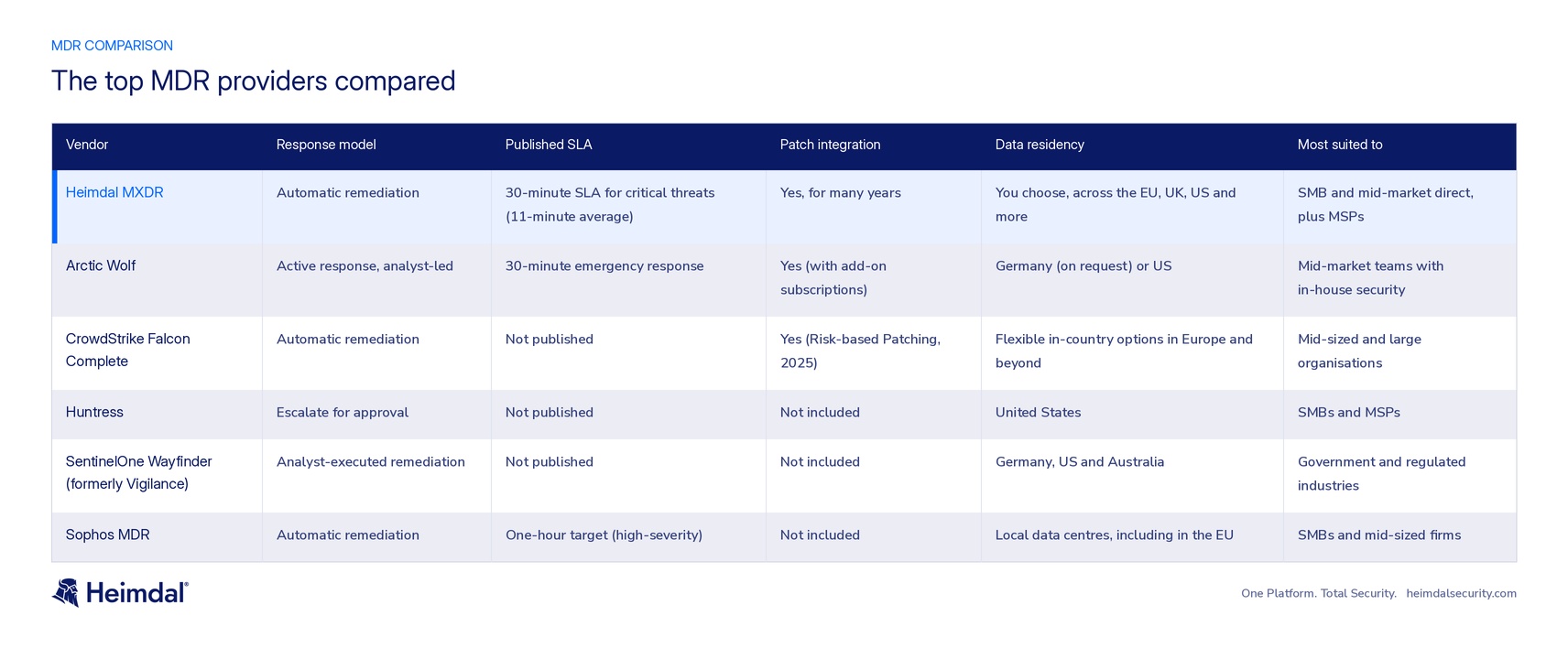
A closer look at the top MDR providers
Ready to go the MDR route? Here’s more detail on each provider and where it’s strongest.
1. Heimdal MXDR
Heimdal MXDR is built on our unified security platform, a broad set of native tools that cover most threat types, with third-party tools connected as needed. A global team of analysts monitors your environment 24/7.
The platform spans threat hunting, vulnerability and patch management, privileged access management, email security, and more. Our SOC watches customer environments continuously and uses Heimdal’s own tooling to remediate threats automatically.
Because the tools are native and proactive, the SOC works to prevent incidents, not just chase alerts after the fact. We serve two audiences with the same platform, SMB and mid-market teams buying direct, and managed service providers (MSPs) building services for their own customers.
Best for. Companies that want broad native coverage from one platform, without being locked into a single-vendor stack.
Pros
- MITRE ATT&CK techniques
- Mature native tooling
- Native MSP multi-tenancy
Cons
- You get the most value by consolidating onto the platform, which means leaning on one vendor for more of your stack
- Third-party tools integrate, though that adds some complexity
2. Arctic Wolf
Arctic Wolf’s managed detection and response runs on its Aurora platform, with an agentic SOC, a set of AI agents that monitor your environment and endpoints alongside human analysts.
You also get the Concierge Security Team, where a named analyst or team works as an extension of your own staff. Aurora is largely technology agnostic and works alongside your existing tools, giving you a single view across them.
Since acquiring Cylance in 2025, Arctic Wolf also has its own endpoint product in Aurora Endpoint Security. It now takes active response actions across identity, endpoint, network, and email, either automatically or analyst-executed, rather than only handing you advice.
Best for. Companies that already have a security team but lack clear visibility across the stack.
Pros
- Named security team
- Recognised expertise
- Conducts security posture reviews
Cons
- Relatively expensive
- Sits on top of your existing tools as an added cost
- Some users report limited access to raw telemetry
3. CrowdStrike Falcon Complete
CrowdStrike’s MDR rolls its Falcon platform out across your organisation. You get its full toolset, agentic detection and response, and human-in-the-loop support from CrowdStrike’s SOC. The platform covers endpoints, identity, and cloud, and can pull in data from third-party tools, with 24/7 monitoring and automatic response to likely breaches.
Best for. Companies that want an all-in-one cybersecurity tooling and monitoring service.
Pros
- MITRE ATT&CK validated processes
- Autonomous response with human oversight
- Hands-off remediation
Cons
- Patch management is newer to the platform, added in 2025 as Risk-based Patching with Falcon for IT
- Commercial minimums and per-endpoint pricing can make it a weaker fit for very small estates
- You’re relying on one vendor
4. Huntress
Huntress is one of the lower-cost providers and is sold largely through MSPs. It made its name in managed EDR and has since grown into a broader platform, with its own Huntress Managed SIEM, identity threat detection and response for Microsoft 365, and security awareness training. Its analysts and threat hunters are widely regarded as some of the best around.
Best for. Companies that want to balance quality with affordability.
Pros
- Excellent analysts
- Low cost
- Few false positives
Cons
- Reporting and API access are limited
- No published response-time SLA or breach warranty
- Data is held in the US, with EU data under transfer safeguards rather than a dedicated EU region
5. SentinelOne Wayfinder (formerly Vigilance)
SentinelOne’s managed service, recently rebranded from Vigilance to Wayfinder, runs on the Singularity platform. You get endpoint, identity, mobile, and cloud monitoring, one-click rollback and vulnerability remediation, with SentinelOne’s in-house SOC monitoring 24/7.
In 2025 it added Purple AI Athena, which automates triage and speeds up investigation and response. Its analysts execute remediation such as kill and quarantine rather than only flagging actions for you.
Best for. Government and regulated industries in the US that need FedRAMP-authorised tooling, and teams that want a single platform for everything.
Pros
- FedRAMP High authorised
- Strong rollback
- Automated response
Cons
- Vendor lock-in risk, less suitable if you already run other tools
- Relatively expensive
- Service and support quality draw mixed feedback
6. Sophos MDR
Sophos bills its service as “the world’s largest Agentic SOC”. It uses Sophos’s own endpoint tooling and pulls in data from hundreds of other security tools. AI agents and Sophos analysts monitor threats and deliver rapid response, and Sophos is now folding next-gen SIEM into the same platform.
Best for. Companies that have already invested in a range of tools and don’t want to switch endpoint vendor.
Pros
- Strong agentic AI
- Works across your existing tools with no lock-in
- Flexible engagement models
Cons
- Telemetry access can feel limited, more of a black box
- Relatively expensive
- You get the deepest value inside Sophos Central
Choose the right MDR solution provider for you
Every business has different security needs, so choosing the right MDR service comes down to your own setup and risks.
We’d always start with an honest assessment of where you are, your strengths and gaps, and the cyber threats you actually face. That tells you whether you’re better off with broad native coverage from a provider like Heimdal or SentinelOne, or a more tool-agnostic option from the likes of Huntress or Sophos.
Ready to see it? Book a free, no-obligation demo of Heimdal MXDR.
FAQs about managed detection and response providers
How does MDR compare to EDR or XDR?
With MDR, you’re outsourcing the monitoring and response part of your cybersecurity. With endpoint detection and response (EDR) or extended detection and response (XDR), you’re the one configuring the tools, managing alerts and responding to threats. MDR hands much of that to the provider or an MSP instead. Here’s more on MDR vs EDR vs XDR.
Is MDR worth it for a small IT team?
Yes. Most security tools throw off dozens of alerts a day, and investigating each one by hand takes time, money, and specialist skills. MDR passes that work to incident response experts who triage alerts, use AI for faster detection, and run specialist tooling day in, day out. You also get round-the-clock cover from a security operations centre (SOC), so threats get caught while your team sleeps.
What does a typical MDR SLA actually cover?
SLAs vary a lot between providers, so there’s no single template. At Heimdal, ours typically guarantee 99.9% uptime, 99.5% uptime on backend and management portal services, and patch management coverage within a maximum of eight hours. For critical threats we work to a 30-minute response SLA, and our average response time is around 11 minutes.


