


 Network Security
 Vulnerability Management
 Privileged Access Management
  Endpoint Security
 Threat Hunting
 Unified Endpoint Management
 Email & Collaboration Security



Contents:
EDITORIAL DISCLOSURE
We build Heimdal, which competes with both products on this page. Here is how we kept this straight. Every price comes from a public pricing page or reseller listing, with the date we checked it. Every test result links to the specific lab round and its date. There are seven points below where we tell you to buy something other than Heimdal, including CrowdStrike and SentinelOne. If you find an error, contact us and we will correct this page.
ESET Endpoint Security and Microsoft Defender for Endpoint are on your desk together for one of two reasons.
A renewal notice landed and you want to know whether staying put is defensible, or someone in finance noticed that Defender already sits inside the Microsoft 365 bill and asked why there is a second endpoint line item at all. Both are fair questions and neither has a universal answer.
What follows is the comparison at the level a purchasing committee needs. Tier-by-tier pricing with the date it was checked, the 2025 lab rounds named, which capabilities sit behind which license, and what each product genuinely cannot do. If you run a mixed fleet of Windows, macOS, and Linux machines, or if EDR is the thing you actually need, the answer turns on details that headline feature lists hide.
Bottom line up front
Both stop commodity malware and their 2025 lab scores sit within a rounding error of each other. ESET wins on independent test breadth and on running clean outside the Microsoft stack, and Defender Plan 2 wins if you already hold the E5 license and the math works.
Choose Defender if
- Your Microsoft 365 E5 licenses are already paid for and your fleet is overwhelmingly Windows.
- You want endpoint alerts correlated with Entra ID sign-ins, Exchange Online mail flow, and cloud app activity in one investigation timeline.
- You have someone who can spend real hours on policy tuning and working across the Defender, Intune, and Entra portals.
Choose ESET if
- You are on E3, or off Microsoft entirely, and do not want an endpoint decision to force a subscription upgrade.
- Your fleet includes aging hardware, thin clients, or macOS and Linux machines where agent weight and multi-OS parity matter.
- You need an on-premises management server or perpetual licensing, neither of which Microsoft offers.
If neither answer fixes what is broken — four consoles, patching by hand, EDR behind a tier you do not hold — there is a third route below and we build it.
Head-to-head comparison
| Criterion | Microsoft Defender for Endpoint | ESET Endpoint Security |
|---|---|---|
| Pricing model | Per user, covers up to five devices per user, annual commitment | Per device, with yearly, monthly, and perpetual options |
| Starting price | Plan 1 about $3 per user per month standalone, Plan 2 about $5.20. Included in E3 and E5 respectively | PROTECT Entry about $211 per year for five devices, roughly $42 per device per year |
| OS coverage | Windows, macOS, Linux, iOS, Android. Detection and management depth on non-Windows trails Windows | Windows, macOS, Linux, Android, with closer capability parity across platforms |
| EDR included at which tier | Plan 2 only, via M365 E5 or standalone P2 | Enterprise or Elite tier only, via the ESET Inspect module |
| Management console | Microsoft Defender portal, plus Intune for policy, Entra for access, Sentinel for retention | ESET PROTECT, single console, available cloud or on-premises |
| Independent lab scores (2025) | AV-TEST 17.8/18 average across the 2025 endurance test period. 6.0 protection, 6.0 performance, 5.8 usability | AV-TEST 17.5/18, April 2025 round. 6.0 protection, 5.5 performance, 6.0 usability |
| MITRE ATT&CK participation | Participates regularly in Enterprise evaluations | Participated in the 2025 Enterprise evaluation. 100% protection score per ESET’s published analysis, detection score about 66.67% |
| On-premises option | None. Cloud management only | Yes. ESET PROTECT on-premises server |
| Managed detection | Defender Experts for XDR, separate purchase | ESET MDR as an add-on or bundled in Elite |
All prices and scores verified August 2026.
All prices and scores verified August 2026.
What the table settles is the shape of each product. Where EDR sits, who holds the console, what the unit of billing is, and whether an on-premises deployment is possible at all.
Those four rows decide most evaluations before anyone opens a detection report. What the table cannot show is the part that consumes your first quarter. The labs draw their scores from consumer Windows testing, because that is where the standardized rounds exist.
Enterprise builds share detection engines with those consumer products without sharing their management surface. Nothing in the table measures how long it takes to write a working policy, how much noise the default configuration produces on your oldest machines, or whether a mixed-OS rollout behaves the way the compatibility matrix promises.
Test both on the fleet you actually have, including the laptops you are embarrassed by.
Microsoft Defender for Endpoint
What it is
Microsoft Defender for Endpoint is a full endpoint protection and EDR platform sold in two plans.
Plan 1, included with Microsoft 365 E3, covers next-generation antivirus, attack surface reduction, and device control. Plan 2, included with E5, adds EDR, automated investigation and response, threat and vulnerability management, and threat hunting across retained telemetry.
Defender for Business is the smaller variant for organizations up to 300 users and ships inside Microsoft 365 Business Premium.
Best for
Organizations that already hold Microsoft 365 E5, run a Windows-dominant fleet, and have at least one person able to spend time on policy tuning and portal work.
Key strengths
- For E5 holders the incremental license cost at the endpoint is zero, which no standalone vendor can answer on price alone.
- XDR correlation across endpoints, Entra ID identity signals, Exchange Online, SaaS apps, and Azure workloads, presented as one incident rather than five unrelated alerts.
- Automated attack disruption and automated investigation in Plan 2 close out routine incidents without an analyst touching them.
- Threat and vulnerability management is built in, so patch prioritization arrives without a separate product or a separate license.
- Gartner named it a Leader in the 2025 Magic Quadrant for Endpoint Protection Platforms, and Security Copilot adds natural language investigation for E5 customers.
- Conditional access through Entra ID lets device risk gate application access, which is difficult to reproduce with a third-party agent and a separate identity provider.
- Attack surface reduction rules, device control, and web content filtering are configurable from Intune policy without an extra module purchase.
Trade-offs
- The daily workflow spans several portals. The Defender portal handles detection and response, Intune handles policy and device configuration, Entra handles conditional access, and Sentinel handles long-term retention. Portal fragmentation is the most consistent complaint in Gartner Peer Insights and PeerSpot reviews.
- macOS and Linux detection depth and management parity trail Windows, which matters if a meaningful share of the fleet is not Windows.
- Out-of-box false positive volume is higher than several competing products, so budget analyst hours for tuning in the first quarter.
- Licensing is genuinely hard to reason about. P1, P2, E3, E5, Business Premium, and the standalone SKUs produce different answers, and real cost depends on subscriptions you may already hold.
- Protection quality depends on Microsoft’s own platform and definition updates reaching the device. Machines that fall behind on update cadence lose ground in a way products with independent update channels do not.
- Managed detection is a separate purchase through Defender Experts, and unaided threat hunting support trails dedicated MDR providers.
Pricing
As of mid-2026, Plan 1 standalone runs about $3 per user per month and Plan 2 standalone about $5.20 per user per month, both on annual commitment. Microsoft 365 E5 sits at roughly $57 to $60 per user per month and includes Plan 2. Licensing is per user and covers up to five devices, which favors organizations where staff carry a laptop and a phone.
Current figures and the plan-by-plan breakdown are published on Microsoft’s Defender for Endpoint page and in Microsoft Learn. Verified August 2026 and subject to change.
ESET Endpoint Security
What it is
ESET sells endpoint protection through the ESET PROTECT range, which runs from Entry at the prevention end to Elite with full XDR and managed detection. The endpoint agent covers antivirus, network attack protection, ransomware shielding, device control, and full disk encryption depending on tier. EDR capability arrives through the ESET Inspect module, which ESET gates to the Enterprise and Elite tiers.
You manage everything from the ESET PROTECT console, in either its cloud or on-premises form.
Best for
Organizations that are not committed to Microsoft 365 E5, run mixed or older hardware, or need deployment flexibility that cloud-only vendors cannot provide.
Key strengths
- A long independent testing record. AV-Comparatives named ESET Product of the Year for 2024 with Advanced+ ratings across all seven test categories, plus a gold award for advanced threat protection.
- Independent performance testing repeatedly confirms low system impact, the deciding factor on thin clients, aging laptops, and machines running heavy line-of-business software.
- In the April 2025 AV-TEST round the shared detection engine scored 6.0 protection, 5.5 performance, and 6.0 usability for 17.5 out of 18.
- Deployment flexibility that has no Microsoft equivalent. Cloud or on-premises management, plus yearly, monthly, and perpetual licensing for segments that cannot phone home.
- Even cross-platform coverage across Windows, macOS, Linux, and mobile, with a public REST API for SIEM, SOAR, and ITSM integration.
Trade-offs
- EDR and XDR require Enterprise or Elite licensing. Entry, Advanced, and Complete have no ESET Inspect at all, which is a hard stop for buyers whose compliance obligations name detection and response.
- XDR depth trails CrowdStrike Falcon and SentinelOne Singularity on threat hunting workflows, query flexibility, and response automation, according to available comparative analyses.
- Per-device licensing can cost more than Microsoft’s per-user model at scale, particularly where staff run two or three managed devices each.
- Integration reach stays largely inside ESET’s own product line, with less native cross-domain correlation than Microsoft achieves within its stack.
- Analyst visibility is lower than Microsoft, CrowdStrike, and SentinelOne, which slows procurement in organizations that require named-analyst validation.
- ESET does not publish Enterprise and Elite pricing, so budgeting for EDR means requesting a quote from ESET or a distributor rather than reading a page.
Pricing
As of mid-2026, PROTECT Entry costs about $211 per year for five devices, roughly $42 per device per year. PROTECT Advanced runs about $255 to $275 per year for five devices, and PROTECT Complete about $288 to $340 per year for the same count, roughly $58 to $68 per device. ESET custom-quotes Enterprise and Elite with ESET Inspect. Published tiers and current regional figures are on ESET’s business pricing pages.
Verified August 2026, and reseller pricing varies by region and volume.
A note on the EDR tier gap. If detection and response is a compliance requirement but Enterprise tier is outside budget, the real options are a lower tier plus a separate EDR product, or an MDR service that supplies the analyst layer. Both usually cost more than the tier upgrade, so price the upgrade first.
Where each genuinely wins
Defender wins when the license is already bought and the environment is Microsoft-shaped. If E5 is on the invoice, the fleet is Windows-dominant, and identity lives in Entra ID, Plan 2 gives you EDR, automated investigation, vulnerability management, and cross-service correlation for no additional endpoint spend.
That is not a marginal advantage.
An organization of 400 knowledge workers with laptops and phones gets endpoint coverage on licenses already paid for, with alerts that tie a suspicious process to the sign-in that preceded it. No standalone product reproduces that correlation, because no standalone product sees the mail flow and the identity events.
ESET wins when Microsoft’s assumptions do not hold.
If you are on E3 with no plan to upgrade, if a third of the fleet runs macOS or Linux, if the hardware refresh is two years late, or if a regulated segment needs on-premises management and perpetual licensing, ESET answers those constraints directly and Microsoft cannot.
The independent testing record is the longest in this pair, the agent is consistently among the lightest measured, and one console runs the whole product rather than four. For a three-person IT team running a mixed fleet, that single-console reality is worth more than a correlation feature nobody has time to use.
The one place the comparison stops being close is EDR at mid-tier.
Defender Plan 2 includes it for E5 holders. ESET puts it behind Enterprise. If EDR is mandatory and E5 is already yours, Defender is the cheaper route by a wide margin, and no amount of lab-score advantage changes that arithmetic.
Choosing by situation
If you already hold Microsoft 365 E5 and the fleet is Windows-dominant, start with Defender Plan 2. Run it for a full quarter before evaluating anything else, and treat the tuning effort as the real cost. Only move if false positives, non-Windows coverage, or portal count become genuine operational blockers.
If you are on E3 with no E5 upgrade planned, compare standalone Plan 2 against ESET at your actual device-to-user ratio, then check whether EDR is required. If it is, budget for ESET Enterprise rather than assuming Complete will do.
If a significant part of the fleet runs macOS or Linux, shortlist ESET and test each operating system separately during the proof of concept. Compatibility matrices agree with each other far more than real agents do.
If you are in a regulated industry with air-gapped or on-premises requirements, choose ESET PROTECT on-premises with perpetual licensing. It is the only option in this pair that survives a no-cloud mandate, and judge it on compliance reporting as much as detection.
If you run a mature SOC that writes custom detection logic and hunts across months of raw telemetry, buy CrowdStrike Falcon instead. Its threat hunting depth, intelligence integration, and managed hunting service are built for teams who will actually use them, and neither product on this page is the right home for that work.
If you want autonomous on-agent response with lower day-to-day operational overhead, evaluate SentinelOne. Its behavioral engine acts locally without waiting on cloud verdicts, which suits teams that need containment to happen when nobody is watching the console.
If you are under 300 users and already on Microsoft 365 Business Premium, use Defender for Business first. It is included, it covers most of what a small organization needs, and the upgrade conversation can wait until something specific breaks.
If you have no security staff at all, buy the analyst layer rather than the better agent. ESET MDR and Defender Experts for XDR both exist for exactly this, and a well-run managed service beats an excellent product nobody monitors.
A third option, if your real problem is four consoles
ESET and Defender answer the same question. Which agent protects this laptop, and how well does it catch things.
Some readers arrived with a different one. Why is patching still a manual job on Tuesday nights, and why does it take four consoles to reconstruct one incident. That is what we build for.
What we are. We are Heimdal, a unified security platform. One agent, one console, modules bought individually. Next-gen antivirus and EDR, ransomware encryption protection, DNS security, email security, privileged access management, and patching. As of August 2026 we protect over 2 million endpoints across more than 10,000 customers worldwide.
The gaps sit outside the endpoint license. DNS filtering, third-party patching across 350+ applications, privileged access management, and email fraud detection are in neither product’s endpoint SKU. We run them from one console, so those events land in one timeline.
Console count, not detection count. Teams arrive with three or four tools and nowhere to answer what happened to one machine. Policy, patches, alerts, and sessions sit in one view.
Pricing. We don’t publish a fixed price list. Use our pricing calculator, select your modules and endpoint count, and you’ll receive an instant estimate by email. A sales representative confirms final pricing.
Ransomware Encryption Protection runs alongside Microsoft Defender without exclusion tuning, and DNS Security and PAM work independently of your endpoint AV choice. Many organizations run us next to Defender to fill gaps rather than replacing it.
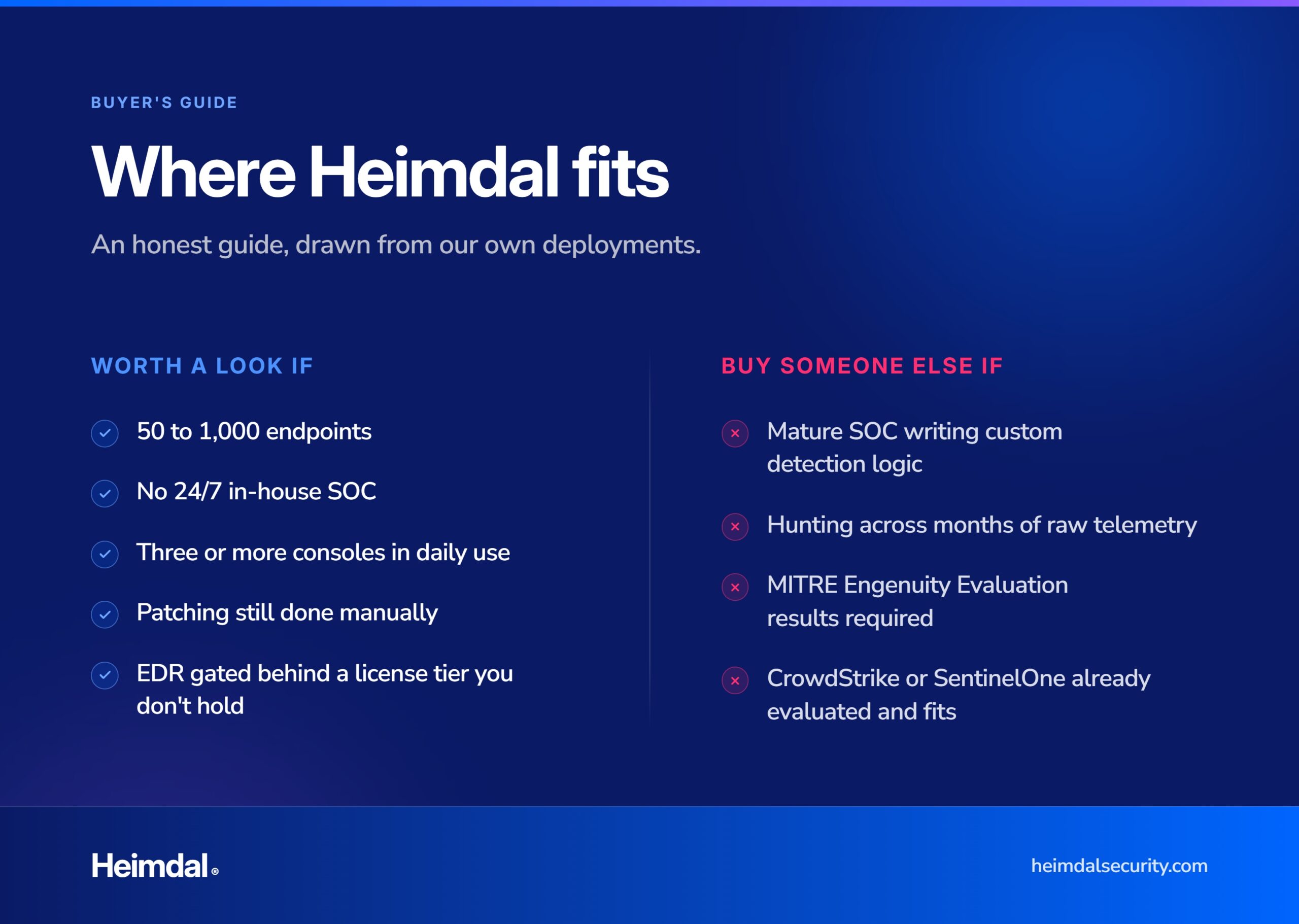
Where we fit, and where we don’t
Worth a look if: 50 to 1,000 endpoints · no 24/7 in-house SOC · three or more consoles in daily use · patching done manually · EDR behind a license tier you don’t hold.
Buy someone else if: you have a mature SOC writing custom detection logic and hunting across months of raw telemetry. CrowdStrike and SentinelOne are built for that work and we won’t pretend otherwise.
Rules of thumb from our own deployments, not published research.
Frequently asked questions
Is Microsoft Defender for Endpoint good enough on its own?
For a Windows-dominant fleet with Plan 2 and someone tuning it, yes. It is a full EPP and EDR platform with automated investigation and vulnerability management, not the basic antivirus its reputation suggests. The failure mode is not detection quality. It is Plan 1 environments assuming they have EDR, and Plan 2 environments never completing the tuning work.
Do I need Microsoft 365 E5 to get Defender’s EDR?
No, but the alternative is a separate line item. EDR lives in Plan 2, which E5 bundles in, or you buy it standalone at about $5.20 per user per month as of mid-2026. E3 includes Plan 1 only, which has next-generation antivirus and attack surface reduction but no EDR, automated investigation, or threat hunting.
What does ESET Endpoint Security cost compared to Defender?
ESET PROTECT Entry is about $42 per device per year and Complete about $58 to $68, as of mid-2026. Standalone Defender Plan 2 is roughly $62 per user per year and covers five devices per user, so Microsoft usually wins on multi-device users and ESET can win on single-device shift or shared workstations. For existing E5 holders the endpoint comparison is zero against ESET’s list price.
Is ESET’s EDR comparable to CrowdStrike or SentinelOne?
Not on threat hunting depth. ESET Inspect covers detection, investigation, and response competently for teams that need EDR rather than a hunting platform, but query flexibility, telemetry retention, and response automation trail both CrowdStrike Falcon and SentinelOne Singularity in available comparisons. ESET’s genuine edge is prevention strength and low system impact, not SOC-grade investigation tooling.
Can ESET and Microsoft Defender run on the same machine?
Technically yes, because Defender steps into passive mode when another registered antivirus takes over real-time protection, and it can still run periodic scans. In practice, running two full endpoint agents costs performance and creates conflicting policy. Pick one as primary. If you want a second layer, choose something that is not another full antivirus engine.
What are the alternatives to both ESET and Defender?
CrowdStrike Falcon for mature SOCs that need deep hunting and threat intelligence. SentinelOne for autonomous on-agent response with less operational overhead. Bitdefender GravityZone for strong lab scores at mid-market pricing with a single console. Heimdal if the missing pieces are DNS filtering, patching, and privileged access alongside endpoint protection rather than a deeper agent.
Does Heimdal have MITRE ATT&CK evaluation results?
No. Our detection rules use MITRE ATT&CK-aligned classification, but we have not participated in the public Enterprise evaluations at the scale ESET, CrowdStrike, and SentinelOne have. As of August 2026 we are working with Forrester and expect a published evaluation. If public MITRE results are a procurement requirement, all three of those vendors have results you can read today.
If you are on M365 E3, is upgrading to E5 worth it for Defender Plan 2?
Only if you will use the rest of E5. The step up costs roughly $21 to $24 per user per month, while standalone Plan 2 is about $5.20. At 300 users that gap is well over $50,000 a year. E5 makes sense when Sentinel, Purview, Entra ID P2, and Power BI Pro are all on the roadmap. Bought for endpoint alone, it rarely does.
The call
Facts you already have settle most of this decision. If E5 is on the invoice and the fleet is Windows, Defender Plan 2 is the defensible answer and the remaining work is tuning it. If you are on E3, running mixed operating systems, or holding hardware that cannot spare the overhead, ESET earns its line item on lab record, agent weight, and deployment flexibility. The trap is upgrading an entire subscription tier to solve one endpoint problem. Price that path fully before you sign.


