



Contents:
SentinelOne Singularity Complete and ESET PROTECT Enterprise both offer endpoint detection and response capabilities, but they start from opposite ends.
SentinelOne builds around autonomous response and rollback. ESET builds around prevention with a light footprint.
This SentinelOne vs ESET comparison uses list and reseller prices from 27 October 2026 and lab rounds from the past 12 months.
Bottom line up front
For a lean team that wants strong prevention plus encryption and mobile protection in one licence, backed by the most recent independent lab results, ESET is the better pick.
For a team with its own security staff that wants autonomous response and ransomware rollback, SentinelOne wins.
Choose SentinelOne if
- You have at least one analyst who can review detections and tune exclusions, and you want the agent to contain and roll back ransomware without waiting for them.
- You protect cloud workloads as well as laptops and servers, and want both on one agent.
- Your procurement process asks for a Leader placement in the 2026 Gartner Magic Quadrant for Endpoint Protection Platforms.
Choose ESET if
- Prevention and low performance impact matter more to you than response automation, especially on older hardware.
- You want full-disk encryption and mobile threat defence in the base licence, not as add-ons.
- You need an on-premises console, an EU-headquartered vendor, or recent AV-Comparatives, SE Labs, and MITRE results to show an auditor.
If your problem is patches pushed out by hand, admin rights never taken back, or nobody on alerts at night, a third route sits further down, and we build it.

SentinelOne
SentinelOne sells its Singularity platform in five tiers:
- Core
- Control
- Complete
- Commercial
- Enterprise
SentinelOne positions Complete “for growing, collaborative teams”.
It includes endpoint protection, device and firewall control, remote shell, cloud workload protection, autonomous prevention, detection, and response, an AI Security Assistant, role-based access control, and 14 days of data retention, according to its platform packages page.
Best for
Mid-market teams with some in-house security capacity who value autonomous response and AI-assisted investigation, and who protect cloud workloads alongside laptops and servers.
A typical fit is a few hundred seats with one or two people who review detections every day.
Key strengths
- The agent detects and responds on the device itself. SentinelOne documents rollback of ransomware changes as a long-standing capability, so containment doesn’t wait for an analyst to log in.
- SentinelOne says one agent covers Windows, macOS, Linux, and cloud workloads at this tier.
- SentinelOne announced in May 2026 that it was named a Leader in the 2026 Gartner Magic Quadrant for Endpoint Protection Platforms for the sixth consecutive year. It also earned AAA in SE Labs’ Enterprise Endpoint Security Q4 2025 round, with 95% protection accuracy, 100% legitimate accuracy, and 98% total accuracy.
- SentinelOne announced general availability of Purple AI auto-investigation in March 2026 and unveiled Singularity ASOC in October 2026. In 2025 it acquired Prompt Security, for GenAI and agent security, and Observo AI, for security data pipelines.
Trade-offs
- Complete keeps 14 days of historical endpoint data, and Commercial and Enterprise keep 90 days. SentinelOne’s Complete page also says incident data for detected malware and fileless attacks is kept for 365 days, with an upgrade to 365 days of historical data available. After two weeks, raw activity from an intrusion that was never flagged may no longer be searchable at the standard level. Identity threat detection and response is also not in Complete and starts at Commercial.
- Managed Threat Hunting and the Agentic AI SOC Analyst are add-ons at Complete, as are Singularity Mobile and RemoteOps Forensics according to SentinelOne’s FAQ. SentinelOne’s packages page shows Managed Detection and Response as not included in Complete and as an add-on from Commercial up.
- SentinelOne didn’t take part in MITRE ATT&CK Evaluations Enterprise 2025 and, in a September 2025 statement, cited a decision to prioritise product and engineering resources. It’s also absent from the named participants in the 2025 to 2026 AV-Comparatives and AV-TEST business tests, and SE Labs’ Q1 and Q2 2026 rounds. That’s a participation choice, not a poor result. It still leaves fewer recent data points for a shortlist.
- The platform is primarily SaaS. SentinelOne’s FAQ mentions an on-premises appliance, but you’ll need to confirm with the partner if it is available at Complete.
Pricing
As of 27 October 2026, SentinelOne lists Singularity Complete at $179.99 per endpoint per year for 5 to 100 workstations on its platform packages page. Commercial is $229.99 and Enterprise is priced through sales.
SentinelOne sells through authorised partners and states that displayed prices aren’t final and may exclude taxes, so treat the list figure as the starting point for a partner quote.
Price is the hardest part of this SentinelOne ESET comparison, because ESET shows no US Enterprise price to set against it.
ESET
ESET, headquartered in Slovakia, sells ESET PROTECT in tiers from Entry through Advanced, Complete, Enterprise, and Elite, with MDR tiers above those.
According to ESET’s tier documentation, Enterprise is the first tier with ESET Inspect.
ESET’s Enterprise page describes the tier as “Extended detection and response (XDR) that delivers enterprise-grade visibility, threat hunting and response options.”
It’s managed from a cloud or on-premises console.
Best for
Small and mid-sized organisations that put prevention and low overhead first, want encryption and mobile protection in one licence, or need an on-premises console or an EU-headquartered vendor.
A typical fit is a firm of under 250 seats with a generalist IT team and no one watching alerts full time.
Key strengths
- In AV-Comparatives’ Business Security Test H1 2026, ESET scored 98.8% real-world protection and 99.2% malware protection, with zero false alarms on business software. In the August to September 2026 factsheet it was the only product with both 100% real-world protection and zero false alarms.
- The agent is light. The same H1 2026 test measured the lowest performance impact of the 16 products tested, with an impact score of 3.7. In AV-TEST’s December 2025 business round, ESET PROTECT Advanced scored 17.5 out of 18.
- Full-disk encryption, mobile threat defence, LiveGuard Advanced cloud sandboxing, and cloud workload protection are all included from the Advanced tier up, so they come with Enterprise.
- ESET Endpoint Security earned AAA with 100% total accuracy in SE Labs’ Enterprise Q1 2026 round.
Trade-offs
- AV-Comparatives tested ESET PROTECT Entry with detection responses set to “Aggressive”, and AV-TEST tested Advanced. Neither test used Enterprise with ESET Inspect, so those results describe prevention, not investigation workflow. The AV-Comparatives EPR Test 2026 did test ESET PROTECT Enterprise Cloud with ESET Inspect, and ESET was a Certified Leader.
- Vulnerability and patch management, mail and cloud app protection, MFA, ESET LiveAI, and ESET MDR are add-ons at Enterprise. Per ESET’s documentation, patch management needs the cloud console, and on-premises versions 11.1 and later don’t support MDM.
- In its own reading of MITRE’s 2025 results, ESET reports 100% protection but 66.67% detection.
Pricing
ESET’s US Enterprise page shows no Enterprise price as of 5 November 2026 and points visitors to a “new equivalent”. The only price on that page, $1,030 for 10 devices, is for Premium.
The CDW Canada listing shows a one-year Enterprise licence extension at $87.99 per seat in the 100 to 249 band. The page shows a dollar sign without naming the currency, so we read it as Canadian dollars. Checked 5 November 2026.
On ESET’s US subscription plans page, Premium with 24/7 MDR costs $1,030 for 10 devices for a year, about $103 per device by our calculation, and Core costs $549.
ESET’s Enterprise page describes Premium as “Everything in Enterprise, and:” plus extras, and its Premium page lists a “Detection & Response” module.
Its plans page describes Premium as “Everything in Core, and:”. None of the pages names ESET Inspect, so ask ESET in writing what Premium includes.
A price check of SentinelOne Singularity vs ESET PROTECT needs a written quote from each side.
SentinelOne vs ESET, where each one wins
SentinelOne wins if someone on your side will act on what it finds. Its case rests on response.
The agent contains and rolls back ransomware on the device, covers cloud workloads at the same tier, and carries a 2026 Gartner Leader placement if your procurement process asks for one.
A 600-seat company with two security engineers and a mix of laptops and cloud servers gets more from that than from a lighter agent.
The condition is budget. If you need identity threat detection or more than 14 days of historical data, price Commercial at $229.99 per endpoint, not Complete, or ask about the retention upgrade.
ESET wins when prevention and evidence matter more than response automation.
It has the deeper independent record from the past 12 months, the lowest measured performance impact in AV-Comparatives’ H1 2026 test, and encryption, mobile threat defence, and sandboxing inside the licence.
No lab tested both products in the same round, so any ESET vs SentinelOne score comparison sets one test against another. ESET simply appears in more of them.
The ideal buyer is an 80-person firm on five-year-old laptops, with one IT generalist and an auditor who wants named lab rounds.
Both products share one gap. Neither includes around-the-clock monitoring at these tiers.
SentinelOne’s packages page shows Managed Detection and Response as not included in Complete. ESET sells MDR as an add-on to Enterprise.
If nobody on your team reads alerts overnight, you will need a managed monitoring service (MDR) on top of either product. Decide how you will get that before you choose between them.
Choosing by situation
The best EDR solution on paper does little for a 40-person firm if nobody reads its alerts. These routes start from your situation, and several lead away from both products.
If you have no security staff, look at ESET PROTECT Premium, which bundles 24/7 MDR at $1,030 for 10 devices a year as of 27 October 2026. Confirm ESET Inspect access before you sign.
If your company runs on Microsoft 365 and has fewer than 300 users, start with Microsoft Defender for Business at a US list price of $3 per user per month as of 5 November 2026, which covers up to five devices per user. Move only when a specific gap appears.
If you need identity threat detection or 90 days of telemetry, price SentinelOne’s Commercial tier at $229.99 per endpoint per year, or ask about the retention upgrade on Complete.
If a no-cloud policy or data-residency rule applies, shortlist ESET with its on-premises console, and plan for patch management and MDM sitting outside it.
If your fleet includes old or underpowered hardware, test ESET first. It had the lowest measured impact of 16 products in AV-Comparatives’ H1 2026 test.
If prevention scores lead your shortlist, add Bitdefender GravityZone to the same proof of concept. It had the top malware protection score, 99.8%, in AV-Comparatives’ August to September 2026 factsheet and was a Certified Leader in the EPR Test 2026.
A third option, if detection isn’t your main problem
SentinelOne and ESET are two answers to the same question: which software can detect and stop an attack on a laptop or server?
None answers to an equally important question: who installs patches, removes unneeded admin rights and watches alerts overnight?
Neither SentinelOne Complete nor ESET Enterprise includes patching, admin-rights control or overnight monitoring, though ESET sells patching and MDR as add-ons.
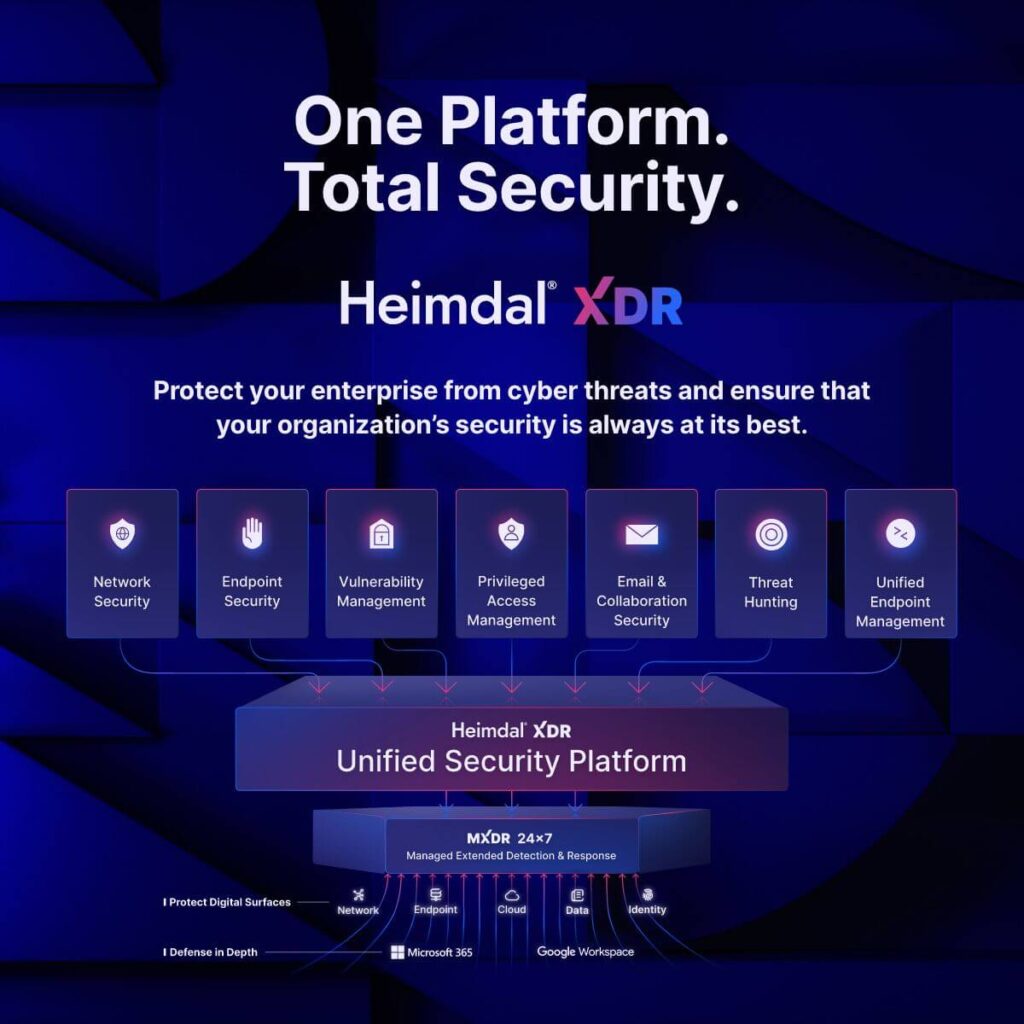
A vendor to cover all that is Heimdal. Its unified but modular platform allows the user to pick and choose exactly the tools and services they need. Here are some of the modules in their stack:
- Patch and Asset Management for OS and 350+ third-party apps
- PEDM, PASM, and Application Control with AppFencing™
- Next-gen antivirus
- EDR
- Ransomware Encryption Protection
- DNS Security for network and endpoint
- Email Security
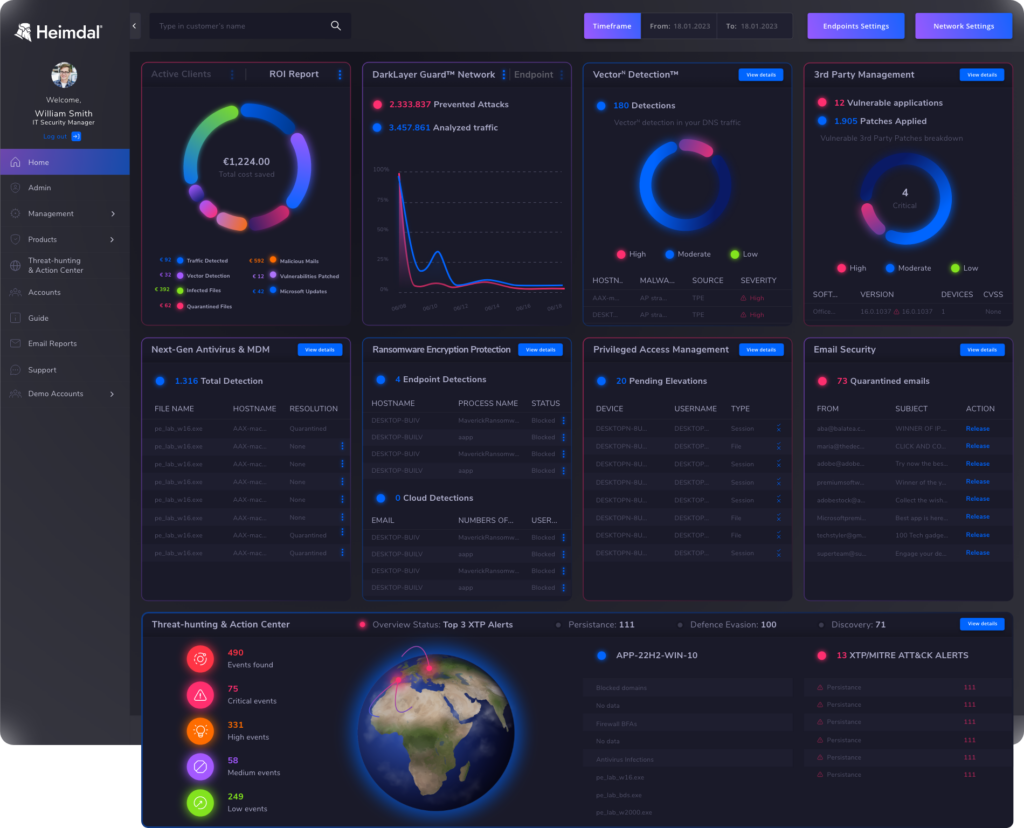
The XDR platform brings them all onto the same dashboard and a 24/7 SOC service (MXDR) makes sure someone’s always on guard.
Where Heimdal fits
Heimdal fits best for companies with 200 to 1,000 endpoints, who need to automate patching and get better control on their admin rights and AI usage, but don’t have a 24/7 in-house SOC.
For a closer look, see how Heimdal compares with SentinelOne in detail. It is Heimdal’s own page, so read it as a vendor’s view.
Making the call
The SentinelOne vs ESET decision turns on who answers the alerts in your company.
Neither SentinelOne Complete nor ESET Enterprise includes round-the-clock monitoring, so settle who will watch and respond overnight before you sign for either product.
Frequently asked questions
Which is better, SentinelOne or ESET?
SentinelOne, if you have security staff who will use autonomous response, ransomware rollback, and cloud workload coverage.
ESET, if you’re a lean team that puts prevention, low performance impact, and included encryption first. ESET also has more independent test results from the past 12 months.
The deciding question is who will act on alerts, so answer that before comparing features.
SentinelOne vs ESET for small business, which makes more sense?
In practice, ESET is the easier fit for a small business without dedicated security staff. Its licence includes full-disk encryption and mobile threat defence, it had the lowest measured performance impact in AV-Comparatives’ H1 2026 test, and US buyers can get 24/7 MDR bundled in the new Premium plan.
SentinelOne’s Complete tier is listed from five workstations and suits a small team with someone to tune exclusions and review detections.
If you liked this article, follow us on LinkedIn, Reddit, X, Facebook, and Youtube.


Cristian is a Content Editor & Creator at Heimdal®, where he developed a deep understanding of the digital threat landscape. His style resonates with both technical and non-technical readers, proof being in his skill of communicating cybersecurity norms effectively, in an easy-to-understand manner.


