



Contents:
As cyber threats multiply and data breaches keep making the news, most security teams are running more tools than they can comfortably manage.
That’s the appeal of a cybersecurity platform.
One place to run your security, with visibility across everything, instead of stitching together a dozen point tools and hoping they talk to each other. In this list of top cybersecurity platforms for 2026, we compare 11 that stand out, and where each one fits.
A quick note on bias. Heimdal builds one of the platforms on this list, and we’ve put it first. We’ve still worked to describe every vendor accurately and fairly, so you can weigh the field for yourself.
Who are the top cybersecurity platforms?
Plenty of vendors describe themselves as a cybersecurity platform. Only a handful bring genuinely comprehensive cover under one console. Here are the standouts, our own first and the rest in alphabetical order:
- Heimdal XDR
- CrowdStrike Falcon
- Huntress
- Mandiant (Google Threat Intelligence)
- Microsoft Defender XDR
- Palo Alto Networks Cortex
- Qualys Enterprise TruRisk
- SentinelOne Singularity
- Sophos
- Trellix Helix Connect
- Trend Vision One
We’ve focused on 11 of the standout platforms here. Others worth a look include Fortinet and Check Point.
What Is a Cybersecurity Platform?
A cybersecurity platform is built to unify your security tools into one environment, with one console, one data model, and one place to manage everything. Instead of separate products for endpoint protection, network security, cloud security, and email, a cloud-based platform brings them together so your team works from a single view.
Most cybersecurity solutions started life as point products, and a genuine platform is the opposite of that.
Done well, a cyber security platform shrinks your attack surface and cuts the time your team loses moving between screens. It’s quicker to learn, needs fewer people to run, and gives you the visibility to spot a problem before it becomes a breach.
What to look for when selecting the right platform
The clearest test is coverage. A real platform should handle all five core security functions, identify, protect, detect, respond, and recover, the set the NIST framework lays out. If it can only do some of them, it’s a strong product rather than a full platform.
After that, a few things separate the genuine platforms from the labels.
- How well do the pieces actually integrate, rather than just sharing a logo?
- Does it fold in the essentials, vulnerability management, threat detection and response, and incident response, without a pile of add-ons?
- Is it open, with APIs to bring in the tools you already run?
- And can your security team actually operate it day to day?
11 Best Cyber Security Platforms on the Market in 2026
The market for cybersecurity platforms is still emerging, and there is only a fairly limited number of true platform providers. Here, we’ve listed 12 of the leaders in this field.
1. Heimdal XDR (+MXDR)
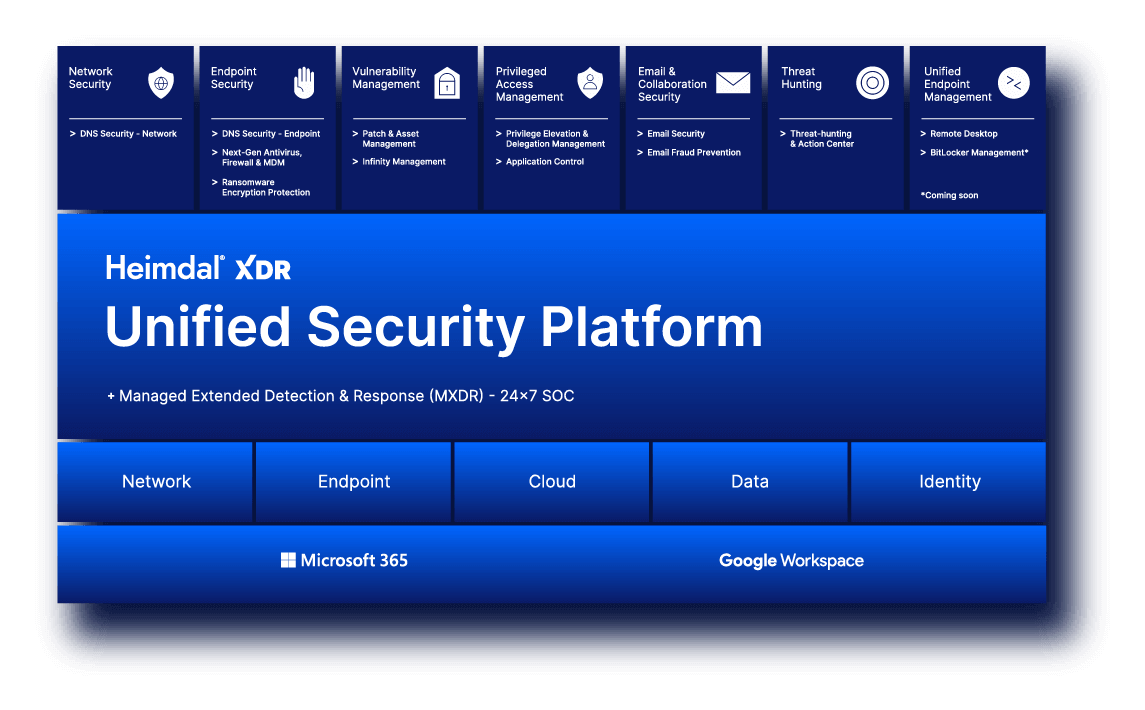
Heimdal XDR is our own unified platform, so treat this as the house view. It covers the five core functions and adds privileged access management, vulnerability and patch management, email and collaboration security, network security, and threat hunting, all under one console.
Its detection and response is backed by round-the-clock threat monitoring, and you can integrate data from third-party tools through its APIs, so it sits alongside what you already run rather than forcing a rip-and-replace. For a lot of teams, that native breadth in one place is the draw.
I like the online management, the complete package of all security applications needed, all-in-one place.
2. CrowdStrike Falcon
CrowdStrike’s Falcon platform covers most of the core functions and is best known for putting artificial intelligence to work, watching how things behave rather than leaning on signatures, with machine learning trained on a huge threat data set.
It pairs endpoint security with identity and cloud in one broad, mature platform, with a well-regarded team of analysts behind its managed tiers. The trade-off tends to be cost and a pull toward standardizing on one vendor.
It is a robust cloud-based endpoint protection tool that offers excellent features and protects our data from unknown threats.
With so many cybersecurity solutions on the market, understanding how top platforms compare is essential for making informed choices.
To give you a head start, we’ve included a video comparison of CrowdStrike vs. SentinelOne—two leading names in the industry.
The video highlights their core strengths, pricing models, and performance differences, offering valuable context as you explore the broader list of must-know platforms for 2026.
3. Palo Alto Networks
This is one of the broadest platforms on the list. The Cortex line handles security operations, now led by XSIAM, its AI-driven answer to the SIEM, with Cortex XDR for detection and response. Add its network and cloud platforms and the 2025 CyberArk acquisition for identity, and it covers a lot of ground.
The flip side of that reach is enterprise-scale complexity and cost.
Cortex XDR is a fantastic utility provided by Palo Alto Networks. It has a vibrant interface and is easy to use. It offers unique features like Anti-Exploit protection along with Anti-Malware protection.
You might like: Sophos vs. Palo Alto: Intercept X vs. Cortex XDR
4. Mandiant, now Google Threat Intelligence
Mandiant is the odd one out here, and it’s fair to say so. Now part of Google Cloud and branded Google Threat Intelligence, it’s a threat intelligence platform built on frontline incident response rather than a full stack of protective tools.
Think of it as a cybersecurity mesh, intelligence and expertise plus managed threat detection, that you lay across your existing tools rather than a platform that replaces them. Because it’s product-agnostic by design, it isn’t a full platform.
For depth of threat intelligence, though, few names carry more weight, and its analysts are among the most respected in the field.
It is a pretty robust solution which helps you find detailed information about threat actors and tactics used by them.
5. Microsoft Defender XDR
It integrates Microsoft’s tools into one platform, spanning endpoint, identity, email, and cloud apps, with Defender for Endpoint at its core and Sentinel available for SIEM. With Microsoft’s resources behind it, it covers most of what an organization needs, and it’s an easy call for teams already living in the Microsoft ecosystem.
Teams running a lot outside that ecosystem tend to get less from it.
This is a solution [that is] perfectly compatible with the Windows operating system. This makes it easy to configure and manage for people familiar with Microsoft tools.
6. Trellix Helix Connect
Trellix Helix Connect is Trellix’s open XDR and SIEM platform, built for security operations. It correlates data from Trellix’s own security controls and more than 490 third-party integrations across 230 vendors, so you can bring in what you already own without ripping anything out.
Deployment is quick, and its pre-built rules and analytics are designed to surface detections within hours of going live, which appeals to teams that don’t have months to spend on detection engineering.
Helix has been a great product. It provided quite a bit of flexibility on tuning and integration. We onboarded a large volume of data sources.
7. SentinelOne Singularity
SentinelOne’s Singularity platform ingests data from a huge range of endpoints and sources and uses AI to identify threats, with automated threat response built in.
Recovery is a genuine strength, its patented one-click rollback reverses an attack’s changes and restores endpoints to their pre-attack state, which matters most against ransomware. It’s a real platform across endpoint, cloud, and identity, and it leans on its Singularity Marketplace to connect the tools it doesn’t cover natively.
Easy to understand and use. It detects threats and provides visibility over the network. It also does threat hunting. Implementing it with other security devices is also feasible.
Read next: CrowdStrike vs. SentinelOne
8. Huntress
Huntress made its name in managed endpoint detection and response for small and mid-sized businesses, and it has grown well past that.
Alongside managed EDR, it now runs its own managed SIEM, identity threat detection and response for Microsoft 365, and security awareness training, with security analysts widely rated among the best around. It’s still narrower than the enterprise platforms on this list, but endpoint-only no longer describes it.
We have peace of mind that someone is looking at everything 24/7, and the portal gives us all the information we need.
9. Qualys Enterprise TruRisk
Qualys Enterprise TruRisk is built around risk. It finds your most exposed assets and misconfigurations through continuous vulnerability management and attack surface management, ranks them by real-world risk, and helps you fix them fast, with built-in patch management and compliance.
It’s more a risk and exposure management platform than a full detect-and-respond one, but it strengthens your security posture across a lot of what teams deal with every day.
Enabled us to manage, view, and control all devices and endpoints in our organizations and sort them in various ways, push scripts selectively based on group, and generally keep things organized.
10. Trend Micro Trend Vision One
Trend Micro’s Vision One is one of the more complete platforms here, spanning endpoint, network, hybrid cloud security, and email in a single console, with AI-driven detection and protection against advanced threats.
The long-standing knock on it is pricing. Its credit-based model, where you spend credits per endpoint, app, or tool, can be hard to predict, though Trend Micro now offers fixed per-endpoint tiers alongside it if you’d rather have a set price.
Personally I consider that Trend Micro Vision One has a lot of functionalities that we can access easily, allowing us to have a lot of possibilities to view and monitor the cyber risk and the surface attack.
Suggested: Trend Micro Vision One Vs SentinelOne Singularity XDR
11. Sophos
Sophos retired its Intercept X brand in late 2025, and the current line-up, Sophos Endpoint, XDR, and MDR, reflects how far the platform has grown.
Far from endpoint-only, it spans firewall, network detection and response, ZTNA, email, cloud, and identity, all managed from Sophos Central, with a 24/7 MDR service and threat hunting on top. It’s a strong fit for teams that want breadth from a single vendor, and it rates consistently well with customers.
Overall experience of using Intercept X is [that it’s] worth the price. It endlessly protects our organization from the threats. It automatically detects and prioritize potential threats [so we can] quickly see where to focus and know which machines may be impacted.
Related: SentinelOne vs. Sophos: Singularity XDR or Intercept X?
Cybersecurity Platforms: An Emerging Market
The direction of travel is clear.
Teams are tired of running multiple security tools and juggling separate security services, and platforms are how they’re cutting that number down. The catch is that plenty of cybersecurity software gets sold as a comprehensive cybersecurity platform when it’s really a strong product with a few add-ons, so it pays to check against the five core functions before you trust it.
Traditional security stacks weren’t built for today’s modern threats, and modern security means covering prevention right through to response. The payoff is unified security instead of a pile of disconnected tools. With native breadth across that whole range, Heimdal is one of the few we’d call genuinely complete, but the honest test is which one fits you.
Book a demo and put it up against what you run today.
Frequently Asked Questions About Cybersecurity Platforms
Is an XDR the same as a cybersecurity platform?
Not quite. It focuses on threat detection and response across your environment. A full platform goes further, adding things like patch and asset management, email security, and privileged access, so it covers prevention and recovery too, not just detection and response.
Is a cybersecurity platform the same as a cybersecurity management platform?
Often, the terms are used interchangeably. However, they do differ slightly. Where they differ, a management platform oversees your security, with central visibility, policy control, and compliance reporting, while a cybersecurity platform also does the protective work itself, from prevention through to response and recovery.
Who should use a cybersecurity platform?
Most organizations benefit, but the fit is clearest for managed service providers (MSPs) and managed security service providers (MSSPs) juggling many customers, SOC teams at larger businesses, and lean IT teams at smaller companies that need broad cover without broad headcount.
Which is the best cybersecurity platform?
There isn’t a single best platform. The right one is whatever fits your environment and the risks in front of you, which is why this article compares the field rather than crowning a winner.
We’re hardly neutral here, so here’s the honest case for Heimdal XDR. It brings everything from prevention through to response into one platform, with a broad set of native tools, patch and asset management, privileged access, DNS security, email security, vulnerability management, and threat hunting among them, plus open APIs so you can plug in what you already run. For a lot of teams, that native breadth under one roof is what makes the difference.
The fairest way to judge it is against your own stack. Book a demo and put it up against what you’re running today.


