


 Network Security
 Vulnerability Management
 Privileged Access Management
  Endpoint Security
 Threat Hunting
 Unified Endpoint Management
 Email & Collaboration Security



Contents:
Without the right tools, no security operations centre (SOC) can do its job properly. A SOC platform brings together a range of security technologies that let your analysts rapidly identify threats, investigate them and implement fixes.
There are many cybersecurity tools that an SOC can use, and there are many vendors selling comparable products. The choice of tools for your security stack depends on the threats you face and your organisation’s maturity.
So, how do you decide on which tools to include in your SOC platform, and how do you decide between vendors? There isn’t a single answer here. With AI now entering the security operations conversation, and new SOC providers emerging every year, the landscape has only grown more complex. Rather, it’s about working out what’s best for you.
This guide is intended to give you pointers on what you should consider in 2026, and introduces some of the key vendors of SOC platforms.
Transparency. Heimdal offers a range of tools that could be used to build a SOC platform. While we have ‘skin in the game’, this article aims to provide an objective overview.
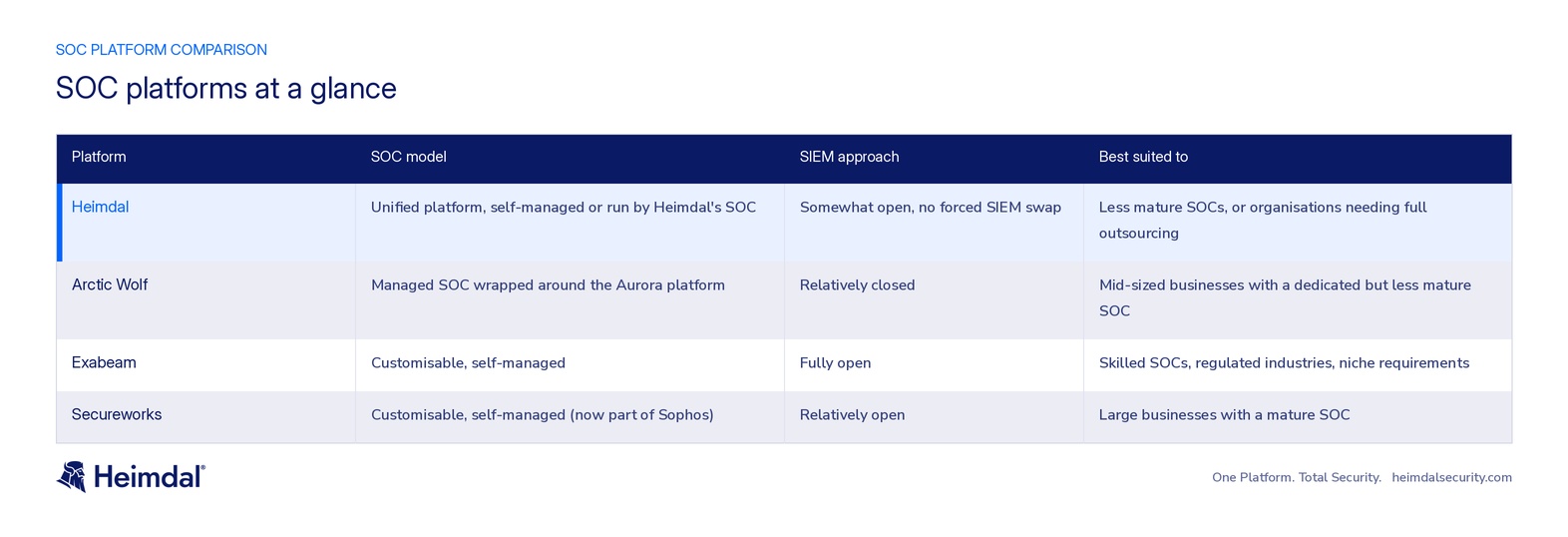
Bottom line. There’s no single best SOC platform. The right one depends on how mature your SOC is, and whether you want to run it in-house or hand it to a managed service. Here’s the short version.
- Heimdal. A unified platform you can self-manage or hand to Heimdal’s SOC. Best if your SOC is less mature, or you want to outsource it entirely.
- Arctic Wolf. A managed SOC built on the Aurora platform. Best if you want it run for you and have analysts to act on its guidance.
- Exabeam. A customisable, self-managed SIEM with strong analytics. Best for skilled teams and regulated industries.
- Secureworks (now part of Sophos). The most open platform of the four. Best for larger businesses with a mature SOC.
What is a SOC platform?
A SOC platform is the combination of tools your organisation uses to monitor threats against your assets and respond to them. To be considered a ‘platform’, you should have one central solution, a SIEM (Security Information and Event Management system), that works as a ‘single pane of glass’ where you can see data from all your cybersecurity tools and orchestrate your response across them.
Different types of organisation will require different things from their SOC platform depending on their size and the kinds of threats they face.
For example, a small retail chain may only need something fairly simple, a firewall, antivirus and an EDR, plus a SIEM tool to bring all that data into one place. By contrast, a large hospital might need all of the above, plus threat hunting, threat intelligence, XDR, SOAR platforms and beyond.
Your SOC platform will also evolve over time, as your organisation grows, your security posture matures and new cyberthreats emerge.
What to think about when planning a SOC platform
When you’re thinking about building out a SOC platform, there are a few key things to bear in mind when comparing vendors and individual tools.
Pureplay vs multi-vendor
With a pureplay model, you exclusively use the security tools of a single vendor. They will typically offer a SIEM plus a range of tools that sync up with that central system. The advantage is that it’s smooth and everything just works. The drawback is that you might not get all the tools you want, and could end up in a vendor lock-in situation.
With a multi-vendor model, you integrate different cybersecurity tools from various vendors into a central SIEM of your choice. This means you can keep the existing tools you want. But it requires a bit more integration work to get them all ‘talking’ together.
Configuration and alert fatigue
A modern SOC needs to find a balance between broad telemetry on one hand, versus alert fatigue on the other. The more logs you monitor with more tools, the higher the chances of this generating alerts, including false positives. This results in more triage work for your SOC analysts, and can result in alert fatigue.
It’s a really fine balance because, if you don’t monitor enough threats, then you could get breached. But monitor too much, and your SOC teams will be drowning in notifications and unnecessary investigations.
As a general rule, it’s best to start monitoring your most important assets. Clear triage workflows and a degree of automation, with a clear audit trail, helps here, so your analysts spend their time on real detections rather than chasing noise. Once you have your processes and tools up and running, you can expand your monitoring surface.
Response model
Some SOC platforms just provide you with a notification that something suspicious or malicious has been detected. You then use your own processes and knowledge of your organisation’s unique needs to respond.
Other platforms are set up to respond to threats for you. They run automated playbooks that close down possible breaches according to predefined rules.
There really isn’t a ‘right’ way of doing things here and it totally depends on your organisation’s specific situation and needs. Either way, the response model you choose shapes your whole investigation and response workflow, and the better platforms let you tune their playbooks and remediation steps to fit your own SOC workflows.
Managed SOC platform vs in-house
Some vendors offer managed SOC where their own analysts will do the monitoring, triage and response for you, 24/7. This can be a good option if you don’t have the skills or staff to do it all yourself. The drawback is that vendors will never understand your business as well as you do.
The alternative is for your own in-house SOC team to deploy and use the tools themselves. Your analysts will need training and onboarding, and this will take longer. But you get a much more tailored platform.
SOC platform comparisons
It can be helpful to compare different SOC platforms to get a sense of the kinds of operating models they support.
We’ve compared four of the best SOC platforms for 2026 to give you an idea of the range of options out there. There are, of course, dozens of other cybersecurity companies whose tools could also be used to build a SOC platform.
Profiles of SOC platform providers
There are numerous cybersecurity companies whose tools can be used to build a SOC platform. Each vendor offers a different ‘flavour’ of platform, and they can each be modified and configured to your specific needs.
Below, we’ve profiled four vendors whose tools could let you build out a SOC platform. As noted above, there are many other suppliers whose tech could also be used by your SOC. These profiles are intended to give you an idea of the different approaches available.
Best SOC Platforms – Top 4
1. Heimdal
Heimdal’s Threat Hunting & Action Centre is a native SOC console that can blend SIEM and SOAR functions for detection and response. You can use it as a standalone SIEM, but it will also integrate with any existing investments you may have made.
The company’s approach is rather different to other vendors, in that they provide a suite of security tools in their ‘unified’ platform. You get a unified platform of SOC tools in one place, and can either use them all together as your primary SOC platform, or simply pick and choose tools and connect them to your SIEM.
Heimdal also offers an optional managed service that operates as an outsourced SOC.
Advantages
- Highly flexible approach, you can pick and choose individual tools, use the entire suite or outsource your SOC depending on your needs
- No forced SIEM replacement, you can keep using third party tools if you wish
- Live process tree and one-click remediation directly from the SOC console
Disadvantages
- Less suitable if you already have a well-established in-house SOC environment
- Interface requires onboarding and training
- As a newer SIEM, its detection engineering and customisation are less deep than long-established platforms
2. Arctic Wolf
Arctic Wolf’s approach is to provide a managed SOC platform. You get their powerful Aurora agentic SOC that draws in data from Arctic Wolf’s own security tools, as well as any other external apps you use through its integrations. The company then offers a ‘concierge experience’, where their 24/7 SOC will monitor all this data for you and alert you to malicious or suspicious events and guide you on how to respond.
Because the responsibility for responding to breaches lies with the customer, it’s important to have a reasonably experienced team of analysts in your own SOC who can implement Arctic Wolf’s recommendations.
Advantages
- Ideal if you want a managed SOC platform
- Powerful combination of AI agents and human experts
- AI agents customised to customer business context
Disadvantages
- Requirement to replace any existing SIEM with Arctic Wolf’s platform as part of the service
- Limited raw log export
- Guided response, customers responsible for enacting recommendations
3. Exabeam
Exabeam is a SIEM-native vendor, meaning their core SIEM platform is built from the ground up. Their tool provides extremely powerful, cloud-based capabilities and customisable detection engineering. The SIEM would work as the foundation of your SOC platform, and you could then connect Exabeam’s other security tools or those of third party vendors.
Exabeam’s solution is highly customisable, so it requires a skilled SOC team with the know-how to configure it to gather the right information.
Advantages
- Ideal for experienced SOCs or teams in regulated industries
- Open API can draw in data from third-party security tools
- Highly regarded behavioural analytics tools
Disadvantages
- Less suitable if you want a managed layer
- You would need to replace any existing SIEM with Exabeam’s platform
- Requires skilled and experienced analysts to configure
4. Secureworks
As of February 2025, Secureworks was acquired by Sophos and their Taegis platform is being consolidated into Sophos Central.
The Taegis platform is a highly flexible and interoperable platform that can integrate threat information from across any third-party security tool. It is perhaps the most open platform, in that it can integrate telemetry through hundreds of integrations with endpoint, network, cloud, email, identity and business apps.
You can either use Taegis as your SIEM, or connect it to an existing SIEM. Its ability to integrate data from such a wide range of logs makes it attractive to larger organisations that already have a well established SOC, but want a clearer way of managing all that data.
Advantages
- Very interoperable, meaning it can slot easily into your existing SOC and serve as an overall visibility layer
- Ingests and correlates data from across your entire attack surface into a single data lake
- Supports automatic response playbooks
Disadvantages
- Less suitable for smaller businesses or organisations without a mature SOC
- Steep learning curve
- Less customisable than some competitors
Choose the best SOC platform for you in 2026
There is no single SOC platform that’s right for every organisation. The choice of platform depends on various considerations, including:
- Your existing security tooling investments
- Your SOC team’s skills, experience and know-how
- The size of your organisation
- The kinds of assets you need to protect
- Whether or not you are a regulated business
- The types of threats you’re facing
- Your appetite for AI-assisted workflow automation, whether you’re adding AI gradually to an existing stack or want broad automation coverage across detection, triage and response from day one
As this article has shown, different security vendors can support different kinds of needs and scenarios.
At Heimdal, we’ve prioritised a highly flexible ‘pick and choose’ approach, which means our tools can integrate well with many kinds of SOC operating model.
You can use our unified security platform as a complete SOC operations environment, giving you a SIEM, SOAR, EDR, AV, threat hunting, detection and response, automated playbooks, and all the other tools you might need. But you can also connect our award winning tools to an existing SIEM you’re already using.
Interested to see how it works? Contact us today for a demo, or learn more about our Threat-hunting & Action Centre.
FAQs about SOC platforms
SOC platform vs SOC-as-a-service vs SIEM
These are three distinct approaches that security teams may wish to use. A SOC platform gives you a central hub to integrate all your security data, alert you to threats through continuous threat detection, and also provides you the tools to investigate and respond to them. SOC-as-a-service is a way of outsourcing your security operations centre to a managed services provider or software vendor who will manage it all for you. A Security Information and Event Management (SIEM) is a type of security technology that records event logs across your IT environment and can identify suspicious activity and alert you to it.
Do you need a SIEM if you buy a SOC platform?
Most SOC platforms include a SIEM, so you shouldn’t need to buy a separate one from a different vendor. That being said, if you are building out a highly customised SOC with tools from various security vendors, then you would of course need to invest in a SIEM too.
What does “managed SOC” actually include?
If a supplier is offering a managed security operations centre, it means they will provide analysts, technology and processes to monitor your environment for threats. Different suppliers will offer quite different levels of service. Some are fairly passive, they will simply monitor for threats and send you an email if they notice something suspicious. Others are more active, and include threat-hunting, incident response, training or consulting as part of the service. Some will give you step-by-step guidance for resolving a problem, while others will automatically remediate it for you. When choosing a managed SOC supplier, it’s important to make sure all parties have a clear understanding of what the service involves.


