



Contents:
TrendAI Vision One is a hugely successful cybersecurity solution. The technology counts tens of thousands of customers worldwide, and has received high marketplace rankings by the likes of Gartner and IDC. Nevertheless, it’s not always right for everyone.
If you feel you need a different provider, this guide is for you. We’ve compiled a list of six alternatives to TrendAI Vision One (previously known as Trend Micro Vision One) that might better suit your needs.
In this guide, we’ll explore why businesses start looking for TrendAI Vision One alternatives, key things to consider when looking for other providers, and a list of six options:
- Heimdal
- Microsoft
- Palo Alto
- Cisco
- SentinelOne
- CrowdStrike

Time for an alternative to TrendAI Vision One?
Broadly speaking, there are two reasons companies look for alternatives to TrendAI Vision One.
1. Dissatisfaction with the platform itself
While it is undoubtedly a powerful solution, TrendAI Vision One users often tell us the software comes with a number of common limitations:
- Challenging user experience: The TrendAI Vision One platform comes with a steep learning curve. Many users also mention its cluttered and confusing interface.
- Licensing complexity: You can use almost any TrendAI Vision One tool by using credits that are paid for upfront. This gives flexibility, but also makes costs difficult to manage and predict. This can mean pricing can end up significantly higher than initially expected.
- Heavy agent footprints: Users often find that the use of multiple agents can affect system performance.
2. Or a change in strategy
Perhaps the most common reason that companies look for TrendAI Vision One alternatives is because of a change in cybersecurity strategy.
Trend’s platform is primarily a type of threat intelligence, they call it a ‘cyber risk exposure management’ or ‘CREM’, and extended detection and response (XDR) platform. It also has an AI security solution and a number of data, cloud, email, identity and network security add-ons.
This means the platform covers quite a lot of what an organisation needs, but not everything.
So, you have two options:
- Invest in a broader solution that covers more attack surfaces
- Invest in a direct competitor that may offer a better UX, clearer pricing, customer services or some other measure
What to consider when comparing TrendAI Vision One alternatives
I always recommend speaking to a variety of cybersecurity vendors when you’re thinking about switching. You’ll have your own priorities, but there are a number of considerations it’s worth checking with all vendors.
- Endpoint detection quality: Request data on false positives, attack story reconstruction methods and independent scores from MITRE ATT&CK or similar evaluations.
- Response actions: Verify that the vendor supports isolation, user/account disablement, rollback and identity management actions.
- Offline behaviour: What can agents do to monitor and control activity on a device when it is offline?
- Telemetry coverage: What’s covered across the network, cloud, third party apps, legacy tech, user logins etc.?
- Integrations: Does the solution integrate with a wide range of third party apps or are you required to use only their solutions?
- Deployment effort: What is the learning curve like? How long do deployments for organisations of your size typically take?
- Commercial model: What’s the pricing like? Not only for upfront license costs, but also for installation, extra packages or tiers for additional features.
- Data governance: Where is the data stored and processed, and does it comply with your regulatory requirements.
6 alternatives to TrendAI Vision One
As mentioned above, organisations often start looking for TrendAI Vision One alternatives for one of two reasons:
- Looking for a more comprehensive cybersecurity platform
- Looking for similar tools but ‘better’ in one way or another
We’ve divided our list of TrendAI Vision One alternatives into two groups to reflect these different motives for changing.
The first four TrendAI Vision One alternatives expand your cybersecurity defences by giving you a broader platform. The final two alternatives are more of a like-for-like swap.
1. Heimdal XDR
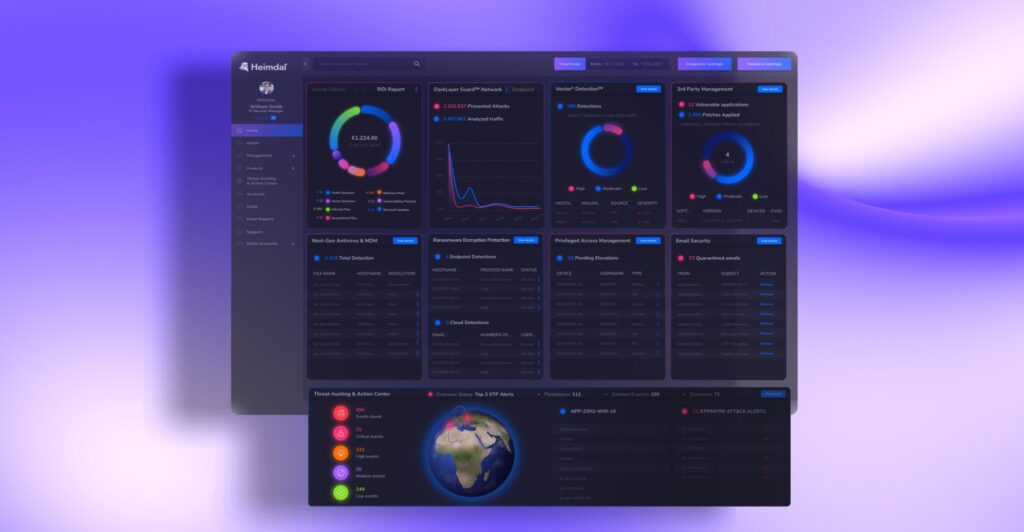
Heimdal’s XDR is a powerful platform with a single lightweight agent that monitors your organisation’s endpoints, devices, network and cloud apps.
Like TrendAI Vision One, Heimdal’s XDR gives you powerful, AI-driven detection abilities, a threat intelligence solution, threat hunting and automated remediation and response.
Where it differs is in the breadth of the platform. Heimdal XDR fits within Heimdal’s wider unified cybersecurity platform. Some of the available modules are:
- Patch and asset management
- Email and collaboration security
- Network security
- DNS security
- Antivirus
- Firewall
- Ransomware encryption protection
- And beyond
You can simply add these modules onto your package, as and when you need them. They work seamlessly together and can all be accessed easily from the same central dashboard. That reduces the learning curve and means you avoid needing to connect multiple point solutions from third party providers.
Heimdal XDR also covers both Microsoft 365 and Google Workspace. It also allows you to integrate data or tools from many other cybersecurity vendors.
Pricing: Heimdal’s self-service pricing calculator can help you build out an accurate estimate based on your expected usage.
When to choose Heimdal to replace TrendAI Vision One
Heimdal is a good alternative to TrendAI Vision One if you’re looking for a broader and deeper set of security tools, but which doesn’t lock you into one vendor or one operating system.
Heimdal’s XDR lets you add on many of Heimdal’s own tools to your package, while you can also connect point solutions from third parties too.
2. Microsoft Defender XDR
Microsoft’s XDR is a very capable platform that includes an endpoint, email, cloud app and identity solution. It also includes a vulnerability management product, which is somewhat similar to TrendAI Vision One’s CREM. Again, it also uses AI to identify threats and remediate some issues autonomously.
As with Heimdal, Microsoft Defender lets you broaden your security with a wider range of additional Microsoft tools, including:
- Sentinel: A SIEM/SOAR
- Entra: for identity and access management
- Purview: For data governance
Pricing: Varies depending on number of users, business type and Microsoft plan. Expect around $3 per user per month for small and medium businesses, or about $12 per month if you’re on Microsoft 365 E3.
When to choose Microsoft Defender XDR to replace TrendAI Vision One
Choose Defender XDR if you are deeply invested in the Microsoft 365 ecosystem. For firms that use Microsoft for most of their activities (or if you’re migrating to Microsoft), then Defender XDR is a logical choice.
3. Palo Alto Cortex XDR
Palo Alto’s Cortex XDR is a highly regarded prevention and detection tool. The XDR connects data from across your endpoints, cloud, network, identity and email sources. Like TrendAI Vision One, it uses AI to detect cyber attacks and respond.
As well as the XDR, Palo Alto also provides a range of other security solutions in one place. These include identity and response tools, email and collaboration security, a SOAR and more.
Pricing: You can expect to pay around $6 per endpoint, per month. There are also a variety of add-ons and onboarding packages.
When to choose Palo Alto’s Cortex XDR to replace TrendAI Vision One
This one is best suited to larger organisations that are already using Palo Alto infrastructur, like their firewalls or Prisma Cloud, for example.
However, if you’re using security solutions, like firewalls, from third-parties, integration can be less smooth.
4. Cisco XDR
Another strong alternative to TrendAI Vision One is Cisco’s XDR. As with Trend Micro’s XDR, the Cisco solution ingests telemetry from endpoints, firewalls, email, cloud and identity providers. It also follows the MITRE ATT&CK framework and uses AI to support remediation.
Where it really differs is in its ease of integration with other third party point solutions. Like Heimdal, it connects with a range of Cisco’s own security products, as well as those of third-party providers.
Pricing: Cisco’s XDR is estimated to cost around $5.75 per user, per month for the Essentials tier.
When to choose Cisco XDR to replace TrendAI Vision One
As with Palo Alto’s Cortex, Cisco XDR is generally best suited to companies that already have licenses for multiple Cisco security products. While it’s true that, like Heimdal, it can connect with third-party point solutions, it’s mainly targeted at buyers who want a single vendor stack.
5. SentinelOne Singularity XDR
Looking for a best of breed point solution? Then SentinelOne’s Singularity XDR could be a good option.
One of the XDR’s biggest selling points is its ability to correlate signals from multiple systems in your network. Rather than just sending you a feed of logs from lots of endpoints, it also connects the dots.
That helps you spot attacks that might otherwise get missed, including signs of lateral movement.
Like TrendAI Vision One, Singularity XDR also uses AI to triage threats, automate responses and investigate incidents.
Pricing: It’s estimated to cost around $15 per endpoint per month, making it a more expensive alternative.
When to choose SentinelOne Singularity XDR to replace TrendAI Vision One
This is a specialised platform that gives you a highly regarded XDR. If your business’s strategy is to knit together multiple best-of-breed point solutions from different vendors, then SentinelOne’s XDR is a strong option.
6. CrowdStrike Falcon Insight XDR
CrowdStrike’s XDR is another best-of-breed XDR. As with SentinelOne, you get powerful endpoint, cloud and SaaS security, AI-powered detection and response, a SIEM, threat intelligence and hunting.
Again, it can integrate with third party solutions, but perhaps less easily than SentinelOne.
Pricing: It depends on the tier you are on, but expect to pay around $15 per endpoint per month.
When to choose CrowdStrike Falcon Insight XDR to replace TrendAI Vision One
CrowdStrike’s XDR will give you a best-of-breed XDR with, arguably, superior telemetry and threat hunting. It also has a more intuitive user interface and lower learning curve.
As with SentinelOne, this is a good option for your shortlist if you’re looking for a point solution that directly replaces TrendAI Vision One, rather than something that’s more comprehensive.
Related: CrowdStrike vs SentinelOne – Which Cybersecurity Platform is Better?
The right TrendAI Vision One alternative for your strategy
If you’ve decided it’s time to move on from your existing XDR, then it’s valuable to know about the main TrendAI Vision One alternatives.
We’d strongly recommend starting with your security strategy and priorities. If you’re looking for a like-for-like XDR replacement, then best-of-breed point solutions like SentinelOne and CrowdStrike are the way to go. They offer a better UX and threat hunting tools that are often regarded as superior.
A different strategy is to invest in a broader cybersecurity platform that gives you access to multiple tools – rather than a single point solution.
Product suites from Heimdal, Microsoft, Palo Alto and Cisco all fit the bill. For something vendor agnostic, Heimdal and, to an extent, Cisco, give you more flexibility. Microsoft and Palo Alto’s tools are more tuned to one ecosystem.
We always recommend investigating a few alternatives when choosing a new XDR. For a no-obligation demo with Heimdal, contact us today to see how our platform would work for you.
FAQs about TrendAI Vision One alternatives
H3: Are there better XDR options than TrendAI Vision One?
It’s hard to say. There are dozens of companies that have built XDR solutions, including Trend Micro. Other companies’ XDR tools can, in some ways, be viewed as better.
They may offer more sophisticated threat hunting, ease of use, speed or customer service. But in other ways, Trend Micro’s XDR may ‘beat’ those same competitors on different metrics.
We’d argue that the best option is the XDR that works for your strategy.
If you want a like-for-like XDR that gets better scores for, say, threat hunting, then an alternative like CrowdStrike might be the way to go.
But if you’re looking for something that’s more flexible or which gives you a greater breadth and depth of cybersecurity tools, then something like Heimdal would fit better.
Is it easy to migrate away from TrendAI Vision One?
Migrating away from TrendAI Vision One is relatively straightforward. You will need to uninstall Trend Micro’s agents, then deal with integrations, policies, data and other issues.
You will then need to replace this with a new vendor. If you have a larger number of endpoints, it can take a few weeks or even a few months to fully migrate.
For smaller companies (up to 250 endpoints) with a fairly simple set-up, it shouldn’t take more than a couple of weeks.
Is it worth leaving TrendAI Vision One for an alternative?
It can be, but it depends on your reasons for ending your contract with Trend Micro. If you are just swapping their XDR for a very similar alternative, you want to be confident that you’re getting something significantly better. That of course without spending more money.
You also want to be certain the alternative will be easier to use, with a lower learning curve. If you’re implementing a new strategy and investing in a broader cybersecurity platform, the argument for changing is stronger.
As well as the competitor vendor’s XDR, you also get several other valuable tools in one package. That can save you a lot of time and money.
If you liked this article, follow us on LinkedIn, Reddit, X, Facebook, and Youtube.


