



Contents:
You are evaluating Darktrace alternatives because something in your current setup is not working the way it should. Maybe investigations take too long. Maybe your team spends more time switching between consoles than actually responding to threats. Maybe the alerts keep arriving but the answers do not.
This article compares the cybersecurity platforms organisations evaluate most often when considering Darktrace alternatives. Each Darktrace competitor profile covers what the product actually does, who it fits best, where it falls short, and what it costs when that information is publicly available.
The list includes pure-play NDR (network detection and response) platforms, XDR platforms with network detection built in, managed detection and response services, and unified security platforms that go after the broader operational gaps Darktrace leaves open.
Best Darktrace alternatives: the bottom line
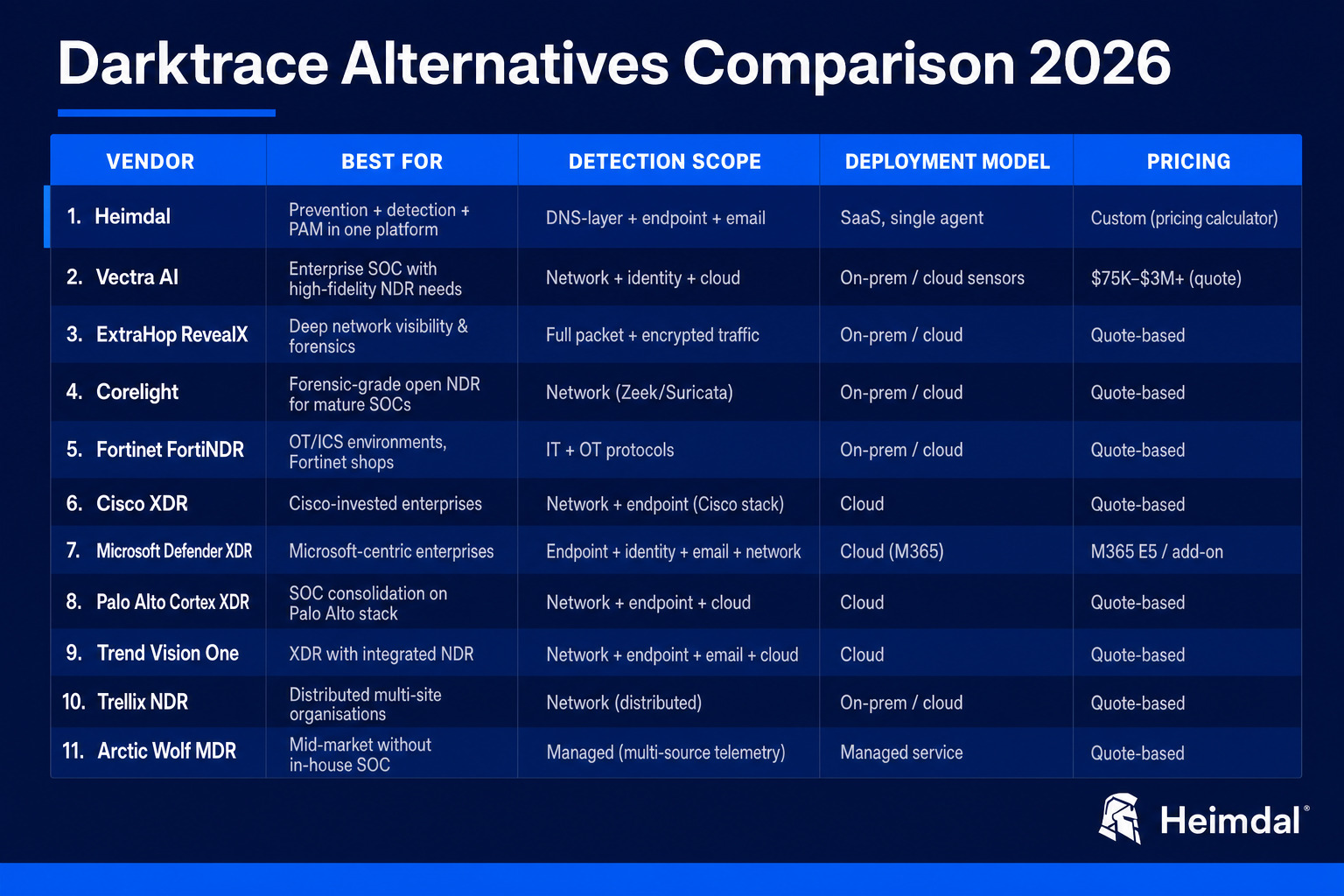
If you need one answer fast, here is the shortlist by situation.
- Heimdal for teams that need prevention, patching, privileged access management, and detection in one platform rather than adding another detection-only tool to the stack.
- Vectra AI for enterprise SOCs that prioritise high-fidelity threat signals with minimal alert noise across hybrid environments.
- ExtraHop RevealX for organisations that need deep network visibility, encrypted traffic analysis, and forensic-grade packet-level evidence.
- Corelight for mature security teams with skilled analysts that need open-evidence forensic investigation and government or regulated compliance.
- FortiNDR for organisations with OT or industrial environments, especially those already running Fortinet infrastructure.
- Cisco XDR for Cisco-invested environments that want to extend existing network infrastructure into detection and response.
- Microsoft Defender XDR for Microsoft-centric enterprises that want unified detection across endpoint, identity, email, and cloud within existing licensing.
- Palo Alto Cortex XDR / XSIAM for organisations committed to Palo Alto that want to consolidate SOC operations into a single platform.
- Trend Vision One for teams wanting native NDR inside a broader XDR platform with cross-domain correlation.
- Trellix NDR for geographically distributed organisations needing network visibility across branch, cloud, and data-centre environments.
- Arctic Wolf for mid-market organisations without dedicated SOC staff that need 24/7 managed detection and response.
How the NDR category has changed in 2026
The term “NDR” meant something specific five years ago. It described tools that watched network traffic and flagged anomalies. You deployed sensors, mirrored traffic, and gave your analysts another dashboard.
That definition no longer captures how most organisations buy or operate network security in 2026.
Here is what shifted.
NDR is converging with XDR. Network detection is increasingly one layer inside a broader platform rather than a standalone product. According to analyst evaluations from Gartner and Forrester published between 2024 and 2026, the lines between NDR, EDR, and XDR keep blurring as vendors bolt on capabilities outside their original category.
Managed services now capture a large share of NDR budgets. One market analysis from MarketIntelo estimates that managed NDR services represent approximately 35% of NDR market revenue as of 2025. For mid-market teams that cannot staff a full SOC, a managed service often replaces the product-only NDR purchase altogether.
Buyers care more about operational outcomes than threat detection volume. The question has shifted from “Can it detect threats?” to “Can my team actually use it?” Investigation speed, analyst workflow quality, and time to value now matter more than detection engine sophistication.
The NDR market sits at approximately USD 4.0 to 4.4 billion in 2026, according to estimates from Grand View Research and MarketsandMarkets. Growth estimates range from 10% to 17% CAGR depending on who is counting and how.
Market trends indicate that cloud-based deployments now make up the majority of new NDR rollouts.
Where traditional approaches fall short
Most mid-market teams do not fail because they lack detection capability. They fail because the operating model does not match their reality.
Too many tools, not enough people. A dedicated NDR platform assumes you have SOC analysts to investigate alerts, correlate findings, and act on them. Many mid-market organisations operate with one to five people handling both IT and security. Another monitoring console does not help if nobody has time to watch it.
Alert fatigue is the real threat. Unsupervised anomaly detection, the foundation of most AI-driven NDR platforms, surfaces every behavioural deviation from a learned baseline. Not all of those deviations are malicious. Without careful tuning over weeks or months, teams end up ignoring the tool that was supposed to protect them.
Investigation still requires too many steps. When an alert fires, analysts often need three or more tools and multiple manual correlations to understand what happened, who was affected, and what to do next. More telemetry does not automatically improve outcomes. It only helps when analysts can turn information into actionable decisions quickly.
Detection without prevention leaves gaps. Many Darktrace customers discover that even after deploying an NDR platform, they still need patch management, privileged access controls, endpoint protection, email security, and automated remediation. The detection tool finds the problem. Everything else has to fix it.
Cost is a real barrier. Premium NDR platforms routinely cost six figures annually. For mid-market organisations, total cost of ownership — infrastructure, tuning, analyst time — can blow past what the budget supports.
Why we built a different approach
We come at this problem from a different angle than most vendors on this list.
Most NDR platforms focus on finding threats after they reach the network. That matters. But for the organisations we work with, the bigger challenge is not detection in isolation. It is running a security operation that actually works with the team and budget available.
We built a unified platform that covers vulnerability management, endpoint protection, privileged access management, DNS security, email security, and automated response. All of these run through a single agent and a single console. The goal is straightforward. Reduce the number of tools a team has to deploy, manage, and switch between during an investigation.
We are not a pure NDR platform. We do not do deep packet inspection or full traffic analysis the way Vectra, ExtraHop, or Darktrace do. Our network-layer detection operates at the DNS level, using AI and ML-driven analysis to identify suspicious destinations and block malicious connections before threats materialise.
That is a narrower scope than full east-west traffic monitoring, and we are transparent about it.
What we bring is the operational capability most NDR buyers realise they need after deploying a detection platform. Automated patch management across Windows, macOS, Linux, and more than 350 third-party applications. Privileged access management that controls elevation and session monitoring without a separate product.
Ransomware encryption protection that detects and stops unauthorised encryption using signatureless kernel-level detection.
Email fraud prevention that uses AI-driven outlier detection to surface impersonation attempts, CEO fraud, and anomalous email behaviour.
In May 2026, we were named in the Gartner Europe Context Magic Quadrant for Endpoint Protection, our first Gartner MQ placement and a meaningful step in independent analyst coverage.
We are also engaged with Forrester on an evaluation process. We hold strong ratings across Gartner Peer Insights and G2 across our product categories, with more than 17,000 customers and over 2.5 million endpoints protected.
For teams evaluating Darktrace alternatives because they need a broader security platform, not just a deeper network detection engine, that is the case we make. The profiles below lay out the rest of the field.
Practical buyer guidance
Do you actually need a dedicated NDR platform?
Before comparing vendors, identify your actual bottleneck.
- If your analysts lack network-level visibility into lateral movement and east-west traffic, a dedicated NDR platform addresses that gap directly.
- If your investigations require five consoles and three manual correlations to answer basic questions, an XDR platform that consolidates detection across domains may deliver more value.
- If your team does not have the capacity to monitor and respond to alerts around the clock, a managed detection and response service is likely the better fit.
- If your biggest gaps are in prevention, patching, access controls, and operational workflow rather than network detection specifically, a unified security platform may solve the actual problem.
Signals that you have outgrown Darktrace
- You spend more time tuning the platform than investigating real threats.
- Your team cannot explain why the AI flagged a specific alert.
- Autonomous response actions are harder to audit and govern than expected.
- You need prevention and remediation that Darktrace does not cover.
- The annual cost exceeds the value your team extracts from the platform.
What this category will not fix
No NDR, XDR, or unified platform eliminates the need for trained analysts who can interpret alerts and make response decisions. Technology narrows the gap. It does not close it. If headcount is the real constraint, evaluate managed services alongside product-based options.
Data sovereignty and evidence retention requirements will also constrain your options. Not every platform supports on-premises deployment or meets specific regulatory frameworks.
How to evaluate without drowning in demos
Most competitive evaluations involve two to four vendors in the final round. Test these scenarios in a proof-of-value exercise, not a vendor-controlled demo.
- Credential misuse. Can the platform detect stolen or compromised credentials and show you the scope of the compromise?
- Lateral movement. Can it identify an attacker moving between systems after initial access?
- Investigation speed. How quickly can your analyst answer three questions. What happened? Who was affected? What should we do next?
- Integration with your existing security tools. Does it work with your current SIEM, SOAR, EDR, and identity tools without manual workarounds?
- Response workflow. Can your team contain a threat from within the platform, or do they need to switch tools to act?
Run the proof-of-value for 30 to 60 days in your actual environment. Measure how long investigations take. Count how many alerts require analyst action versus how many are noise. Those numbers tell you more than any feature checklist.
Top Darktrace competitors: vendor profiles
Heimdal
What it is. A modular, unified security platform that combines vulnerability management, endpoint protection, privileged access management, DNS security, email security, and automated response through a single agent and console.
Best for. Enterprise and mid-market organisations that need prevention, detection, and response in one platform — particularly teams using Darktrace for network detection but finding gaps in prevention, patching, and access controls.
Key strengths
- Patch and asset management. We automate third-party patch deployment across Windows, macOS, Linux, and more than 350 third-party applications. Patches deploy within four hours of release with configurable schedules and rollback capability. Full software asset management and compliance reporting come built in.
- Privileged access management. Our platform integrates privilege elevation and delegation management (PEDM), privileged account and session management (PASM), and application control into the security stack. This covers just-in-time access, session recording, credential vaulting, and zero-trust execution policies. As of August 2026, we have not found another platform that ties application control directly to PAM decisions in the same way.
- DNS security. Our Predictive DNS technology uses AI and ML-driven neural networks to identify malicious domains before they host malicious content. This blocks command-and-control communications, data exfiltration, and malicious web traffic at the DNS, HTTP, and HTTPS layers. We evaluate over 300,000 domains daily. The DarkLayer Guard engine spots processes, users, URLs, and attacker origins used to infiltrate networks, while VectorN Detection identifies hidden threats through traffic-pattern algorithms.
- Email security and fraud prevention. AI-powered outlier detection surfaces deceptive email behaviour including CEO fraud, impersonation attempts, spoofed emails, and modified invoices. This is a live platform capability that analyses inbound and outbound communications against normal organisational patterns, with a reported 0.05% false-positive rate based on internal testing. This capability predates AI Wingman and operates independently within the platform.
- Ransomware encryption protection. REP X uses four complementary detection engines (encryption, rename, shadow copy, and canary) to stop unauthorised file encryption. It works signaturelessly at the kernel level and covers both local and cloud workloads including OneDrive, SharePoint, and Teams. Validated against more than 800 ransomware samples.
- Next-gen antivirus with extended threat protection (XTP). Four malware detection layers with over 1,400 curated detection rules mapped to MITRE ATT&CK. Includes zero-trust execution protection, brute-force protection, and remote access protection that blocks all unsolicited external remote access by default.
- Threat-hunting and Action Center (TAC). Our next-gen SIEM provides estate monitoring, M365 user security monitoring, XTP/MITRE ATT&CK classified risk and events, and a unified Action Center for response across all modules. External firewall integration (including Cisco Meraki) brings third-party alerts into the same operational view.
- AI Wingman. A separate cross-platform intelligence layer delivered in phases. AI Wingman Assist provides platform guidance and best-practice recommendations across the dashboard. AI Wingman Triage, included with TAC, uses multi-agent systems (MAS) for incident validation and triage acceleration. AI Wingman SOC, included with TAC and MXDR, brings AI acceleration into our managed SOC operations. These phases are distinct from our existing AI/ML capabilities in DNS and email, which have been live since before AI Wingman.
- Single-agent architecture. One agent, one console. That cuts deployment complexity, endpoint resource draw, and the overhead of managing multiple security products. Coverage spans Windows, macOS, and Linux.
Trade-offs
- We are not a deep packet inspection NDR platform. Our network-layer detection operates at the DNS level rather than full traffic flow analysis. Teams that need east-west traffic monitoring or packet-level forensics should pair us with a dedicated NDR tool.
- As of August 2026, we are engaged with Forrester on an evaluation process. Until that is available, we have fewer independent third-party analyst evaluations in the NDR-specific category compared to vendors like Darktrace, Vectra, or ExtraHop.
- Organisations heavily invested in another security stack should evaluate feature overlap before consolidating tools.
Pricing. Custom pricing based on modules selected and endpoint count. Use our pricing calculator for an instant estimate.
Vectra AI
What it is. An AI-driven detection platform focused on Attack Signal Intelligence across network, identity, cloud, and SaaS environments.
Best for. Enterprise SOCs with large network and cloud footprints that prioritise high-fidelity detection with minimal alert noise, and can invest in deployment and tuning.
Key strengths
- Named a Leader in the 2025 Gartner Magic Quadrant for NDR and a Leader/Outperformer in the GigaOm Radar for NDR.
- Holds a 4.8/5 rating with 95 to 96% recommendation rate in Gartner Peer Insights for NDR as of early/mid 2025, earning Customers’ Choice recognition.
- Individual reviewers have cited reductions of 80 to 90% in alert fatigue compared to previous tools, though individual results vary.
- Hybrid coverage across enterprise data centres, cloud environments (AWS, Azure, GCP), IoT, and unmanaged devices.
- Identity-based detection correlates network behaviours with Active Directory and Azure AD/Entra ID credential activity.
- The Stream module exports enriched metadata in Zeek format to SIEMs and data lakes for flexible retention and analysis.
- Managed detection and response service option available for teams that need external monitoring support.
Trade-offs
- Enterprise-level pricing. According to third-party benchmarking data, typical annual contracts range from approximately $75K to $275K for small enterprise NDR-only deployments (2,500 to 10,000 IPs) up to $500K to $3M+ for Fortune 500 full platform engagements. Actual pricing is quote-based.
- Deployment complexity requiring multiple appliances and significant configuration.
- Works best alongside a mature SOC and existing tooling rather than as a standalone product for lean teams.
- Vectra focuses on detection and investigation. Its response capabilities are lighter than Darktrace’s autonomous response.
- Reporting flexibility gets flagged as a weak spot in peer reviews.
Pricing. Quote-based. Contact Vectra sales for current pricing.
ExtraHop RevealX
What it is. A cloud-native NDR platform focused on deep network visibility, encrypted traffic analysis, and forensic-grade investigation.
Best for. Organisations with significant east-west traffic, hybrid or cloud infrastructure, or complex network environments that need deep network-level visibility and forensic evidence.
Key strengths
- Named a Leader in both the 2025 and 2026 Gartner Magic Quadrant for NDR and a Leader in the Forrester Wave for Network Analysis and Visibility, Q4 2025.
- Second-highest NDR revenue globally according to Gartner market-share data as of 2025.
- According to ExtraHop product documentation, RevealX can decrypt and analyse TLS 1.3 traffic with perfect forward secrecy in supported deployments.
- Full packet-level forensic investigation with PCAP repository for post-incident analysis and regulatory evidence.
- Automatic discovery and classification of all communicating network devices with role identification.
- Full-spectrum detection combining security hygiene checks, rule-based detections, behavioural ML, and retrospective detection.
- ExtraHop cites a Forrester Consulting study reporting that RevealX helps teams resolve threats 84 to 87% faster.
Trade-offs
- Peer reviewers flag premium pricing as the top concern.
- Deployment requires traffic mirroring and tapping infrastructure, adding planning, hardware, and maintenance overhead.
- Network-first approach means RevealX is a component of a broader security stack, not a replacement for EDR, SIEM, or SOAR.
- Configuration and optimisation get complex in large, mixed environments.
- Advanced encrypted traffic decryption features require careful architecture and key management.
Pricing. Quote-based. Contact ExtraHop sales for current pricing.
Corelight Open NDR
What it is. An evidence-based NDR platform built on Zeek and Suricata, focused on high-fidelity network evidence, open detection standards, and forensic investigation.
Best for. Mature security teams with skilled analysts who care about forensic investigation quality, open evidence standards, and tight integration with existing SOC workflows. A natural fit for government and regulated environments.
Key strengths
- Built on Zeek and Suricata open evidence frameworks, reducing vendor lock-in and giving analysts direct access to well-understood data formats.
- According to Corelight product documentation, the platform includes 70,000+ out-of-the-box detections (signatures, behavioural analytics, and AI-based detections) mapping to 80+ MITRE ATT&CK techniques.
- Encrypted traffic analytics that detect threats without requiring decryption.
- Forensic retention with queryable evidence for investigations.
- Integrates well with SIEM, XDR, SOAR, and endpoint platforms including Microsoft and CrowdStrike.
- 2026 additions include agentic triage, AI-assisted investigations, and passive asset classification.
- Achieved FedRAMP In-Process certification in 2026.
Trade-offs
- Complex to deploy and operate, especially in multi-sensor setups.
- Requires skilled analysts. Not the right fit for teams that want operational simplicity.
- High telemetry volume will increase SIEM ingestion and retention costs.
- Quote-based enterprise pricing with limited public cost transparency.
- No autonomous response capability. Corelight focuses on evidence and investigation, not automated containment.
Pricing. Quote-based. Contact Corelight sales for current pricing.
Fortinet FortiNDR
What it is. An NDR platform designed for both IT and OT/ICS environments with AI-driven behavioural detection and integration into the Fortinet Security Fabric.
Best for. Organisations managing industrial, manufacturing, or OT assets, especially those already running Fortinet infrastructure.
Key strengths
- Purpose-built for both IT and OT environments with native support for industrial protocols such as Modbus, DNP3, and BACnet.
- AI and ML-driven behavioural detection with virtual security analyst capabilities.
- According to Fortinet product documentation, FortiNDR Cloud offers 365-day retrospective threat hunting.
- Integration with the Fortinet Security Fabric including FortiGate, FortiSIEM, and FortiSOAR.
- Support for isolated and air-gapped OT environments.
Trade-offs
- Delivers the most value inside Fortinet-heavy environments. In mixed-vendor shops, the advantage thins out.
- Not named a Leader in the 2025 Gartner Magic Quadrant for NDR or other major analyst rankings.
- Less public documentation and fewer independent reviews than the leading NDR vendors.
Pricing. Quote-based. Contact Fortinet sales for current pricing.
Cisco Secure Network Analytics / Cisco XDR
What it is. Network analytics and XDR platform that extends Cisco networking infrastructure into detection and response.
Best for. Organisations already running Cisco infrastructure that want to add detection and response without introducing a new vendor.
Key strengths
- Native integration with Cisco networking infrastructure including switches, routers, and firewalls.
- Ingests telemetry from multiple sources and correlates across the Cisco security portfolio.
- Network analytics built into the broader Cisco security product family.
- Large installed base in enterprises already running Cisco.
Trade-offs
- Greatest value comes from deep Cisco adoption. Less useful in environments where Cisco is not the primary networking vendor.
- NDR-specific capabilities do not match pure-play NDR vendors in analyst evaluations.
- Less prominent in analyst NDR rankings compared to Darktrace, Vectra, or ExtraHop.
Pricing. Quote-based. Contact Cisco sales for current pricing.
Microsoft Defender XDR
What it is. A unified XDR platform that correlates endpoint, identity, email, cloud, and network signals within the Microsoft security product family.
Best for. Microsoft-centric enterprises that want to consolidate detection and response across multiple security domains within their existing Microsoft licensing.
Key strengths
- Native integration across Microsoft security products including Defender for Endpoint, Defender for Identity, Defender for Office 365, and Defender for Cloud Apps.
- Unified investigation and incident management across all Microsoft-covered domains.
- Automatic attack disruption.
- Identity-based detection using Azure AD/Entra ID signals.
- Cost-effective when bundled with Microsoft 365 E5 or E5 Security licensing.
- Massive install base with continued platform investment from Microsoft.
Trade-offs
- Network detection is shallow compared to dedicated NDR platforms. No deep packet inspection, no full traffic analysis.
- Delivers maximum value in Microsoft-centric environments. Mixed-vendor shops get less from it.
- Less specialised for advanced NDR use cases such as traffic forensics, OT monitoring, and unmanaged device discovery.
- DNS security, PAM, and vulnerability management remain significant gaps, according to competitive analysis.
Pricing. Varies by licensing tier. Often included with Microsoft 365 E5 or available as an E5 Security add-on.
Palo Alto Networks Cortex XDR / XSIAM
What it is. A security operations platform that combines detection, investigation, automation, and SOC workflow consolidation.
Best for. Organisations committed to the Palo Alto product family that want to consolidate SOC operations into a single platform with NDR as one detection layer among many.
Key strengths
- Cross-domain visibility correlating network, endpoint, cloud, and identity data.
- XSIAM consolidates SIEM, SOAR, and XDR functionality into a single SOC platform.
- Automates repetitive analyst tasks well.
- Integration with Palo Alto’s firewall and cloud security portfolio.
- Competitive in platform-consolidation evaluations.
Trade-offs
- Not a dedicated NDR platform. Network detection is one component of a broader platform.
- Strongest value inside the Palo Alto product family, with the platform lock-in that implies.
- XSIAM demands a full SOC transformation. Most organisations are not ready for that on day one.
Pricing. Quote-based. Contact Palo Alto Networks sales for current pricing.
Trend Micro Trend Vision One
What it is. An XDR platform with purpose-built NDR capabilities including deep traffic inspection, encrypted traffic analysis, and cross-domain correlation.
Best for. Teams that want integrated NDR inside a broader XDR platform, especially those already using Trend Micro for endpoint or email security.
Key strengths
- Native NDR with inline and out-of-band sensor options.
- Encrypted traffic analysis and historical attack reconstruction.
- Network-to-endpoint correlation and unmanaged or agentless asset visibility.
- Multi-domain correlation across endpoint, cloud, email, and network activity.
- Covers multiple security domains within the Trend Micro platform.
Trade-offs
- Less recognised as an NDR-first vendor compared to Darktrace, Vectra, or ExtraHop.
- Network-focused capabilities are more specialised than some teams need.
- Best value inside the Trend Micro product family.
Pricing. Quote-based. Contact Trend Micro sales for current pricing.
Trellix NDR
What it is. An NDR platform focused on network visibility across cloud, branch, and data-centre environments.
Best for. Organisations with geographically distributed infrastructure needing NDR visibility across multiple site types.
Key strengths
- Network visibility across distributed infrastructure.
- Risk prioritisation capabilities.
- Support for hybrid-environment deployments.
Trade-offs
- Does not stand out in the NDR market against leading pure-play vendors.
- Less independent analyst recognition for NDR than Darktrace, Vectra, or ExtraHop.
- Check for overlap with your existing security investments before committing.
Pricing. Quote-based. Contact Trellix sales for current pricing.
Arctic Wolf MDR
What it is. A managed detection and response service providing 24/7 SOC operations with concierge-style support and guided remediation.
Best for. Mid-market organisations without dedicated SOC staff that need continuous monitoring and expert-led response.
Key strengths
- 24/7 managed detection, response, and remediation with human-led SOC support.
- Named a Leader in the 2026 IDC MarketScape for Worldwide MDR Service for Midmarket.
- Guided response and remediation that reduce the load on internal teams.
- Telemetry collection across endpoint, network, cloud, and identity sources.
- Built for organisations that cannot hire dedicated security analysts.
Trade-offs
- Not a dedicated NDR platform. Network detection depth depends on ingested sensors and integrations rather than native packet-centric workflows.
- Less operational control than product-based approaches.
- Dependence on provider workflows and SLAs.
- Mature SOCs will find the managed model more restrictive than running their own tooling.
Pricing. Quote-based. Contact Arctic Wolf sales for current pricing.
Choosing a Darktrace alternative by situation
The right alternative to Darktrace depends less on which platform has the most impressive feature list and more on what problem you are actually trying to solve.
If your primary gap is deep network visibility and you have a mature SOC.
Evaluate Vectra AI, ExtraHop, or Corelight. These platforms go deep on network detection and investigation. Vectra leads on signal-to-noise ratio. ExtraHop leads on encrypted traffic analysis and forensic depth. Corelight leads on open evidence standards and government compliance.
If you want to consolidate security tools rather than add another detection layer.
Evaluate Microsoft Defender XDR if your infrastructure is Microsoft-centric, Palo Alto XSIAM if you are committed to that product family, or Heimdal if you need prevention, patching, PAM, and detection in one platform regardless of vendor alignment.
If your team cannot operate another monitoring tool without additional headcount.
Evaluate Arctic Wolf or a managed NDR service from Vectra or ExtraHop. The managed model offloads monitoring and investigation to external analysts while your team focuses on what it can control.
If you run OT or industrial environments alongside standard IT.
Evaluate FortiNDR, especially if you already use Fortinet infrastructure, or Darktrace /OT. These platforms have native support for industrial protocols and can monitor air-gapped environments.
If your real problem is that Darktrace detects threats but you lack the prevention and remediation tools to act on them.
Evaluate us at Heimdal. We built the platform around closing that operational gap between detecting a threat and actually resolving it. Our approach works alongside a network detection tool or as a replacement for organisations whose biggest gaps are in prevention and workflow rather than network-level detection specifically.
If you want XDR with meaningful NDR built in rather than bolted on.
Evaluate Trend Vision One. Its native NDR capabilities are stronger than most XDR platforms, with multi-domain correlation across endpoint, cloud, email, and network.
Frequently asked questions
How is Darktrace different from SIEM?
Darktrace monitors network traffic and uses self-learning AI to detect behavioural anomalies in real time. It builds a baseline of “normal” for every device and user, then flags deviations from that baseline. SIEM platforms aggregate logs from multiple sources for correlation, compliance reporting, and historical analysis. Modern SIEMs increasingly include real-time monitoring, but Darktrace is purpose-built for continuous behavioural detection across the network. The two serve different functions and most organisations use both.
What are the main disadvantages of Darktrace?
Independent reviews and peer feedback flag the same issues repeatedly. First, the unsupervised anomaly detection generates a high volume of alerts, many of which flag behavioural deviations rather than genuine threats. Alert fatigue follows. Second, autonomous detection and response actions have a “black box” quality that makes post-incident review and governance harder — a real problem for audit-conscious teams. Third, the platform needs significant tuning. Expect roughly two weeks of baselining before full-confidence detections kick in, with ongoing calibration stretching weeks to months. Pricing is a recurring concern too — independent reviews put network detection at roughly £30,000 per year and up, with enterprise full-suite deployments exceeding £500,000 per year.
Does Darktrace stop ransomware?
According to Darktrace case studies, RESPOND has contained ransomware attacks by quarantining infected devices and blocking suspicious external connections. The platform can detect anomalous encryption activity and take autonomous containment actions at machine speed. Darktrace operates at the detection and response layer, though. It does not cover prevention — patch management, privilege controls, or pre-compromise endpoint hardening.
How much does Darktrace cost?
Darktrace pricing is quote-based and varies by deployment size and modules selected. According to independent reviews, indicative pricing for network detection ranges from approximately £30,000 to £150,000+ per year. Enterprise full-suite deployments covering network, email, cloud, and endpoint can exceed £500,000 per year. Actual pricing varies by environment. Contact Darktrace directly for a current quote.
Can NDR replace SIEM?
No. NDR and SIEM serve different functions. NDR provides network-layer behavioural detection using traffic analysis and machine learning. SIEM aggregates logs from multiple sources for correlation, compliance reporting, and forensic analysis. Most organisations use both. NDR feeds enriched network alerts into the SIEM for broader correlation across security domains.
Is a managed detection and response service better than an NDR product?
It depends on your team’s capacity. If you have a dedicated SOC with trained analysts, a product-based NDR platform gives you direct control over detection, investigation, and response. If your team lacks the headcount or expertise to monitor and respond around the clock, a managed service handles that operational burden. One market analysis estimates that approximately 35% of NDR market revenue now goes to managed services, and that share is growing as mid-market organisations increasingly choose managed models over product-only deployments.
What should I test during a proof-of-value evaluation?
Focus on real-world scenarios your team encounters regularly rather than vendor-scripted demonstrations. Test credential misuse detection, lateral movement identification, cloud privilege escalation, and encrypted traffic analysis. Measure how quickly your analyst can answer three questions for each alert. What happened? Who was affected? What should we do next? Run the evaluation for 30 to 60 days and track both investigation speed and the ratio of meaningful alerts to noise.


