


 Network Security
 Vulnerability Management
 Privileged Access Management
  Endpoint Security
 Threat Hunting
 Unified Endpoint Management
 Email & Collaboration Security


Contents:
There are several cybersecurity companies that offer managed EDR services in 2026. Here’s what actually separates them, and who each one suits.
Most successful cyber attacks begin with a breached laptop, a smartphone or a server. Over the past 15 years, endpoint detection and response (EDR) has gone from niche to a mainstream security solution.
But managing that software, and triaging the alerts it raises, can be seriously time consuming. That’s where managed EDR services come in. An MSP, or the vendor itself, runs the tool for you and flags what actually matters.
Transparency: As well as our own EDR software, Heimdal also offers managed EDR services that incorporate advanced threat intelligence. This article is intended as informational, and we’ve aimed to present the facts and other suppliers in a fair and balanced way.
4 Best Managed EDR Solutions – The Short Answer
There’s no single best supplier here. It comes down to whether you already have a SOC, how much of the response you want handled for you, and whether you want EDR tied to patching and access control, or running on its own.
- Heimdal MXDR: best for small and medium-sized businesses and MSPs without their own SOC that want response, and the fix itself, handled in one place.
- Arctic Wolf: best for larger companies with their own SOC that want a named team watching a broad estate, even though full incident response is a separate retainer.
- Huntress: best for MSPs that want a SOC acting directly on threats at transparent, per-endpoint pricing.
- Sophos MDR: best for firms of any size that want tier flexibility, and are willing to pay for Complete to get a contractual SLA and breach warranty.
Configuration of an EDR Tool is Key
You can have the best EDR solution in the world, but if it isn’t correctly configured, it won’t protect you from harm.
When you opt for managed EDR services, you are choosing to outsource usage of the tool to a managed services provider or the vendor’s own SOC. This can be a good option, because the supplier should know how to use the tool effectively. But it still needs to be configured to your environment.
This is crucial because, on the surface, many EDR solutions do very similar things. Most flag suspicious activity across endpoints in real time. It’s the way they’re managed that makes the difference.
How to evaluate suppliers of managed EDR services
Whether you choose to work with an MSP or go direct to the software vendor and use their SOC, there are a few things security teams should weigh up when deciding which supplier to use.
The response model
Broadly speaking, EDR service providers offer one of two response models:
- Alert and advise. The supplier will let you know when they’ve identified an issue and will provide step by step instructions to resolve it.
- Automatically remediate. The supplier handles remediation itself, as soon as it identifies an issue.
Option 1 is good if you have your own, well-resourced security team. It gives you more control and flexibility (you might choose to ignore some advice for specific reasons). Option 2 suits teams that want the response automated end to end, or simply don’t have enough in-house staff to solve problems themselves.
Service level agreements
This is basically about how quickly managed endpoint detection and response providers say they can respond to threats they’ve identified. Response speed matters most for the alerts that can’t wait.
For critical threats, such as ransomware, you’d expect a response time of less than one hour. You should also check the mean time to remediation, and how quickly an analyst actually looks at the alert, not just when the system flags it.
It’s also important to verify what’s offered to different service tiers. Some managed endpoint detection and response providers offer different SLAs, depending on how much you pay, and some exclude MSPs from the SLA altogether.
You should expect 24/7 monitoring and support as standard.
Sensor agent count
All the best EDR tools use a single, lightweight sensor on each endpoint. More than one agent, and it will start to slow the device down.
Sometimes, other security tools, such as patch management or an antivirus, are also bundled into the same agent. The platform’s job is to unify them under one dashboard rather than several.
Pricing model
There are a couple of different pricing models for managed EDR service:
Per-endpoint subscription. You pay a set amount per endpoint, per month. It’s flexible and predictable, but can suddenly cost a lot if you expand rapidly.
Tiered models. You pay a base fee for the EDR licence, then the monthly price is tiered depending on the service level you choose. For smaller firms, this is usually very expensive. But when you have a lot of devices or employees, it works out cheaper than monthly subscriptions.
Data residency
This is an important consideration for highly regulated industries or companies affected by the GDPR. You should verify where telemetry data is stored and who can access that information.
Certification and SOC analyst expertise
Getting certified by independent bodies is a clear signal that the supplier meets certain minimum standards of security and expertise.
Here are some of the key certifications to look out for:
SOC 2, ISAE 3000, Blue Team Level 1, Certified Threat Hunting Professional (eCTHP), OPSWAT Endpoint Security certification, VB100 certification, and ISO 27001.
It’s also worth asking what threat hunting or forensics experience actually sits behind those certifications, not just which ones the SOC holds. Ask how many analysts are on shift at 3am, not just how many the team has on paper.
Services beyond EDR
As well as an EDR, some vendors will also bundle additional, valuable tools into the wider endpoint protection stack.
It depends on your needs and current security setup, but it can be helpful to include things like patch management, antivirus, and privilege management as one security tool rather than several. This adds more depth to your endpoint security posture.
Comparing managed EDR services
Different providers offer different kinds of endpoint detection and response services. In the table below, we’ve compared pricing, response model, SLA, and best fit across a select group of major cybersecurity companies that offer managed EDR services.
There are dozens of companies that offer various “flavours” of managed EDR, and we can’t include them all here. This table is intended to illustrate how services can differ.
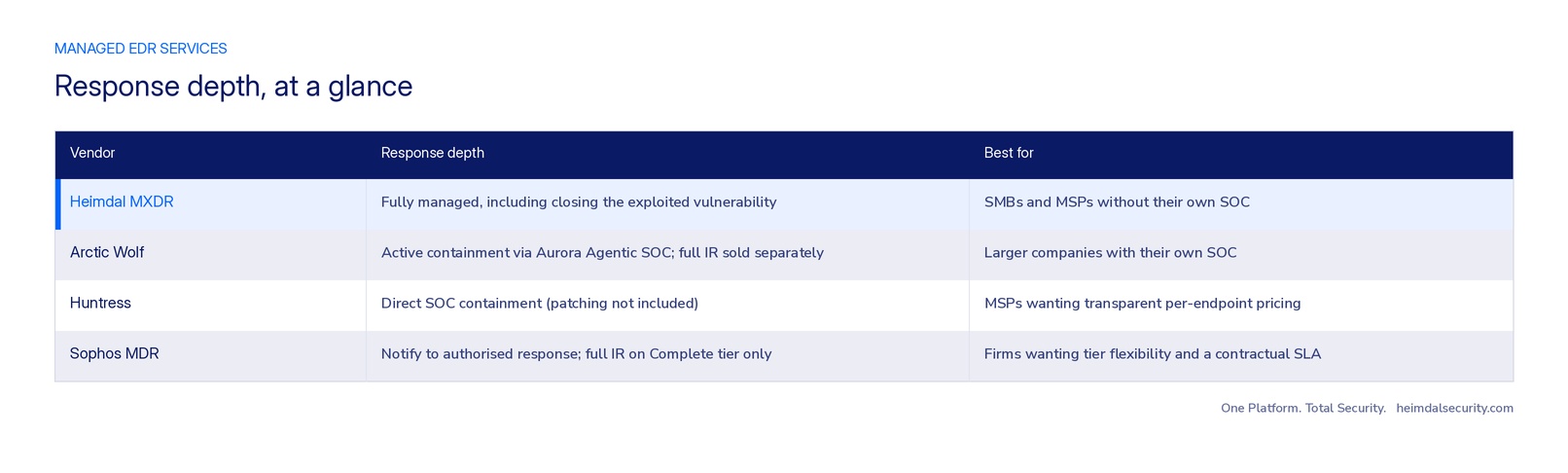
Arctic Wolf. Flat annual platform fee, plus a per-endpoint subscription. Active containment via Aurora Agentic SOC, with full incident response implemented separately. No published baseline SLA; 1 to 4 hour SLAs on paid incident response retainers. Best for larger companies with their own SOC.
Heimdal MXDR. Per-endpoint subscription. Fully managed by Heimdal, including closing the vulnerability that let the attacker in. No published SLA; ask for current response targets. Best for small and medium-sized businesses without their own SOC, and MSPs.
Huntress. Per-endpoint subscription. Direct SOC containment and remediation (patching not included). Not published; Huntress reports an average 8-minute time to respond. Best for managed service providers.
Sophos MDR. Per-user subscription, two tiers. Essentials (notify to authorised response) and Complete (adds full incident response). 60-minute response time for 90% of high-severity cases, Complete tier only, with service credits. Best for firms of all sizes, with or without their own SOC.
Profiles of managed EDR providers
All the best EDR solutions offer comparable core technology. The differences that matter show up in each provider’s approach to service, not the engine underneath it.
These profiles aren’t comprehensive. There are dozens of providers we haven’t included, but the four below give you a sense of how the approach to service actually differs.
Arctic Wolf
Arctic Wolf’s EDR service combines an AI-driven SOC with a “Concierge Experience”. You get a team of experts who understand your business and context.
Arctic Wolf’s Aurora Agentic SOC now performs automated response and active containment on your behalf, so this is more hands-on than a pure notify-and-advise service. Full incident response, meaning forensics, ransom negotiation and business restoration, is still sold separately as a retainer, with response times of 1, 3 or 4 hours depending which you buy. You do get a named security team who will walk you through anything beyond that. This is why the service is best for companies that have their own SOC. You will need in-house staff who can enact the guidance for anything the SOC doesn’t handle directly.
Because their pricing combines a base fee for the software plus additional fees per endpoint, Arctic Wolf is more attractive to larger businesses that can absorb the cost.
Pros: global 24/7 monitoring, including in Europe; technology-agnostic design; up to $3m breach warranty (top bundle, 3-year term).
Cons: no additional security software included; full incident response, forensics and restoration, sold as a separate retainer; only suitable if you have a SOC in-house.
Heimdal MXDR
MXDR stands for managed extended detection and response, and Heimdal’s version provides both MSPs and direct customers with a dedicated SOC that monitors endpoints 24/7.
They offer a fully-managed service, with response and remediation, including patching the vulnerability an attacker used to get in, handled automatically by the SOC. That automation is only possible because the underlying platform is unified rather than bolted together, which is attractive to companies that don’t have their own security department.
Pricing per endpoint is relatively low, and the same fees apply to all businesses, of any size. In addition to EDR, the managed service also includes automatic patching. The EDR sensor can also be combined with a patching, privilege and antivirus tool from the same brand, all on one platform.
Pros: possibility of adding services (AV, PAM etc.) to the same endpoint sensor; SOC based in Europe; response included as standard, with no separate paid tier required.
Cons: fewer standout advantages if you have your own SOC with EDR tools already; requires organisations to move security infrastructure to Heimdal; need to hand over control of remediation to Heimdal’s SOC.
Huntress
Huntress managed EDR is designed specifically for MSPs. If you are an MSP, they will handle the endpoint detection and response side of your business.
The model is hands-on for threat response. Huntress’s SOC handles investigation, containment and remediation directly on your behalf, rather than just advising you. Where the model is guided is patching. Huntress will flag missing updates, but won’t apply them for you.
They are more of a pure-play managed EDR. Additional services, such as applying patches, are not covered, although they will flag any issues they discover.
Pros: well-regarded by MSPs for responsive and clear communications; affordable and transparent per-endpoint pricing; SOC acts directly on threats, not just guidance.
Cons: a pure-play EDR, so fewer related services; no published breach warranty or contractual SLA; no patch management, so a found vulnerability still needs a separate tool.
Sophos MDR
Sophos now offers managed EDR through two tiers, Essentials and Complete. Both let you choose how much authority Sophos’s SOC has to act, from full authorisation to notify-only. Only Complete adds a formal incident response service, a contractual SLA of 60 minutes for 90% of high-severity cases with service credits attached, and a breach warranty.
This Complete service costs more, but it is very comprehensive. Like Heimdal, it offers a very extensive range of additional tools and security/IT integrations. In February 2025, Sophos also completed its acquisition of Secureworks. The Taegis platform is now folded into its MDR line.
Pros: highly regarded MDR service; $1m breach warranty (Complete tier; ransomware payouts capped at $100k per claim, plus a patch-compliance requirement); vendor agnostic, with 500+ integrations.
Cons: only the more expensive “Complete” tier offers the SLA, warranty and full incident response; relatively expensive; alert fatigue.
Choosing the best EDR solution for you
There are several companies offering managed EDR services. But while their tech might do similar things, the way the service is delivered can vary a lot.
Choosing the right managed EDR service will therefore depend on your situation, your cybersecurity maturity, whether or not you have your own SOC, your existing security setup, and any additional needs you might have.
It’s also worth checking what SentinelOne’s Vigilance Respond or CrowdStrike’s Falcon Complete offer if you already run either agent as your core EDR.
Want to see how Heimdal’s MXDR service would fit your organisation? Learn more about our service, or contact us for a demo today.
FAQs
Managed EDR vs MDR, what’s the difference?
Managed EDR and MDR (managed detection and response) are closely related, and often overlapping, business models. Managed EDR covers your endpoints. MDR usually covers the same ground and extends monitoring into identity, email, network or cloud telemetry too. In practice the terms overlap heavily, and vendors use them almost interchangeably, so check what’s actually being monitored rather than relying on the label.
What does “response” mean across managed endpoint detection and response vendors?
Different vendors have different definitions of what “response” means within their managed EDR services. Broadly speaking, there are two models across EDR platforms. The first is to actively remediate issues that they detect for you. In the second model, they will notify you of issues they have identified and then provide step-by-step instructions on how to solve the issue.
Is managed EDR enough without a separate patch tool?
No, managed EDR is fairly limited if you don’t have a separate patch tool. The EDR may discover that some devices are not up to date or do not have suitable security patches installed, which is exactly the kind of gap ransomware exploits. But if you don’t have a separate patching tool to update those devices centrally, you cannot resolve the problem. Some software, like Heimdal’s unified security platform, includes automatic patching, bundled in with the EDR agent deployed on individual devices. But other EDR will need you to deploy a separate patch tool to roll out updates.


