



Contents:
Proofpoint catches malicious traffic and blocks data exfiltration well, with solid coverage for business email compromise, phishing, and malware.
But it’s built for the enterprise, and it shows. G2 reviewers flagged a steep learning curve and steep pricing, and suggested Proofpoint’s support would need improving.
The platform’s also in flux. Proofpoint closed a $1.8 billion acquisition of Hornetsecurity in December 2025, folding in a Microsoft 365 security vendor with over 12,000 MSP partners. It’s a bet on the MSP and SMB market Proofpoint hasn’t historically served directly, and integrations like that take time to settle.
That’s the snapshot for Proofpoint today, here’s how the alternatives compare.
9 Proofpoint alternatives for email security
There’s plenty of effective email security options on the market. Here’s a look at some of the leading ones:
1. Heimdal
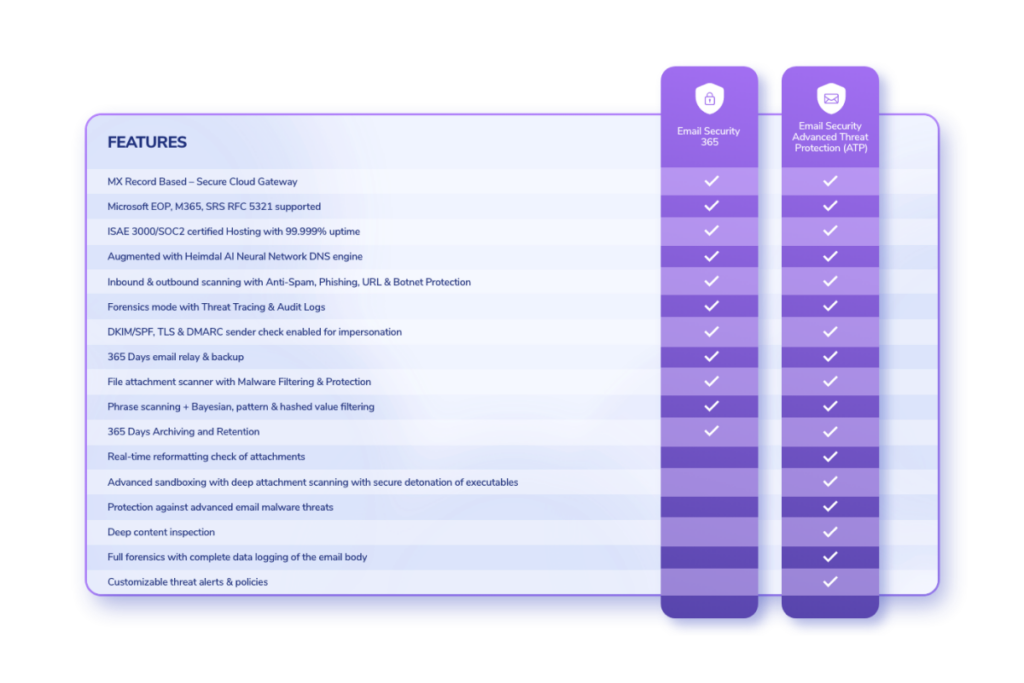
Unlike many vendors on this list, Heimdal Email Security is a gateway-based product. That means every incoming email is diverted to a secure MX-based gateway before it can land in the user’s inbox.
This makes it impossible for users to click on an email before it’s been thoroughly vetted.
Pre-delivery inspection isn’t everything, this product also features:
- AI-powered threat defense – Heimdal’s Email Security uses AI anomaly analysis and advanced behavioral analytics to detect emerging threats like phishing, ransomware, and infiltration attempts before they reach the user’s inbox.
- Forensic scanning – inspects every element of the email for malicious activity, including attachments, URLs, and text.
- Protection beyond the basics – checks the content and sentiment of emails to detect CEO fraud and business email compromise (BEC) attacks.
- Remove spam and malware – the professional spam and malware filter helps protect inboxes from noise and nuisance.
- Low false positives – keeps false positives to an absolute minimum, with a verifiable rate of as low as 0.05%.
- Compliance – offers detailed threat tracing logs and audit logging for in-depth visibility and fast compliance.
All these features make Heimdal one of the most advanced email defense platforms on the market.
But it’s not just about email. Heimdal’s defining feature is that it offers the widest suite of cybersecurity products anywhere on the market. Besides email security, it includes DNS protection, vulnerability management, privileged access management, XDR, threat hunting, and unified endpoint management.
While other tools focus just on emails, this one monitors the whole journey a hacker takes. The result? You can stop them in their tracks before they can infiltrate your business.

2. Abnormal AI
Abnormal AI is an AI-based security vendor with a particular focus on email security. Its products are available through the Abnormal Behavior Platform, of which email is a major module.
The product is a classic example of API-based email security, meaning it runs into the time-lag issues we discussed above. Nonetheless, some customers appreciate the platform’s focus on end-user training and behavioral monitoring.
Pros:
- Behavioral analysis: The platform features anomaly analysis algorithms that compare behavioral patterns to proactively spot malicious emails. This helps to identify more complex attacks.
- Customer experience: Customers generally report an effective customer experience, with robust processes in place to manage and respond to customer requests.
- User training: Abnormal AI has recently released the Abnormal AI Data Analyst and AI Phishing Coach. These use AI to provide simulation-based phishing training for everyday business users.
Cons:
- SaaS-only: The product is only available through a SaaS-based licensing model. This may not appeal to larger organizations or those looking to monitor on-premises environments.
- API-based: The API-based approach inspects emails after they land in a customer’s inbox. This risks users clicking on the email before malicious mail can be identified and removed.
- Product roadmap: The vendor’s roadmap is generally focused on training materials, rather than security features. While user training is effective, customers will likely find more advanced threat protection tools elsewhere on this list.
3. Ironscales
Ironscales is another specialist email security vendor. It uses Adaptive AI and Agentic SOC Automation to identify more complex phishing attacks.
The product is chiefly available through three separate tiers: Ironscales Protect, Email Protect, and Complete Protect. These offer a range of innovative tools to help protect against AI-powered phishing, business email compromise (BEC), account takeover, and more.
Nonetheless, Ironscales’ API-based approach still relies on post-delivery detection.
Pros:
- AI defense: The product provides effective AI-based defense against complex and emerging email threats.
- Innovation: Ironscales has an innovative product map. The vendor has recently bought out a range of tools that aren’t widely available in the market, including Deepfake Protection for Microsoft Teams, graymail filtering, DMARC management, and more.
- Cost: Pricing is competitive across all customer tiers. The vendor also benefits from a transparent approach.
Cons:
- Technical depth: Analysts report less technical depth on some Ironscales features vs. other vendors on this list. This is particularly relevant to data loss prevention (DLP) functionality.
- API-based: The post-delivery inspection model risks malicious emails reaching users before defenses can kick in.
- Support and scale: Ironscales has less heritage than other Proofpoint competitors on this list. As such, it has a comparatively small support team and isn’t strong in the enterprise space. Larger organizations may want to proceed with caution.
4. Check Point Email Security
Check Point is a cybersecurity vendor with products across a wide range of different categories. Its email management product was recently rebranded to Check Point Email Security, though it was previously called Harmony Email & Collaboration (HEC).
Like others on this list, Check Point Email Security is primarily an API-based service. But in this case, the defense happens before the email lands in the user’s inbox. This means the issues with most API-based vendors don’t apply here in the same way.
Pros:
- Customer support: Check Point has invested heavily in its support team in recent years. Customer feedback generally reports a responsive and effective support experience.
- Ease of use: The product has a straightforward user experience, with coverage across a broad range of features. This is a good choice for customers looking to prioritize ease of use and cost-efficiency.
- Price: Customers and analysts report that Check Point products are competitively priced for their place in the market.
Cons:
- False positives: Users report that the tool creates a high level of false positives, which can make it difficult to identify genuine threats.
- Data sovereignty: The product is not as developed as other vendors when it comes to region-specific data sovereignty.
- Reporting: The dashboard lacks export functionality, and the wider reporting/compliance capabilities are less developed than competing products. This can make monitoring and compliance a challenge.
5. Sublime Security
Sublime Security also specializes in email security. It has a big focus on agentic AI, relying on agents to manage much of the monitoring and response.
This approach has its pros and cons. In the long run, it has the potential to reduce the amount of manual work for IT teams. However, it requires quite a bit of up-front work from IT teams to set up.
Pros:
- Flexible deployment: Sublime Security offers SaaS, private cloud, or self-hosted options. This flexibility is good for larger organizations and enterprises that might struggle with a SaaS-only model.
- Agentic approach: The platform has a particular focus on agentic AI to autonomously detect and shut down attacks.
- Ease of use: Many customers praise the product’s straightforward interface and ease of use.
Cons:
- API-based: Like other API-based tools, this largely relies on inspecting emails after they’ve already landed in the customer’s inbox. However, pre-delivery monitoring options are available – though these aren’t the default option.
- Missing features: Sublime Security’s detection and response features are generally effective. However, users report missing features they’d expect to find in other platforms, such as geographic threat maps and shadow IT visibility.
- Learning curve: Despite the straightforward UI, some users still report a steep up-front learning curve. This is particularly true when it comes to configuring and applying the platform’s built-in rules, of which there are several hundred.
6. Mimecast
In many ways, Mimecast is similar to Proofpoint in both architecture and approach. It operates on a classic gateway model, ensuring that emails are directed via an MX-based secure email gateway before they land in the customer’s inbox.
Mimecast offers a wide range of different security products, but email security is the most common. Other additional modules include the DMARC Analyzer, Collaboration Threat Protection, and Incydr Data Protection.
Pros:
- Secure email gateway: By diverting emails to an MX-based gateway, Mimecast can detect malicious emails before they reach the customer’s inbox.
- Market presence: Mimecast has a strong market presence in the email security space, which is particularly appealing for larger customers.
- Human risk: Mimecast’s focus on human/insider-based threats is a unique draw. However, this comes at the expense of more traditional adversary-based threat monitoring, unlike other Proofpoint competitors on this list.
Cons:
- Complex licensing: Customers and analysts report a confusing pricing model. This problem has gotten worse since Mimecast’s recent acquisition of Code42, Elevate Security, and Aware, since products from all vendors are now in the process of being merged.
- Customer experience: Mimecast’s customer relationship management processes and support are less extensive than other vendors on this list.
- False positives: Many customers report a high number of false positives, with genuine communications often being marked as spam.
7. Barracuda Email Protection
Barracuda Networks is another vendor that offers products across a wide range of security categories. This includes email security, data protection, XDR, and more.
Email security is available through the Barracuda Email Protection product. Unlike other vendors on this list, it takes a hybrid approach, with gateway and API-based options both being available. Email Gateway Defense offers pre-delivery security, while Phishing and Impersonation Protection is API-integrated. In practice, this means customers can choose which is best for them.
Pros:
- Research and development: Barracuda invests heavily in research and development, giving it good awareness of emerging attack vectors.
- Hybrid approach: Unlike other vendors, Barracuda enables customers to choose between gateway and API-based defenses.
- Platform approach: Barracuda also offers XDR/SIEM functionality, alongside other security tools. This avoids the email protection product existing in a silo and gives it more visibility over the wider IT environment.
Cons:
- Support: Customers report a variable experience with Barracuda’s support team. Organizations requiring a more hands-on approach to support may wish to look elsewhere.
- Threat defense: Barracuda’s threat detection and scanning capabilities are less mature than other vendors on this list. This may result in false positives or unnecessary manual work for the IT team.
- Partner-focus: Barracuda largely relies on its partner network to manage contracts and support. This approach can favor shorter commercial contracts and more variable quality and support between different partners.
8. Cisco Secure Email
Cisco is one of the longest established vendors in the cybersecurity space. Its email management functionality is offered through the Cisco Secure Email product, which is designed to work within the wider Cisco product suite.
While Cisco has its fans, it’s not right for everybody. Its enterprise focus, high costs, and complex environment mean many are better off looking elsewhere.
Pros:
- Cross-environment: Cisco supports cloud, on-premises, and hybrid IT environments, unlike many other vendors. This makes it particularly appealing to larger organizations with complex IT environments.
- Threat defense: Customers often report that Cisco is an effective tool for identifying and containing real time and emerging email threats.
- Enterprise-focus: The platform is squarely aimed at the enterprise market. This means it excels in complex environments with high volumes of emails.
Cons:
- Vendor lock-in: Cisco products are primarily designed to work within Cisco’s own ecosystem. This makes them unappealing for any organizations not already bought-in to the vendor’s platform.
- Cost: Cisco tools are consistently ranked some of the most expensive on the market.
- Complexity: Despite some technical prowess, the platform suffers from an overly complex approach and user interface, creating significant operational complexity for the teams using it.
9. Microsoft Defender
For many, Microsoft Defender is the first port-of-call when it comes to security of any kind. After all, there’s a good chance you’ve already got some level of access in an existing Microsoft 365 license.
The product offers some decent threat detection functionality and particularly benefits from its Microsoft-native approach. However, most organizations prefer to use Microsoft Defender as the baseline of their security and build more advanced functionality in with other products.
Pros:
- Microsoft-native: This product is built on the technology many organizations are already using – and many will have access bundled in their existing licenses. This makes it the obvious first place to start.
- Vendor presence: As one of the market’s leading security vendors, Microsoft has good visibility over some of the most complex, emerging security tactics. This leads to an effective threat detection approach.
- No detection lag: Microsoft’s security tools apply to products before they land in the inbox. Since Microsoft also manages the inbox (via Microsoft Outlook), it can do this without a separate gateway.
Cons:
- Customer experience: For most customers, customer support is managed through the partner network, creating an uneven and inconsistent experience. Those using direct Microsoft support also often report a variable experience.
- Product strategy: Microsoft Defender frequently brings out new features and products. But generally, these are focused on efficiency, rather than security. Other vendors have a more innovative roadmap of active security features.
- Automation: Microsoft’s automation controls are more basic than other vendors. This can work for small teams with simple requirements, but becomes increasingly limiting as organizations grow.
Heimdal: An integrated approach to email security
On this list, we’ve discussed some effective email security vendors. Each has its pros and cons. But none of them combines Heimdal’s unique approach to create a genuinely integrated and effective security defense.
With Heimdal, you get pre-delivery protection, advanced AI-based threat hunting, and access to the widest cybersecurity platform on the market. This makes it as easy as possible to keep hackers out, costs down, and manual work to a minimum.
Want to find out more? Request a demo today.
 FAQs
FAQs
What features should I look for beyond price when comparing Proofpoint alternatives?
Price gaps between these vendors are real, but they’re not the deciding factor.
Start with detection architecture: gateway-based tools inspect mail before delivery, API-based tools inspect it after. That matters more for a phishing-prone team than a few dollars per seat.
Then match the vendor’s focus to your actual need. Some, like Ironscales or Abnormal AI, lean into user training. Others, like Check Point or Barracuda, lean into raw detection and platform breadth. Buy for your weakest spot, not the lowest sticker price.
Gateway vs. API: What’s the difference for email security?
Most email security products fit into one of two categories, gateway or API-based. Here’s what makes them different:
- API-based: These use an API to connect directly with your email inbox. This means the email must land in the user’s email inbox before the tool can start analyzing it. So, the users might click on the malicious link before the tool can identify and lock it down.
- Gateway-based: These tools divert all emails into a secure MX-based gateway before they land in the user’s inbox. The users cannot see emails until after they’ve been fully inspected.
What’s the best Proofpoint alternative for MSPs?
MSPs need more than good detection. To choose the best Proofpoint alternative for you, check:
- Per-seat pricing across client accounts
- How much control you get over policy templates per tenant
- How responsive partner support really is
Also ask who owns the roadmap long-term. Proofpoint’s Hornetsecurity acquisition shows that can change fast.
If you liked this article, follow us on LinkedIn, Reddit, X, Facebook, and Youtube.


