


 Network Security
 Vulnerability Management
 Privileged Access Management
  Endpoint Security
 Threat Hunting
 Unified Endpoint Management
 Email & Collaboration Security


Comparing PAM tools rarely starts with a calm budget line. Usually something forces it.
- An auditor question nobody could answer from one screen.
- A penetration test that reached Domain Admin in an afternoon. A customer security questionnaire with a gap against it.
- An insurance renewal that now asks whether administrative accounts are separate, time-bound and monitored.
It is almost never a line item that appeared calmly in the budget cycle.
This guide compares 15 privileged access management solutions and tells you which tier each one actually sits in. Some are full platforms.
Some are endpoint privilege products. Some are identity platforms you may already own, sold with privileged access language on top. Confusing those three is the most expensive mistake in this category, so each profile says plainly which it is, what it costs where pricing is published, and what it will not fix.
A disclosure before you read further.
We are Heimdal. We sell a privileged access management tool, we list ours first, and we tell you where it is the wrong choice. You should still read the negative reviews for every product here, including ours.
The bottom line
A quick-reference shortlist of PAM tools and PAM solutions. Full profiles and pricing follow further down.
Heimdal. For teams that want administrative rights removed from endpoints and servers fast, either as a standalone PAM tool or inside one unified security platform with one agent and one console.
CyberArk (Palo Alto Networks). For large regulated estates with a dedicated identity team and a multi-year program, especially existing Palo Alto customers.
BeyondTrust. Complex hybrid estates where supplier and contractor access, or Unix and Linux least privilege, is the dominant problem.
Delinea. For enterprise-grade vaulting with less operational weight than the heaviest platforms, and for buyers who also need developer and database access from one vendor.
One Identity Safeguard. When privileged access has to be governed by the same certification and joiner-mover-leaver workflows as everything else.
Netwrix Privilege Secure. For buyers who want standing administrative accounts deleted, not vaulted.
WALLIX Bastion. For EU sovereignty requirements and for industrial or OT environments that need agentless session control.
ARCON PAM. APAC and Middle East enterprises where regional support and price decide the outcome.
ManageEngine PAM360. For budget-constrained IT teams already running ManageEngine that need discovery, vaulting and session audit quickly.
KeeperPAM. For teams already using Keeper as a password manager who want vaulting, secrets and session recording without a program.
Admin By Request. One job, done cheaply. Removing local administrator rights across Windows, macOS and Linux.
ThreatLocker Elevation Control. Application-level elevation inside default-deny allowlisting, rather than as a separate purchase.
Microsoft Entra ID and Privileged Identity Management. For Microsoft-only estates where the privileged risk sits in Entra and Azure roles, and as one component of a wider architecture everywhere else.
Okta Privileged Access. For Okta-standardized, cloud-first organizations with server and infrastructure access needs and little legacy estate.
JumpCloud. Lean teams replacing Active Directory, MDM and SSO, where “PAM” means central identity plus control of administrative rights.
Products built exclusively for multi-tenant service delivery are also out of scope. This guide is written for direct enterprise and mid-market buyers.
What changed in privileged access management, and what outdated thinking looks like
The 2015 purchase was a credential vault and a jump host. The 2026 purchase is a component of a broader identity and access management strategy. The evidence for that is acquisition activity, not marketing language.
Palo Alto Networks completed its acquisition of CyberArk on 11 February 2026, in a cash-and-stock deal valued at roughly USD 25 billion. Palo Alto has stated the CyberArk Identity Security Platform will remain available standalone while being integrated across its Strata and Cortex lines.
Delinea completed its acquisition of StrongDM in March 2026, adding modern infrastructure access. Delinea had already absorbed Authomize (announced January 2024) and Fastpath (completed 2 April 2024).
BeyondTrust acquired Entitle (announced April 2024), adding cloud just-in-time access.
IBM completed its acquisition of HashiCorp in February 2025, bringing Vault inside a large infrastructure vendor.
CyberArk itself acquired Venafi (2024) and Zilla Security (2025) before being acquired.
This changes your diligence list, not just the logos.
At the top of the market, the pure-play PAM vendor is now rare. Roadmap continuity, SKU structure and price protection depend on parent-company strategy as much as on product strategy.
Nobody was asking that question in 2023.
Privileged access management tools are four things, sold separately
| Pillar | What it does | Vendor label |
|---|---|---|
| Credential and session control | Vaulting, rotation, checkout, brokered sessions, recording and playback | PASM |
| Privilege elevation | Removing standing local admin and root, granting time-bound approved rights per task or application | PEDM, EPM |
| Machine credentials | API keys, service accounts, pipeline secrets, certificates | Secrets management |
| Cloud and modern infrastructure access | Brokered access to cloud consoles, Kubernetes and databases, entitlement visibility | CIEM, infrastructure access |
Vendors name and package these four pillars, credential management, privilege elevation, secrets and cloud access, inconsistently, which makes like-for-like comparison genuinely hard.
The inconsistency is commercial, not technical. Modular packaging lets a vendor lead with an attractive entry price and sell the rest of the pillars later.
Key terms: What PAM vendors actually mean
Vendors aren’t consistent about naming features, which makes comparisons painful.
Here are the terms you’ll see most often:
PASM (Privileged Account & Session Management): The core PAM feature set—policies and controls for access, credentials, and privileged sessions.
PEDM (Privilege Elevation & Delegation Management): Controls just-in-time / time-bound elevation to prevent privilege creep and standing privileges.
Secrets Management: Secure storage and password rotation for credentials, keys, and API tokens.
CIEM (Cloud Infrastructure Entitlements Management): Visibility and access control for cloud entitlements and privileged identities.
Most vendors bundle traditional PASM in a core product, then sell PEDM/secrets management/CIEM as add-ons or separate modules.
The total cost and complexity rise fast.
Four beliefs that no longer hold
“PAM is a password vault.”
Vaulting is one pillar of four. A vault-only deployment leaves standing privilege, endpoint elevation and machine credentials untouched. The classic stalled program is a well-populated vault sitting alongside administrators who still hold permanent local and domain admin rights.
“We have MFA, so privileged access is covered.”
MFA authenticates the human at the door. It does not remove standing rights, rotate a shared service-account password, record what happened inside a session, or attribute an action to a named person when an account is shared.
“Our IAM license covers it.”
Taxonomically PAM sits inside the identity and access management (IAM) family. Commercially and operationally it is a separate purchase with a separate budget and often a separate owner. IAM, the broader identity management discipline, decides who can log in. PAM decides what they can do with elevated rights once they are in, and proves it afterwards.
“Deploying the tool is the project.”
The binding constraint is workflow change. What matters is how administrators, suppliers and applications request privilege. Installation is the easy part. Privileged estates also change continuously as new cloud roles, service accounts and suppliers appear, so coverage decays without ongoing discovery.
One point of genuine consensus has emerged.
Every serious vendor now sells time-bound, approved, audited rights in place of permanent administrative access, and EU regulation has started to codify the same principle.
One note on market size
Published estimates for the global PAM market cluster around USD 4.0 to 4.9 billion for 2025 and USD 4.2 to 6.3 billion for 2026, with CAGRs ranging from roughly 15% to 29% across Mordor Intelligence, Fortune Business Insights, Precedence Research, Research Nester, MarkNtel Advisors and The Business Research Company.
The gap between the lowest and highest 2026 figure is about 50%.
That tells you the firms are drawing the category boundary differently, not measuring different realities. Treat any single “the market is worth X” number as a boundary choice, not a measurement.
Where traditional approaches fall short
Complexity is the category’s defining failure mode
In asurvey sponsored by Keeper Security, which sells a simpler alternative and should be read with that in mind, 56% of IT and security leaders said they had attempted to deploy a PAM product and never fully implemented it, and 92% of those blamed excessive complexity.
The same study reported 68% finding their product too feature-heavy, 87% preferring a pared-down alternative, and average utilization of around 62% of the functionality purchased.
That 56% figure now gets repeated across dozens of secondary sources without attribution, which creates a false impression of independent corroboration. It is one sponsored study.
Directionally consistent with what practitioners describe, and that is as far as it goes.
Timelines outlast the sponsorship that funded them
Commonly cited implementation estimates for enterprise-scale programs run from several months to well over a year before meaningful coverage exists.
Those estimates come mostly from vendor and consultancy content rather than primary research. They do match a pattern anyone can observe.
Phased rollouts that stall permanently after phase one.
Integration breadth is the real bottleneck
A working deployment has to touch your directory, ticketing and change management, SIEM, the MFA provider and the HR joiner-mover-leaver feed.
Then it has to reach every target type you own, including Windows, Linux and Unix variants, network device operating systems, databases, hypervisors, cloud consoles, SaaS admin interfaces, legacy systems and OT protocols.
Recurring themes across public reviews put integration effort, not missing features, at the center of deployment pain.
Service accounts break things, so onboarding quietly stops
Rotating a privileged credential hard-coded into a scheduled task, a legacy application config or a CI job causes an outage. The predictable result is that teams onboard the easy accounts, hit the first breakage, and leave an unmanaged tail of application and service credentials for years.
Administrators route around friction
Slow session launch, repeated re-authentication and approval flows for routine work all show up as recurring review themes. So do the responses. A personal backdoor account outside the vault.
Breakglass credentials in a password manager. A standing exception granted once and never revisited.
Emergency access is one of the least governed paths in many designs.
Practitioners describe breakglass accounts that are under-rotated, weakly monitored and, under incident pressure, used as a default rather than an exception. It is rarely tested.
Vault-only deployments leave the actual risk in place
Credential theft, then privilege escalation, then lateral movement. That is the standard pattern in ransomware and hands-on-keyboard intrusions reported in public incident-response research.
A vault-only deployment leaves intact exactly the 24/7 administrative rights those attacks depend on. That gap between owning a PAM tool and having privileged access under control is where most programs actually sit.
Where we fit, and where we do not
We built our privileged access management software for a specific constraint.
Most teams evaluating this category do not have a spare administrator to run a platform, and they cannot wait three quarters for the first visible outcome.
You can buy our PAM as a standalone tool, or as part of our unified security platform.
Both are real options and we sell them both. If privileged access is the only problem you have, take the PAM modules on their own.
If you are also carrying separate vendors for DNS security, patching, endpoint protection and email security, the same agent and console cover those too.
Consolidating is usually cheaper.
As of August 2026 we run one console and one agent across more than ten integrated modules, with around 17,000 customers and more than 4 million protected endpoints.
Our PAM suite has three parts.
- Privilege Elevation and Delegation Management (PEDM) removes persistent local administrator rights and grants time-bound rights per user, file or task. You set the escalation period, revoke in real time, and approve requests from the dashboard, email or a mobile app.
- Privileged Account and Session Management (PASM) covers the enterprise credential vault, automated discovery of privileged accounts over LDAP, MFA, role-based access control with just-in-time grants, request-and-release password sharing, session monitoring, recording and playback, session isolation, automatic session termination and SSH key management. Sessions are brokered over RDP for Windows and SSH for Linux.
- Application Control with AppFencing enforces zero-trust execution, blocks unauthorized applications, restricts process spawns to cut off lateral movement, and keeps 90 days of allowed, blocked and monitored execution logs. It can raise rights for pre-approved applications without handing the user full admin.
Three design choices are worth testing against whatever else is on your shortlist.
Rights come back down automatically when a threat appears.
When our endpoint protection detects a threat on a device, elevated rights on that device are withdrawn rather than left running until someone notices. Most privileged access management tools have no mechanism for this because privilege and detection sit in different products from different vendors.
Escalation can be denied on vulnerability grounds. A request to run something with a critical known vulnerability attached, at CVSS 7 or above, can be refused by policy instead of approved by a tired administrator at 17:45.
Approval work is designed to disappear. Auto-pilot mode handles recurring pre-approvals, and ML-based auto-approval uses historical behavior and thresholds to clear routine requests. Passive monitoring mode lets you watch real behavior before you enforce anything, which is how you avoid the helpdesk queue that makes teams abandon least privilege in week two.
On compliance, our audit trails and reporting are built to evidence NIS2, GDPR, ISO 27001, NIST AC-6, PCI DSS, HIPAA and Cyber Essentials controls, and our elevation flow follows the Cyber Essentials approach defined by IASME.
Coverage runs across Windows 10/11 and Server 2016 and above, macOS Catalina 10.15 and above, Citrix and Hyper-V, with mobile approval apps on iOS and Android.
AI, described accurately
Two AI capabilities are live in the platform today and predate anything we badge as AI Wingman.
Predictive DNS applies AI and ML analysis to identify malicious domains and attack patterns before threats fully materialize.
AI-powered email fraud prevention uses outlier detection to surface impersonation, CEO fraud and out-of-character behavior against normal organizational patterns.
AI Wingman is a separate cross-platform intelligence layer built on top of those capabilities and delivered in phases.
- AI Wingman Assist surfaces the right actions and best-practice settings inside the platform.
- AI Wingman Triage uses multi-agent systems to validate incidents and speed up triage, included with our Threat-hunting and Action Center.
- AI Wingman SOC brings the same acceleration into our managed SOC, included with TAC plus MXDR.
- A post-elevation AI and ML assessment for PEDM, which checks whether privileged activity stayed aligned to the original elevation request, is on the roadmap rather than shipping today.
There is also a use case that barely existed when most PAM tools were designed.
Third-party AI agents now access data, trigger tools and chain actions, and our existing control layers contain that behavior.
DNS and CASB controls govern access to AI services, Application Control restricts what can run, AppFencing stops an approved AI entry point from spawning risky tools, and PEDM prevents AI-assisted actions from quietly acquiring elevated rights.
Where we are not the right answer
We are endpoint-privilege-led.
If your dominant problem is fine-grained sudo delegation across a large Unix estate, machine-secrets management at CI/CD scale, cloud entitlement analysis across AWS, Azure and GCP, or brokering supplier sessions into OT equipment agentlessly, the enterprise platforms below are deeper and you should shortlist them.
We also carry fewer independent third-party evaluations than the leader tier, which is the honest version of that gap rather than something we can paper over.
Practical buyer guidance
Do you actually need a PAM tool right now?
Signals that you do.
- Administrators, or ordinary users, hold permanent local admin rights on laptops and servers.
- Two or more people share a privileged account password, and at least one of them has left.
- Suppliers get access through a VPN account plus domain credentials that outlive the engagement.
- You cannot produce a current list of privileged and service accounts without a manual exercise.
- An auditor, customer or insurer has asked a question you answered with a spreadsheet.
Signals that a full platform is premature.
- Your entire privileged risk is 40 laptops with local admin, and nothing else. Start with endpoint privilege management.
- Nobody owns this internally. Buying a platform with no owner produces shelfware with a false sense of coverage.
Start by naming the dominant risk, then shortlist the right tier
Buying the wrong pillar first is the most common structural mistake here. It produces a working product that does not reduce the risk you had.
| Your dominant risk | Tier to shortlist | Illustrative products |
|---|---|---|
| Standing local admin rights on endpoints | Endpoint privilege management | Heimdal, Admin By Request, ThreatLocker Elevation Control, BeyondTrust EPM |
| Shared infrastructure admin accounts, no audit trail | Vaulting and session management | Delinea Secret Server, CyberArk, ManageEngine PAM360, WALLIX, ARCON |
| Supplier and contractor privileged access | Privileged remote access | BeyondTrust Privileged Remote Access, WALLIX, CyberArk |
| Standing admin accounts you want gone, not managed | Ephemeral account and JIT architectures | Netwrix Privilege Secure, Delinea with StrongDM, BeyondTrust with Entitle |
| Developer access to Kubernetes, databases, cloud APIs | Modern infrastructure access | Teleport, StrongDM (Delinea), Okta Privileged Access |
| Service accounts, API keys, CI/CD secrets | Secrets management | HashiCorp Vault (IBM), CyberArk Conjur, cloud-native secret stores, KeeperPAM |
| Over-permissioned cloud IAM roles | Cloud entitlement management | CIEM tools, CIEM modules inside the leader platforms |
| Risk concentrated in Entra and Azure roles only | Identity platform controls | Microsoft Entra ID P2, Entra ID Governance |
Apply hard filters before you compare features
These eliminate more shortlists than feature gaps ever do, which is why security teams should apply them before scoring vendor features.
- Deployment model. SaaS, self-hosted, sovereign, air-gapped or FedRAMP-eligible.
- Data residency. Can session recordings leave your jurisdiction, and are you allowed to let them?
- Target platform coverage. Your specific Unix variants, network operating systems, databases, mainframe and OT protocols.
- Can PAM administrators silently grant themselves access or delete their own audit trail? Segregation of duties inside the tool is table stakes.
What buyers consistently underestimate
Operational capacity. Estimate the full-time-equivalent effort to run the platform in steady state, then compare it against the people you actually have. A capability your team cannot operate has negative value.
The integration spine. Directory, MFA and IdP, ticketing and change management, SIEM, and the HR feed. Gaps here are the most reliable early warning that administrators will build workarounds.
Session recording as a people problem. In parts of the EU, recording administrator activity engages employee-monitoring and codetermination rules, which means a works council or union representative becomes a required participant in the project.
Ask about configurable recording scope, masking, dual control over access to recordings and retention limits before you sign, not after.
Unified platform, standalone PAM tool, or point tools
Standalone privileged access management tool. Right when privileged access is a distinct problem with a distinct owner, and when your other security tooling is settled and working.
Unified PAM platform. Right when privilege is one of four or five gaps and you are already paying separate vendors for endpoint, DNS, patching and email. Fewer agents and one audit trail reduce operational load. The trade-off is real.
You are making a consolidation decision, so price the whole platform, not the PAM module.
Point tools stitched together. Common and often correct in the mid-market, typically an endpoint privilege management product plus a business password manager.
Be honest that this leaves rotation, session recording and secrets uncovered, and write down when you intend to close those gaps.
What PAM tools will not fix
- Misconfigured cloud IAM policies. Vaulting a root account does not right-size a permission boundary.
- Application-embedded credentials nobody documented. You still have to find and refactor them.
- A missing joiner-mover-leaver process. Automation applied to a broken process produces faster wrong answers.
- Backup and recovery gaps. Removing standing privilege slows an attacker down. It does not restore your data.
- Culture. If exceptions are approved by default, the tool records that fact in detail and changes nothing.
Where implementation breaks
The three failure points to plan for are the first service-account rotation, the first legacy target that will not accept an agent, and the first week administrators lose rights they had for years.
Stage the rollout so each of those happens against non-critical systems while sponsorship is still strong.
Design PAM policy breakglass access before go-live. Document offline emergency access, put it under dual control, and test it on a schedule. It is the likeliest weak point in an otherwise good deployment.
Privileged access management pricing, and how to model it
Most vendors in this category do not publish list prices.
Quote-based pricing is the norm, and the counting basis varies between per user, per administrator, per endpoint, per managed account and per resource unit, which makes headline comparisons meaningless.
Two rules keep you out of trouble.
- Model the three-year cost of the target architecture. Count every module and every counted unit at projected growth, then add implementation services and internal administration effort. The phase-one license is not the number that matters.
- Ignore “X% above market average” claims. They circulate widely in PAM comparison content and originate from aggregators that publish neither sample nor methodology.
Ask for a written three-year quote covering the full architecture you intend to reach, with growth mechanics and a price cap. Procurement will reopen module bundling after technical selection anyway, so bring the numbers early.
How to run a proof of concept without drowning in demos
Serious evaluations run for weeks against the buyer’s hardest targets, not the vendor’s cleanest ones. Pick the legacy Unix host, the network appliance, the service account buried in a 2014 application, and one supplier access path.
Then require four proofs, each demonstrated on your systems by your administrators doing their real work.
- A named administrator’s standing privilege removed, with their actual daily tasks still completing through time-bound rights.
- A privileged session recorded, searchable and attributable to an individual, including in a shared-account scenario.
- A credential rotated without breaking the dependent application, including at least one embedded service account.
- An auditor-ready report showing who held which privilege, when, and who approved it.
Then finish with continuity diligence. Given the 2026 consolidation, ask for written commitments on standalone product availability, support continuity, data portability and exit terms.
The 15 PAM tools compared
Heimdal
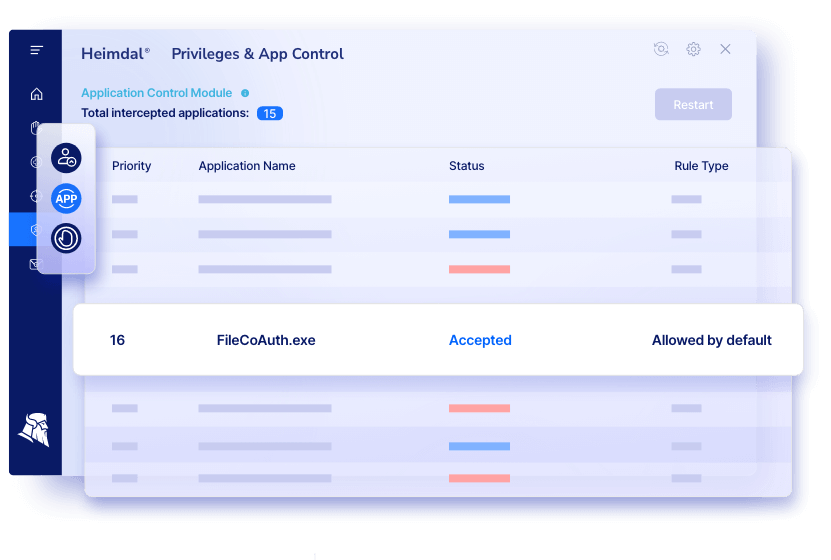
What it is. A PAM suite spanning privilege elevation, credential and session management and application control, available on its own or inside our unified security platform.
Best for. Enterprise and mid-market teams that need standing administrative rights gone quickly, and teams consolidating several security vendors onto one agent and one console.
Strengths. Rights are withdrawn automatically when our endpoint protection finds a threat on the device, closing the window between compromise and someone reacting.
Escalation can also be denied automatically for vulnerabilities at CVSS 7 and above.
The approval load stays off your helpdesk:
- Auto-pilot pre-approvals handle recurring requests
- ML-based auto-approval clears routine requests against historical behavior and thresholds
- Multi-channel approval from dashboard, email, or mobile for everything else
- Passive monitoring mode lets you watch real behavior before you enforce anything
PASM covers:
- Enterprise credential vault with LDAP-based account discovery
- RBAC with just-in-time grants and request-and-release password sharing
- Session recording, playback, and isolation
- SSH key management
Compliance reporting maps to NIS2, GDPR, ISO 27001, NIST AC-6, PCI DSS, HIPAA, and Cyber Essentials.
Trade-offs. We are endpoint-privilege-led, and that focus shapes where we are strongest.
If your requirements run deep into Unix and Linux delegation, machine-secrets management at CI/CD scale, cloud entitlement analysis, or agentless OT session brokering, the specialist enterprise platforms will go further.
Initial policy configuration takes real effort in large estates, and granular privilege rules have a learning curve, though most teams find their footing quickly.
Our value compounds when the wider platform is adopted, which makes this a consolidation decision as much as a PAM one.
On third-party evaluations, the leader-tier vendors have more coverage. Our MITRE ATT&CK mapping is publicly available on the Tidal Cyber Registry.
Search for Heimdal and you can see exactly which attack techniques and sub-techniques we detect and stop, down to the sub-technique level.
Transparent and independently verifiable any time.
CyberArk (Palo Alto Networks)
What it is. The broadest enterprise PAM and identity-security portfolio, now the identity pillar of Palo Alto Networks following completion of the acquisition in February 2026.
Best for. Large regulated enterprises with a dedicated identity team, a heterogeneous estate and a multi-year privileged access program.
Strengths. Coverage across credential and session management, endpoint privilege management, secrets including Conjur and the Venafi machine-identity portfolio, and cloud access. The deepest integration and partner network in the category. Established deployment patterns and references for very large regulated estates. CyberArk states it was named a Leader in the 2025 Gartner Magic Quadrant for PAM, its seventh consecutive placement, and positioned furthest in Completeness of Vision.
Trade-offs. Recurring themes in customer reviews include architectural and commercial complexity, a steep learning curve, overlapping SKUs and effortful upgrades, alongside premium pricing. Since February 2026, buyers also carry integration and roadmap uncertainty. Get written commitments on standalone availability, support continuity and license terms before you sign.
Pricing. Not published. Contact sales.
BeyondTrust
What it is. Identity-centric privilege security with unusually strong endpoint privilege management and third-party remote access.
Best for. Complex hybrid estates where supplier or contractor privileged access, or Unix and Linux least privilege, is the primary problem.
Strengths. Deep Unix, Linux and Windows privilege management heritage. Remote Support and Privileged Remote Access are unusually well developed for supplier access, including OT scenarios that require agentless brokering because controllers and HMIs cannot host an agent. The 2024 Entitle acquisition added cloud just-in-time access. BeyondTrust states it was named a Leader in the 2025 Gartner Magic Quadrant for PAM, its seventh consecutive time, and positioned highest for Ability to Execute.
Trade-offs. The portfolio is modular by design. A full footprint across credential and session management, endpoint privilege, remote access and cloud entitlements means several products. Recurring review themes include buyers discovering they need more SKUs than the original scoping suggested, with the cost and administrative overhead that follows.
Pricing. Not published.
Delinea
What it is. An enterprise PAM platform assembled from Thycotic and Centrify, then expanded by acquisition into governance (Fastpath), cloud entitlements and identity threat detection (Authomize) and modern infrastructure access (StrongDM, March 2026).
Best for. Organizations wanting enterprise-grade vaulting with less operational weight than the heaviest platforms, or PAM and developer infrastructure access from one vendor.
Strengths. Reviewers consistently rate Secret Server the most approachable of the enterprise vaults. Centrify-lineage Unix and Linux privilege delegation is a genuine strength. StrongDM materially closes the developer, Kubernetes and database access gap that classic PAM platforms struggled with. Delinea states it was named a Leader in the 2025 Gartner Magic Quadrant for PAM, its seventh consecutive recognition counting the Thycotic and Centrify lineage.
Trade-offs. Three acquisitions in roughly two years leaves integration work in progress, including overlapping products, inconsistent consoles and continuing SKU rationalisation. Ask which capabilities sit on one platform today versus on the roadmap. The architecture also assumes vaults and session brokers, which adds infrastructure, cost and deployment time compared with agent-based endpoint privilege products.
Pricing. Not published. Contact sales.
One Identity Safeguard (Quest)
What it is. Privileged access tied into a broader identity governance suite alongside Identity Manager and Active Roles.
Best for. Enterprises standardising on One Identity for governance that want privileged access governed by the same workflows and certifications.
Strengths. Strong privileged session management with transparent session recording. Genuinely valuable when governance and privileged access are bought together and joiner-mover-leaver processes need to drive privilege assignment.
Trade-offs. According to product documentation, cloud entitlement management is not native, and just-in-time access and governance capabilities depend on additional modules. The suite-led approach means more moving parts to operate.
Pricing. Not published. Subscription-based.
Netwrix Privilege Secure
What it is. According to product documentation, a PAM product built around ephemeral accounts and just-in-time access rather than vaulting permanent privileged accounts.
Best for. Mid-market and lower-enterprise buyers whose explicit objective is eliminating standing administrative accounts rather than managing them.
Strengths. Creating an account for the session and destroying it afterwards is architecturally stronger than vaulting a permanent account, because it removes the asset the vault exists to protect. Lighter to deploy than the enterprise platforms, and complementary to Netwrix’s audit and visibility heritage.
Trade-offs. Narrower breadth than the leader tier, with limited secrets management and cloud entitlement coverage, and a smaller partner network.
Pricing. Not published
WALLIX Bastion
What it is. A European PAM vendor built around agentless privileged session brokering, recording and audit, with a distinctive industrial and OT practice.
Best for. EU and EMEA organizations with sovereignty requirements, and industrial or OT environments needing agentless privileged session control.
Strengths. Clean session recording and audit. The agentless proxy architecture reaches OT equipment and network devices that cannot host an agent. EU data-residency positioning, and availability through the major cloud marketplaces with perpetual, annual and on-demand licensing.
Trade-offs. Narrower than the leader tier. The architecture centers on session brokering and audit rather than machine-credential lifecycle management or cloud entitlement analysis, so those pillars need additional tooling. Partner and integration depth outside EMEA is thinner.
Pricing. Not published. Multiple licensing models available.
ARCON PAM
What it is. An established vaulting and session-audit vendor whose primary strength is in APAC and the Middle East.
Best for. APAC and Middle East enterprises, particularly banking, where regional support and price are decisive.
Strengths. A mature password vault with aggressive rotation, detailed audit trails and analytics, and competitive commercials in its core regions.
Trade-offs. The user experience is dated relative to newer entrants. Presence, partner depth and support coverage in North America and Western Europe are limited. The portfolio is split across several products, which creates confusion during scoping.
Pricing. Not published. Request a quote.
ManageEngine PAM360
What it is. Cost-conscious PAM inside the broad ManageEngine and Zoho IT-management portfolio.
Best for. Budget-constrained IT teams already invested in ManageEngine that need vaulting, discovery and session audit quickly.
Strengths. Strong discovery of privileged and service accounts, which is exactly what most teams are missing at the start. Unusually good value. A natural fit where ServiceDesk Plus or ADManager Plus are already deployed.
Trade-offs. The center of gravity is discovery, vaulting and session audit. Endpoint privilege management is thinner here than in products built for it. Full session management is resource-intensive at scale. User-experience consistency across the wider portfolio varies.
Pricing. Not published. Request a quote.
KeeperPAM (Keeper Security)
What it is. According to product documentation, a zero-knowledge password and secrets management platform extended into a cloud PAM suite with a vault, secrets manager, connection manager with session recording and remote browser isolation.
Best for. Organizations already using Keeper as a password manager that want vaulting, secrets management and session recording without a program.
Strengths. Strong encryption architecture and compliance posture. Unusually simple deployment. A clear upgrade path from password management, which shortens both procurement and rollout.
Trade-offs. Endpoint privilege management is not its center of gravity, and deep Unix and Linux delegation and OT coverage are not comparable to the enterprise platforms. Business-tier pricing is published but PAM-tier pricing is quote-based, and the third-party per-user figures circulating for KeeperPAM are not vendor-published, so they are not quoted here.
Pricing. PAM tier is quote-based. Business password management tiers are published.
Admin By Request (FastTrack Software)
What it is. A focused endpoint privilege management product for removing local administrator rights and handling elevation requests across Windows, macOS and Linux.
Best for. Organizations whose immediate objective is eliminating standing local administrator rights at low cost and low operational effort.
Strengths. Narrow and very capable, with a fast rollout and minimal infrastructure. Granular approval workflows and session auditing built specifically for on-demand elevation. According to vendor licensing documentation it is licensed per endpoint rather than per user, and a free tier is available for small estates.
Trade-offs. Not a vault-first platform. Server credential management, rotation and full session brokering are limited compared with platform vendors, so you will be buying a second product for those pillars. It also carries no patching, endpoint detection or email security, so it sits alongside your existing stack rather than reducing it.
Pricing. Per endpoint, with a published free tier for small estates. Verify current rates with the vendor.
ThreatLocker Elevation Control
What it is. Application-level elevation inside a default-deny allowlisting platform.
Best for. Buyers prioritizing endpoint hardening who want elevation control as part of allowlisting rather than as a separate purchase.
Strengths. Elevation granted to a specific approved application inside a default-deny model is architecturally stronger than elevation on its own, because the set of things that can run is already constrained.
Trade-offs. This is an endpoint control platform with an elevation module, not a PAM suite. There is no credential vault and no privileged session brokering for servers or cloud.
Pricing. Not published. Contact sales.
What matters most when you evaluate privileged access management
Microsoft Entra ID and Privileged Identity Management
What it is. Not a full PAM suite. A set of privileged-identity controls for Microsoft-centric estates, covering eligible role assignment with approval and time-bound activation, access reviews and Conditional Access.
Best for. Microsoft-only estates where privileged risk is concentrated in Entra and Azure roles, and elsewhere as one component of a wider architecture.
Strengths. Often already licensed, which removes both a procurement cycle and a vendor to onboard. Strong for Entra and Azure role just-in-time activation and periodic access reviews. The Privileged Identity Management module gives time-bound eligible role activation and access review.
Trade-offs. It does not vault or rotate credentials for non-Microsoft targets, does not record sessions in the PAM sense, and does not manage privileged access to Linux, network devices or databases. License tiering is genuinely hard to navigate, and coverage outside the Microsoft estate is minimal.
Pricing. Per Microsoft’s pricing page as of mid-2026, a free tier is included with Microsoft 365, Entra ID P1 is approximately $7 per user per month, P2 approximately $10, and Entra ID Governance is an add-on at approximately $7. Re-verify before you budget.
Okta Privileged Access
What it is. Cloud-native privileged access for servers and infrastructure, extending Okta Workforce Identity.
Best for. Okta-standardized, cloud-first organizations with server and infrastructure access needs and little legacy or OT estate.
Strengths. One identity control plane, with onboarding and offboarding inherited from Okta lifecycle management and no separate directory integration project.
Trade-offs. Audit and compliance reporting is less mature than in dedicated PAM platforms. Policy is oriented around groups and teams rather than individual grants, which is worth verifying against current documentation because it evolves. The resource-unit pricing model is hard to forecast, which hurts budgeting more than the headline rate suggests.
Pricing. Priced per resource unit. Get the current rate directly from Okta and model it against your real server count.
JumpCloud
What it is. A cloud directory with device management, SSO and MFA, offering capability adjacent to privileged access rather than a PAM platform.
Best for. Lean teams replacing Active Directory, MDM and SSO, where “PAM” means central identity plus control over administrative rights.
Strengths. Replaces three tools at once for small and mid-market teams. Transparent published pricing. Fast to stand up.
Trade-offs. It is not a PAM platform. There is no enterprise-grade session recording and no credential rotation for third-party targets. Some users report gaps in reporting and audit depth, and in macOS management depth relative to dedicated MDM tools.
Pricing. JumpCloud publishes modular package pricing on its own site with annual billing. A free tier previously existed for small numbers of users and devices; as of early 2026 the vendor’s pricing page shows a 30-day trial rather than a permanent free plan, so verify current availability directly. Published third-party figures conflict with each other and packaging changes often, so take the number from the vendor’s page and date it.
Which PAM tool to shortlist, by situation
You have a small IT team and no dedicated privileged access owner. Start with endpoint privilege management and get standing local admin rights gone. Heimdal, Admin By Request and ThreatLocker Elevation Control all deliver a visible result in weeks. Add vaulting, rotation and session recording once the first outcome is banked.
You are consolidating vendors as well as fixing privilege. Price the platform, not the module. Our unified platform covers privilege alongside DNS, patching, endpoint and email on one agent. Compare that against your current combined spend, not against a standalone PAM license.
You run a large regulated estate with a dedicated identity team. CyberArk and BeyondTrust are the deepest, and Delinea is the lighter enterprise option. Budget for professional services, and get the post-acquisition roadmap and support commitments in writing.
Your biggest exposure is suppliers and contractors. BeyondTrust Privileged Remote Access and WALLIX are built for this. Test agentless brokering against your least cooperative target before anything else.
You want standing administrative accounts to stop existing. Look at ephemeral-account architectures. Netwrix Privilege Secure, Delinea with StrongDM and BeyondTrust with Entitle are the credible starting points.
Your privileged risk is developers reaching Kubernetes, databases and cloud APIs. Modern infrastructure access fits better than classic PAM. Teleport, StrongDM inside Delinea and Okta Privileged Access are the shortlist. Developer experience is a security control here, because developers route around tooling that breaks their workflow.
You are a Microsoft-only estate. Entra ID P2 with Privileged Identity Management may already cover your concentrated risk. Map the gap honestly for Linux, network devices, databases and session recording before you conclude you are done.
You need EU sovereignty or OT coverage. WALLIX first, with BeyondTrust as the enterprise comparison.
Compliance is the trigger. PCI DSS v4.0 is the most prescriptive driver available, and its future-dated requirements have been mandatory since 31 March 2025. Requirement 7 covers the principle of least privilege by job function, 8.4.1 and 8.4.2 cover MFA for administrative and general access into the cardholder data environment, and 8.6 covers application and system account credentials.
DORA Article 9(4) and the associated technical standards point at time-limited privileged access, periodic review and minimization of shared accounts. NIS2 Article 21(2)(i) and (j) require access control and strong authentication, though the precise obligation varies by member state, so treat “NIS2 requires PAM” as an interpretation rather than a citation.
Whatever you shortlist, the four proof-of-concept tests above decide it. Run them on your own hardest systems, with your own administrators, doing their own real work.


