


 Network Security
 Vulnerability Management
 Privileged Access Management
  Endpoint Security
 Threat Hunting
 Unified Endpoint Management
 Email & Collaboration Security


The NIS2 Directive is the EU law that sets cybersecurity rules for organisations in 18 critical sectors.
It asks for technical security measures, incident reporting to your national authority and oversight by your management. Software can support all three, but it can’t submit the reports or sign off the measures for you.
This guide compares the best NIS2 compliance software from five providers:
- Heimdal
- Vanta
- Syteca
- Trend Micro Vision One
- DataGuard
5 best NIS2 compliance software providers
The five providers below sit in different categories. Before you decide which fits better with your expectations, assess your organization and see what gaps you need to close.
None of these 5 top NIS2 compliance software providers cover every NIS2 requirement alone.
1. Heimdal
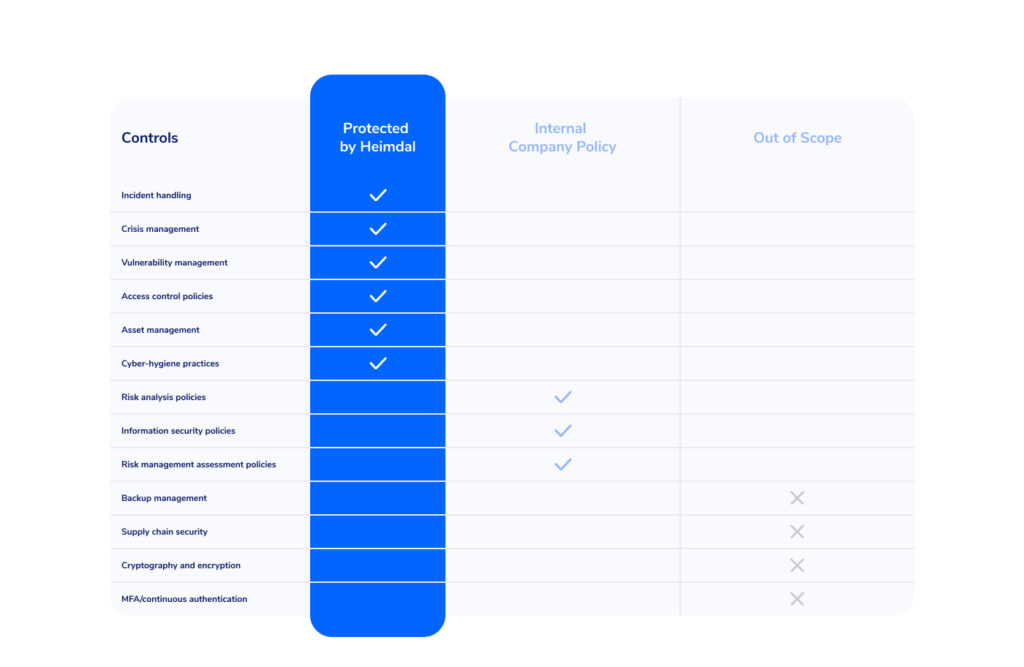
Heimdal is a Danish security platform that serves over 20,000 companies. Its XDR platform is modular, so you can pick and choose whatever you want from the stack. The platform includes these modules.
- Next-Gen Antivirus and firewall
- Ransomware Encryption Protection
- Patch and Asset Management for Windows, macOS, Linux and 350+ third-party applications
- DNS Security for network and endpoint
- Privileged access management with PEDM, PASM and Application Control (explained below)
- Email Security
- Threat-hunting and Action Center
- Remote Desktop, BitLocker Management and USB management
A 24/7 SOC team is also available, if you go for their MXDR.
For the measures these modules cover, your NIS2 evidence comes from one console instead of a separate tool for each.
Best for
Mid-market and enterprise teams that need to cover the technical measures in Article 21 and produce NIS2 evidence from one console.
Strengths
Heimdal’s NIS2 report includes real-time risk scoring, endpoint hygiene, unsecured device detection and encryption-policy gaps.
You can run it on demand or on a schedule and export it as a PDF. Each report covers up to 30 days.
- Privileged access management, which controls who gets admin rights, supports the access-control measures in Article 21. Privilege Elevation and Delegation Management (PEDM) handles requests for admin rights and keeps a full audit trail. Privileged Account and Session Management (PASM) adds a credential vault, session monitoring and recording, and just-in-time access. Application Control decides which applications are allowed to run.
- Patch and Asset Management automates operating-system and third-party patching, with 350+ third-party applications supported, and keeps an asset inventory. That gives you evidence for vulnerability handling and asset management.
- Ransomware Encryption Protection uses several detection engines to catch malicious file encryption on endpoints. DNS Security blocks connections to malicious domains. Both support the incident-handling and cyber-hygiene measures in Article 21.
- With MXDR, a SOC team watches your alerts 24x7x365 and handles incident response. So you’re covered if an incident starts at night or over a weekend.
Trade-offs
Heimdal is not a GRC system. You’ll need a separate tool or process for policy management, supplier-risk assessment, management-body records and regulatory submissions.
It also doesn’t cover management oversight under Article 20 and doesn’t submit incident reports to your authority for you.
Pricing
Heimdal’s modular approach lets you add or remove tools from the platform depending on your requirements.
This means you can select from 12 different products and services and only pay for what you use.
Because pricing depends on exactly which tools you choose, you need to use Heimdal’s calculator to request an exact quote.
2. Vanta
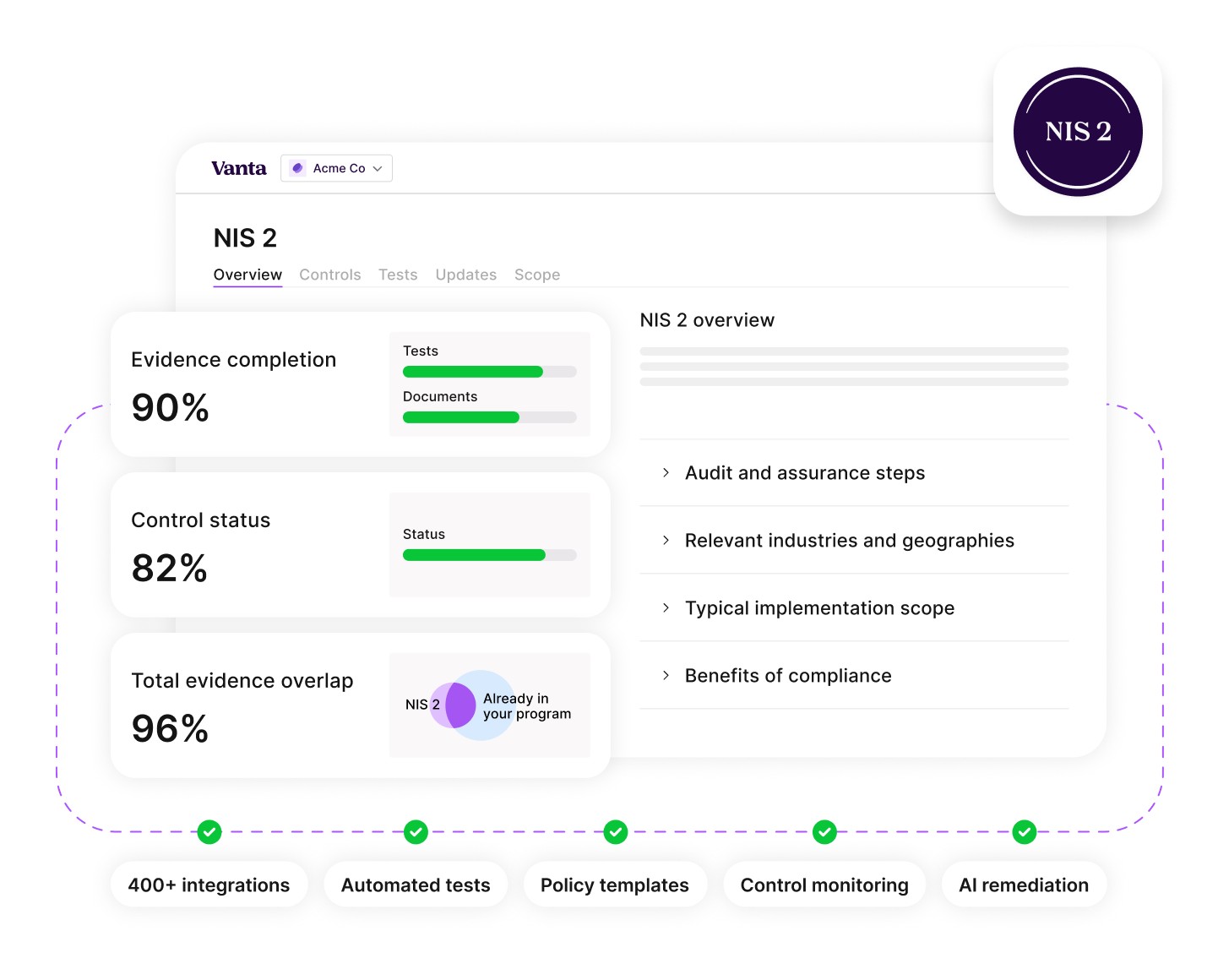
Vanta is a US compliance automation platform with a dedicated NIS2 product. It connects to your cloud, identity, code and device tools, collects evidence automatically and tracks the status of your measures.
Best for
Teams whose evidence lives in cloud and software-as-a-service tools and that want one place for policies, supplier risk and audit evidence.
Strengths
Vanta’s NIS2 page states 400+ integrations and 1,400+ automated tests that check your controls hourly. It describes a tracker that shows who owns each NIS2 measure and its status, scoping by sector, size and national rules, policy templates and supplier-risk assessment.
It also lists risk workflows based on ISO 27005 and issue tracking for incidents and corrective actions. Vanta states that its in-house GRC team updates frameworks and templates as NIS2 guidance and national rules change.
Trade-offs
Vanta collects evidence from your tools but doesn’t run security measures itself, so you still need tools for patching, access control and detection.
Its incident support is issue tracking, so ask for a live walkthrough of the 24-hour, 72-hour and one-month stages.
The page doesn’t say how deeply it maps individual national laws or where your data is hosted, so ask both in a demo.
Pricing
Vanta doesn’t publish prices. You request a demo to get a personalised quote. Its pricing page lists four plans, and some features, such as third-party risk reviews, are add-ons, so ask what’s included.
As of October 2026, third-party estimates for this type of platform typically run to five figures a year, depending on company size, frameworks and modules.
3. Syteca
A user activity monitoring and privileged access management platform focused on insider risk, meaning misuse of access by people inside the organisation. The company is based in Needham, Massachusetts, and rebranded from Ekran System in 2024.
Best for
Organisations whose gap assessment flags privileged access or insider risk as the main weakness.
Strengths
Syteca’s NIS2 page describes session recording, privileged-account discovery, granular access control, real-time alerting and audit trails.
These support the incident-handling, access-control and authentication measures in Article 21.
The company states it holds certification to ISO/IEC 27001, the international standard for information security management.
Trade-offs
The scope is narrow. Syteca doesn’t address supply-chain security, business continuity or governance, so it needs other tools alongside it.
Pricing
Quote-based as of October 2026.
4. Trend Micro Vision One
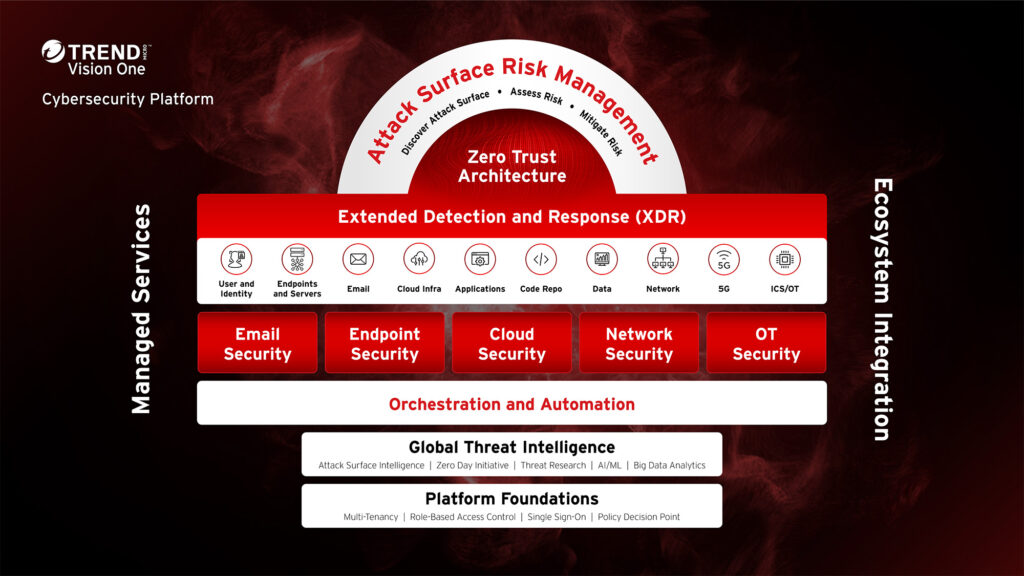
This is an extended detection and response (XDR) platform from Japan-headquartered Trend Micro.
Trend Micro’s NIS2 page maps its tools to areas of Article 21, including risk management, incident handling, supply-chain security and access control.
Best for
Larger security teams already invested in Trend Micro that want detection and response evidence for the technical measures in Article 21.
Strengths
Vision One XDR and Trend Service One Complete cover incident management, with automated response and 24/7 expert support. Zero Trust Secure Access checks each access request and monitors multi-factor authentication.
Trade-offs
Trend Micro Vision One isn’t a GRC tool, so policies, supplier assessments and management records sit outside it. Their NIS2 page doesn’t mention the 24-hour and 72-hour reports or name a NIS2 report, so ask for a live walkthrough of the reporting stages.
Pricing
Pricing is not public. Licensing is credit-based, so estimate how many credits your estate and modules will use before you commit.
5. DataGuard
DataGuard is a Munich-based compliance and security software company with a dedicated NIS2 framework page. It combines software with expert-led guidance and also covers ISO 27001 and TISAX.
Best for
Small and mid-sized teams with little compliance staff that want expert guidance alongside the software.
Strengths
The platform offers a pre-configured NIS2 framework with mapped controls, risk assessments and policy support.
It tracks progress in dashboards and reports and automates evidence collection. It also includes employee e-learning modules and an online NIS2 Checker to see whether you’re likely in scope.
Trade-offs
It documents and monitors measures rather than running them, so you still need security tools for patching, access control and detection.
The pages describe automated incident reporting but mention only the 24-hour deadline, so ask for a live walkthrough of all three reporting stages.
They don’t say where data is hosted or how many integrations the platform has.
Pricing
For price info book a call or a demo.
Keep Reading:
NIS2 Compliance - How to Do It Sustainably by Continuous Compliance


How NIS2 compliance tools differ
NIS2 compliance software falls into three categories. Most organisations need at least two of them.
- Security tools run the technical measures. Article 21 of the NIS2 Directive covers cybersecurity risk-management measures, such as patching, access control, encryption, backup and incident handling. Security tools carry out many of these measures and produce the logs and reports that show they work. In this guide, Heimdal, Syteca and Trend Micro Vision One are in this category.
- Compliance platforms hold the paperwork side of the programme. This category includes governance, risk and compliance (GRC) software, information security management system tools and compliance automation, which pulls evidence from your other systems. They keep the risk register (your list of risks and how you handle them), policies, supplier assessments and audit workflow. Vanta and DataGuard are in this category.
- Advisory services give you people rather than software. Consultants run gap analyses, write roadmaps and support the programme over time.
When you read vendor pages, separate NIS2 mapping from operational coverage. Mapping shows how a feature matches Article 21. Operational coverage means the tool runs the measure and keeps a record that it ran.
Used well, these tools:
- run and record technical measures
- hold your risk register and policies
- track remediation tasks
- build evidence packs for auditors
Some also give you templates and timers for incident reports.
Learn how Heimdal helps comply with:
EU'S NIS2 DIRECTIVE
Know your part in NIS2 compliance
Five duties stay with your organisation no matter what you buy.
- Deciding whether an incident is significant. Someone in your organisation makes that call, often out of hours.
- Submitting the reports. Article 23 of the NIS2 Directive covers incident reporting. For a significant incident, it requires three reports. The first is an early warning, due within 24 hours of becoming aware of the incident. The second is a notification within 72 hours. The third is a final report within one month of the notification. Your team sends these to your national authority or CSIRT (Computer Security Incident Response Team).
- Approving the measures. Article 20 of the NIS2 Directive covers management oversight. Your management body must approve the risk-management measures and oversee how they’re put in place.
- Training your management. Article 20 also requires management to follow training, and managers can be held liable for infringements.
- Registering with your national authority.
What to focus on when choosing a NIS2 tool
Test each tool against your own gaps.
- Start with the weak spots your assessment found. If patching and privileged (admin) access are the weak spots, you need a security tool. If policies and supplier assessments are missing, you need a compliance platform or a defined process.
- Separate operational coverage from documentation. Ask each vendor to name the measures its product runs and the ones it only maps or stores.
- Test incident reporting live. Ask for a walkthrough of the 24-hour early warning, the 72-hour notification and the one-month final report, including who gets alerted and what the tool records.
- Look at the evidence export. Ask for the actual report an auditor would receive, not a dashboard screenshot. Read our NIS2 compliance guide.
- Check national law and hosting. Ask whether the tool’s NIS2 content reflects your Member State’s law, for example registration with Germany’s Federal Office for Information Security (BSI). Ask where your data is hosted and which third parties (sub-processors) handle it.
- Work out the total cost of ownership. Include licences, implementation, services, add-on frameworks and the staff time to run the tool.
- Run a short proof of concept. Trial the tool on a representative slice of your estate, then generate the evidence pack at the end.


