


 Network Security
 Vulnerability Management
 Privileged Access Management
 Endpoint Security
 Threat Hunting
 Unified Endpoint Management
 Email & Collaboration Security



Contents:
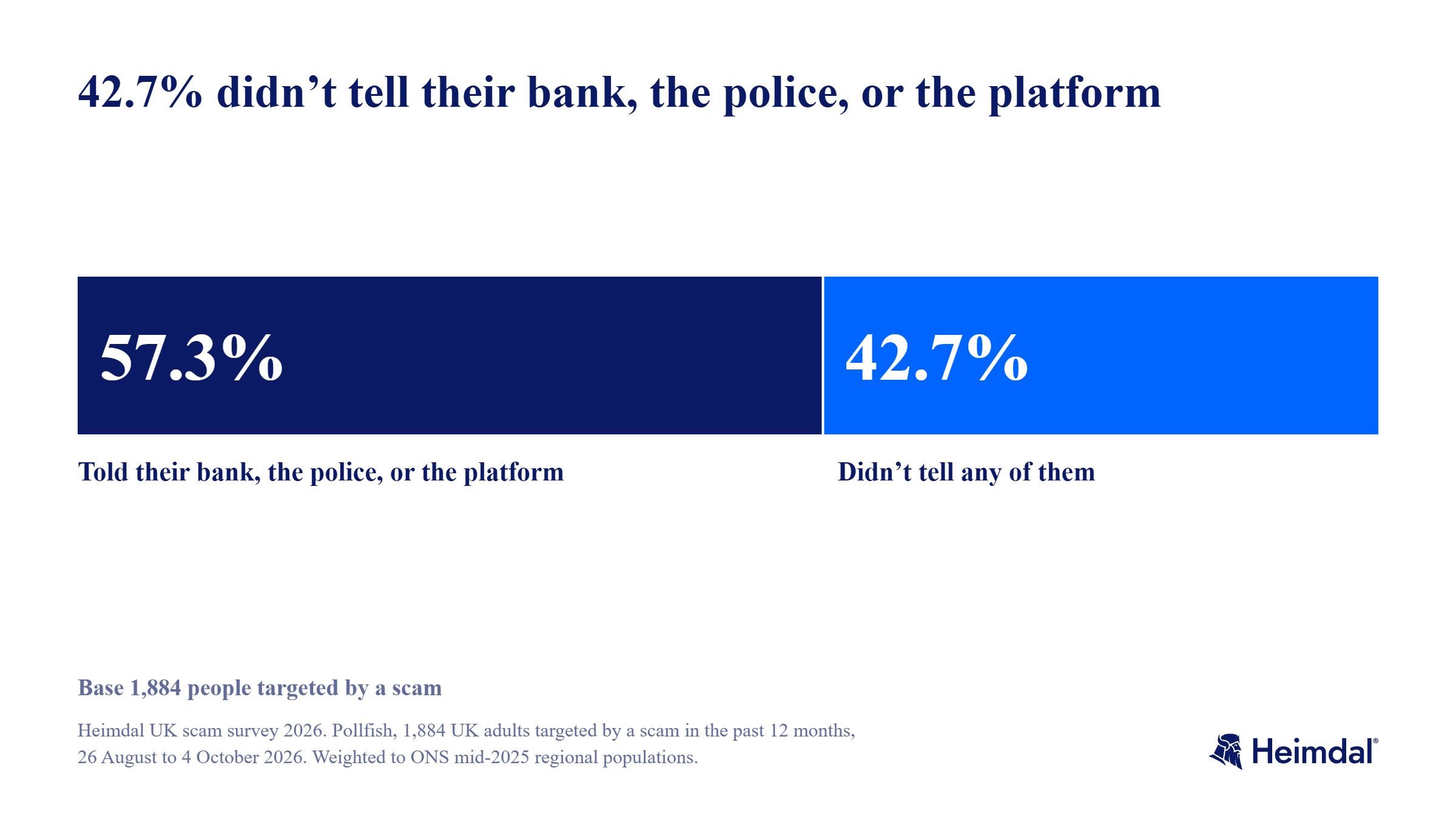
More than four in 10 people targeted by scammers didn’t tell their bank, the police, or the platform.
Instead, many told someone close to them while not many said embarrassment was a reason.
Key findings
- 42.7% of people targeted by a scam didn’t tell their bank, the police, or the platform (based on 1,884 people)
- Of those, 47.2% said they’d lost nothing, so it didn’t seem to matter. 7.2% said they were embarrassed (based on the 800 people who didn’t report it)
- 24.4% told only family or friends (based on 1,884 people)
- 11.7% of people who lost money didn’t tell their bank, the police, or the platform, against 49.9% of people who lost nothing (based on 348 people who lost money and 1,518 who didn’t)
- 35.7% of 25 to 34 year olds targeted by a scam lost money, more than any other age group and more than five times the rate for over-65s, at 6.8% (based on 340 people aged 25 to 34 and 384 aged 65+)
Nearly half thought it didn’t matter because they’d lost nothing
47.2%
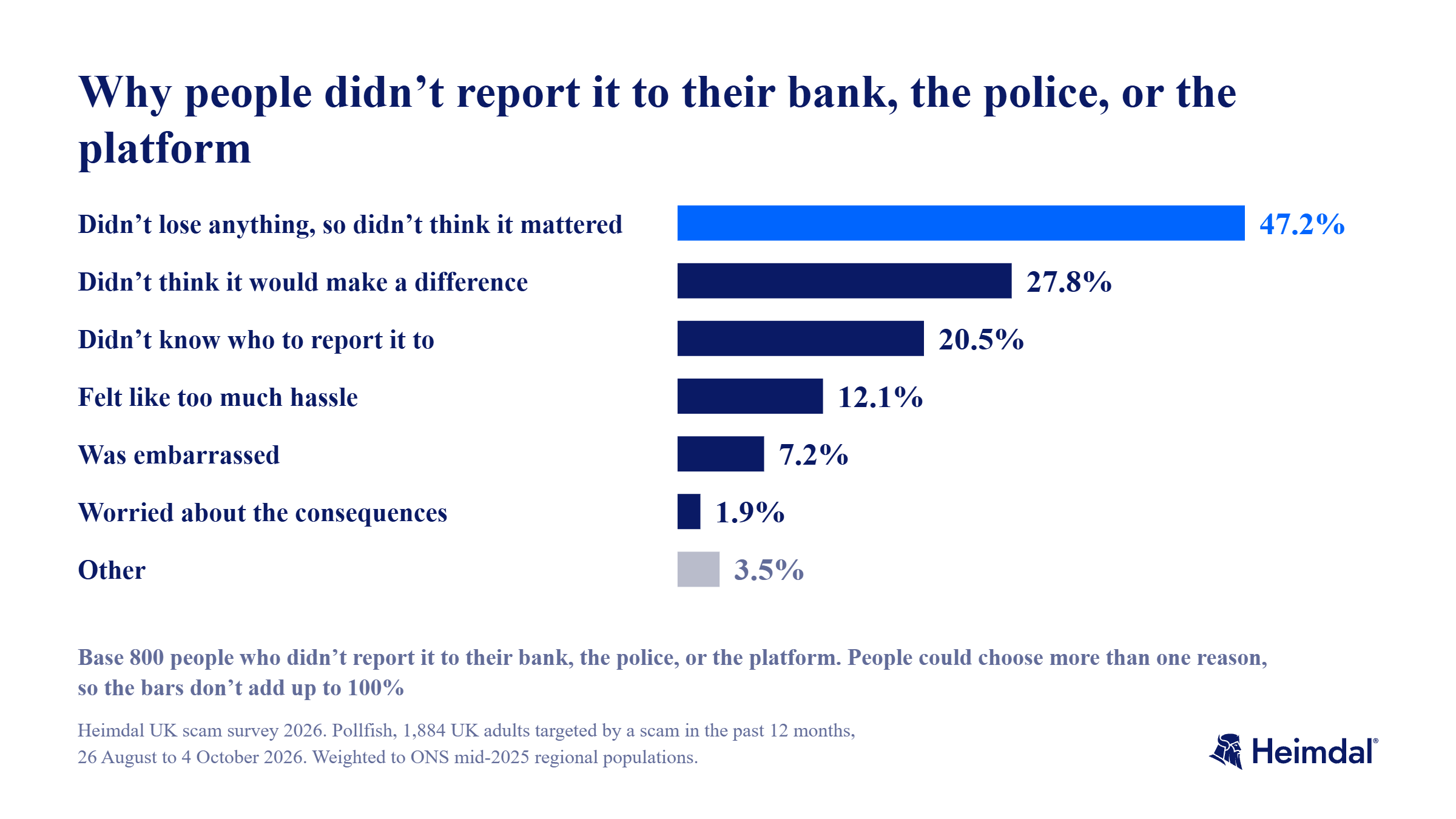 Of the people who didn’t report a scam to their bank, the police, or the platform, 47.2% said they hadn’t lost anything, so it didn’t seem to matter.
More than a quarter (27.8%) didn’t think reporting it would make a difference. A fifth (20.5%) didn’t know who to report it to. People could give more than one reason, and the ones at the top of the list are practical.
Embarrassment came fifth of the six named reasons, at 7.2%.
A scam that didn’t cost you anything is still worth reporting as reports help the authorities take scams down. If you’re not sure who to tell, the contacts are in the ‘What you can do’ section, further down.
One in four told only family or friends
24.4%
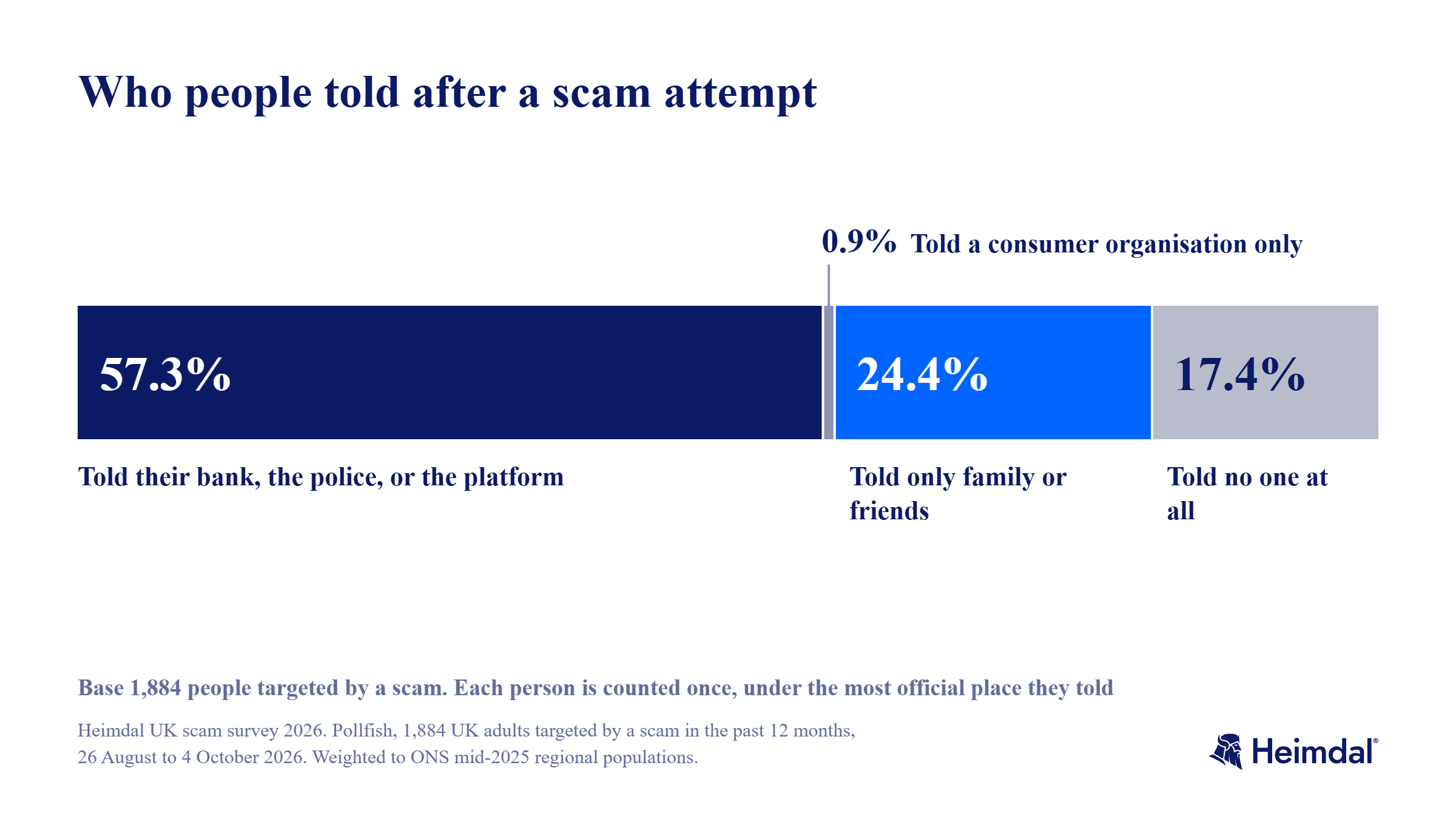
Almost a quarter of people targeted by a scam told only family or friends while another 17.4% told no one at all.
Women targeted by a scam were more likely than men to tell only family or friends, with 28.8% up against 19.7%. Talking it over with someone close makes sense but doesn’t get the scam in front of anyone who can act on it officially.
If someone tells you a scammer tried it on them, help them report it. If they’ve lost money, the first call is to their bank, or to 159. If they haven’t, the right place for each kind of scam is in the ‘What you can do’ section below.
You can even just forward a scam text to 7726.
People who lost money were far more likely to tell their bank, the police, or the platform
11.7%
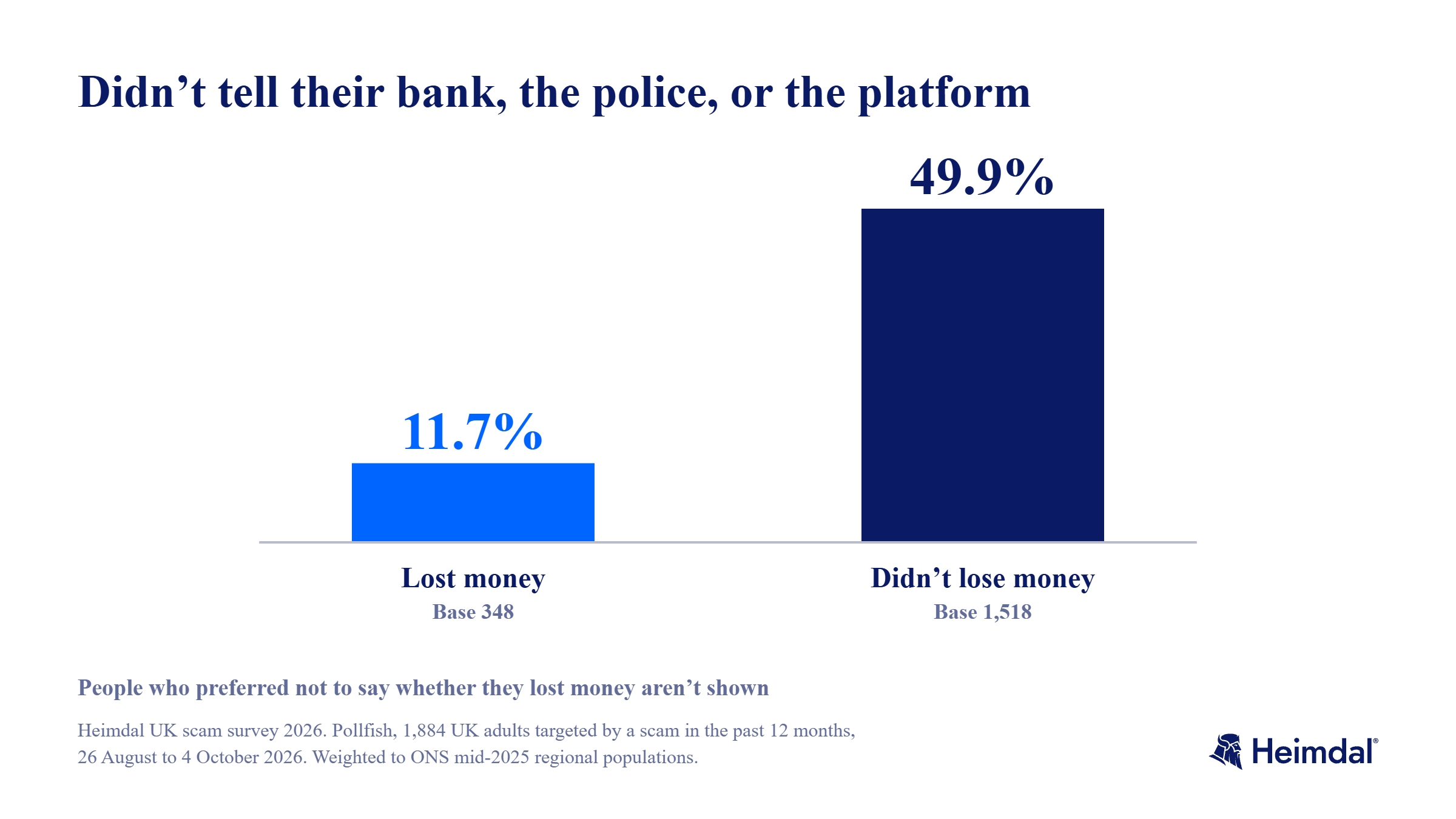
18.4% of people targeted by a scam lost money. Of them, 11.7% didn’t tell their bank, the police, or the platform. Half of the people who lost nothing didn’t report, which is over four times the rate.
Losing money gives people a clear reason to call their bank, though the survey didn’t ask why people reported, so we can’t be sure that’s what made the difference.
If money has gone, contact your bank straight away. You can call 159 to reach it.
A third of people who told no one didn’t change how careful they are online
33.6%
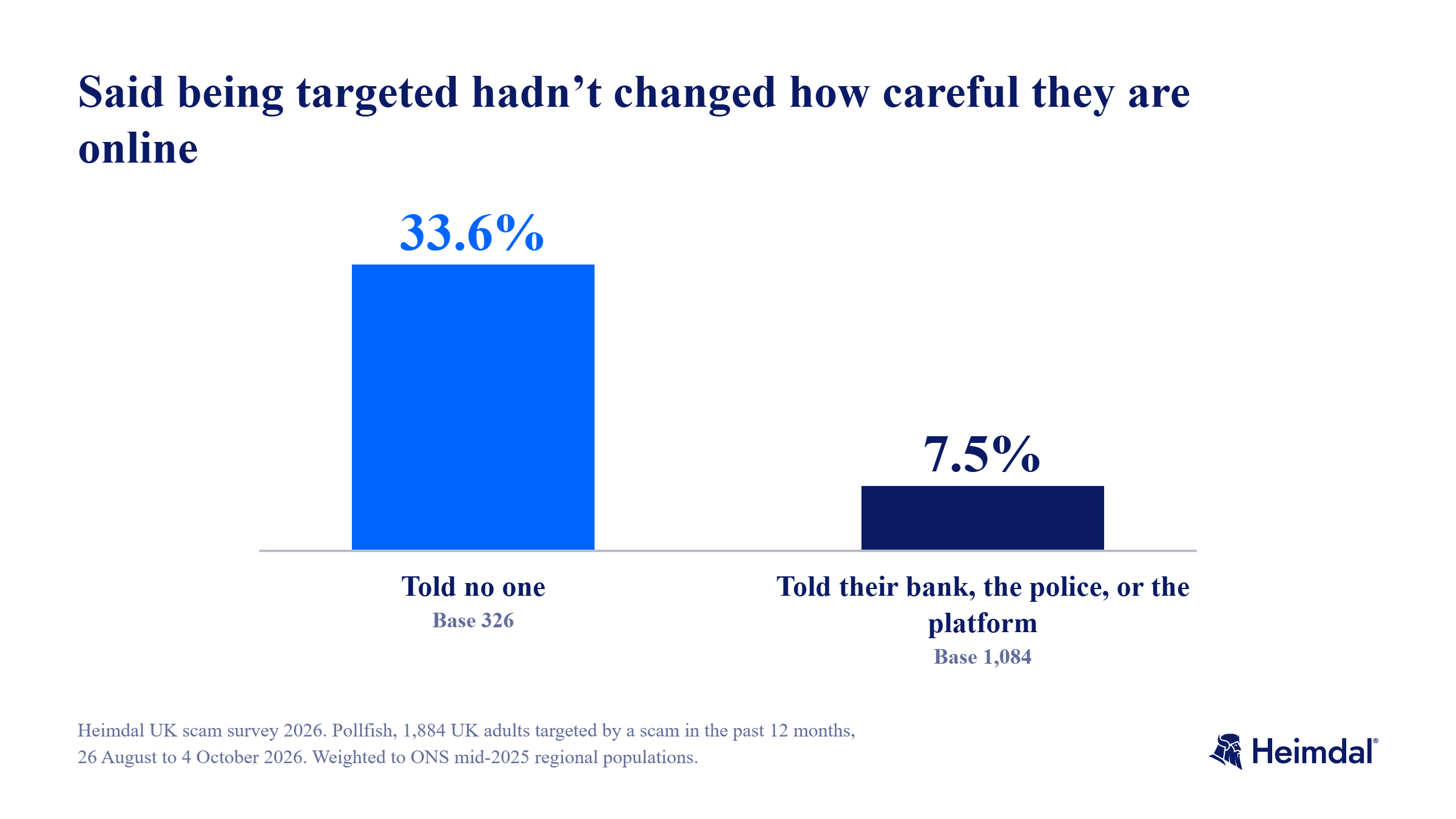
A third of people who told no one said being targeted hadn’t changed how careful they are online. Among people who told their bank, the police, or the platform, it was 7.5%.
There’s a gap on money too.
2.1% of people who lost money said nothing had changed, against 19.9% of people who lost nothing.
If the scam email is still in your inbox, you can still report it by forwarding to report@phishing.gov.uk.
Fake bank, police, and government calls reached 18 to 24s far more than over-65s
60.5%
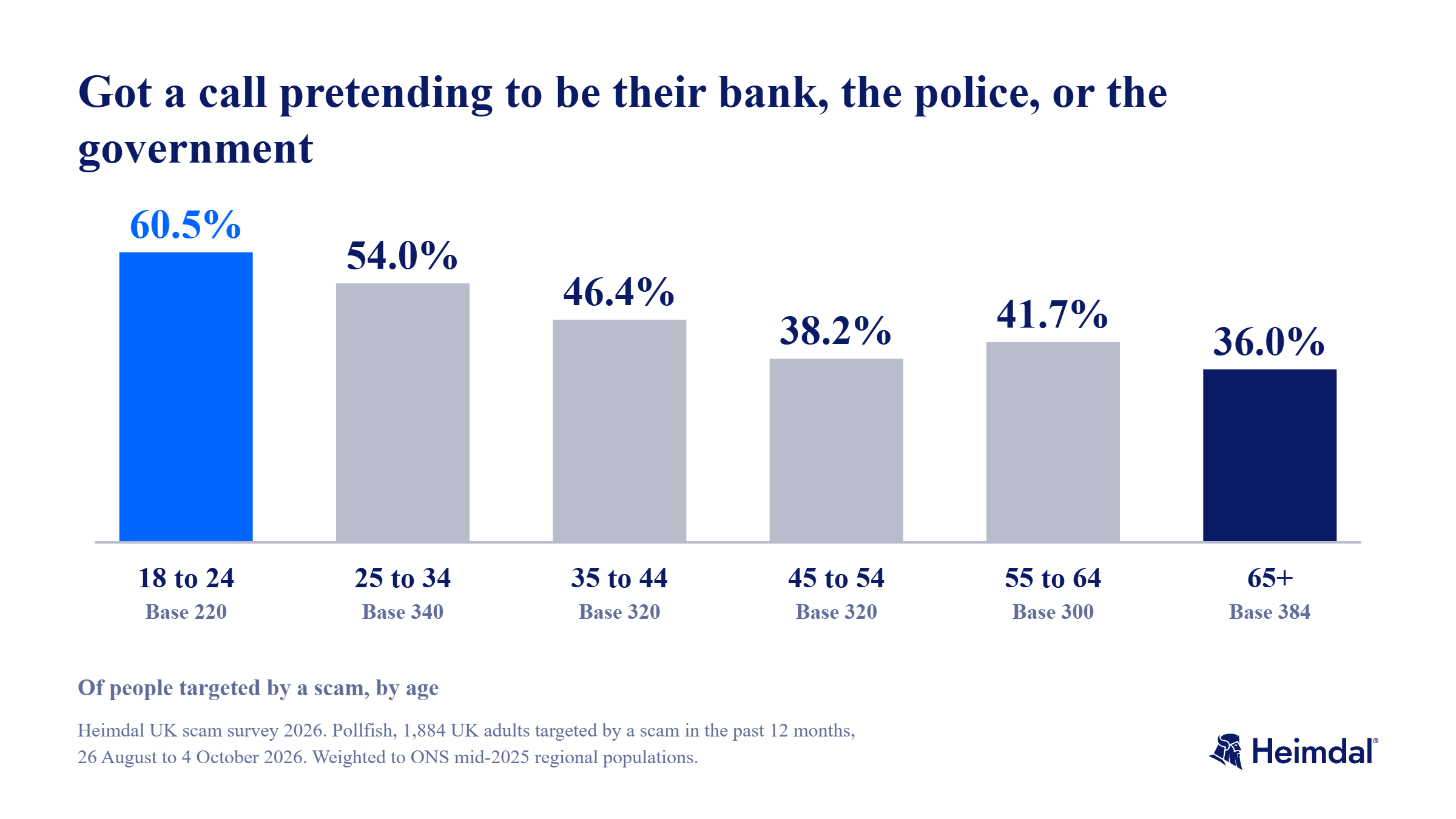
60.5% of 18 to 24 year olds targeted by a scam got a call pretending to be their bank, the police, or the government. For over-65s, the figure was 36.0%.
Your bank or the police will never ask you to move money to a ‘safe account’, even one in your name. So if a caller asks, they aren’t who they say they are. If you get an unexpected call about your money, hang up and call 159 to reach your bank.
25 to 34 year olds were the most likely to lose money
35.7%
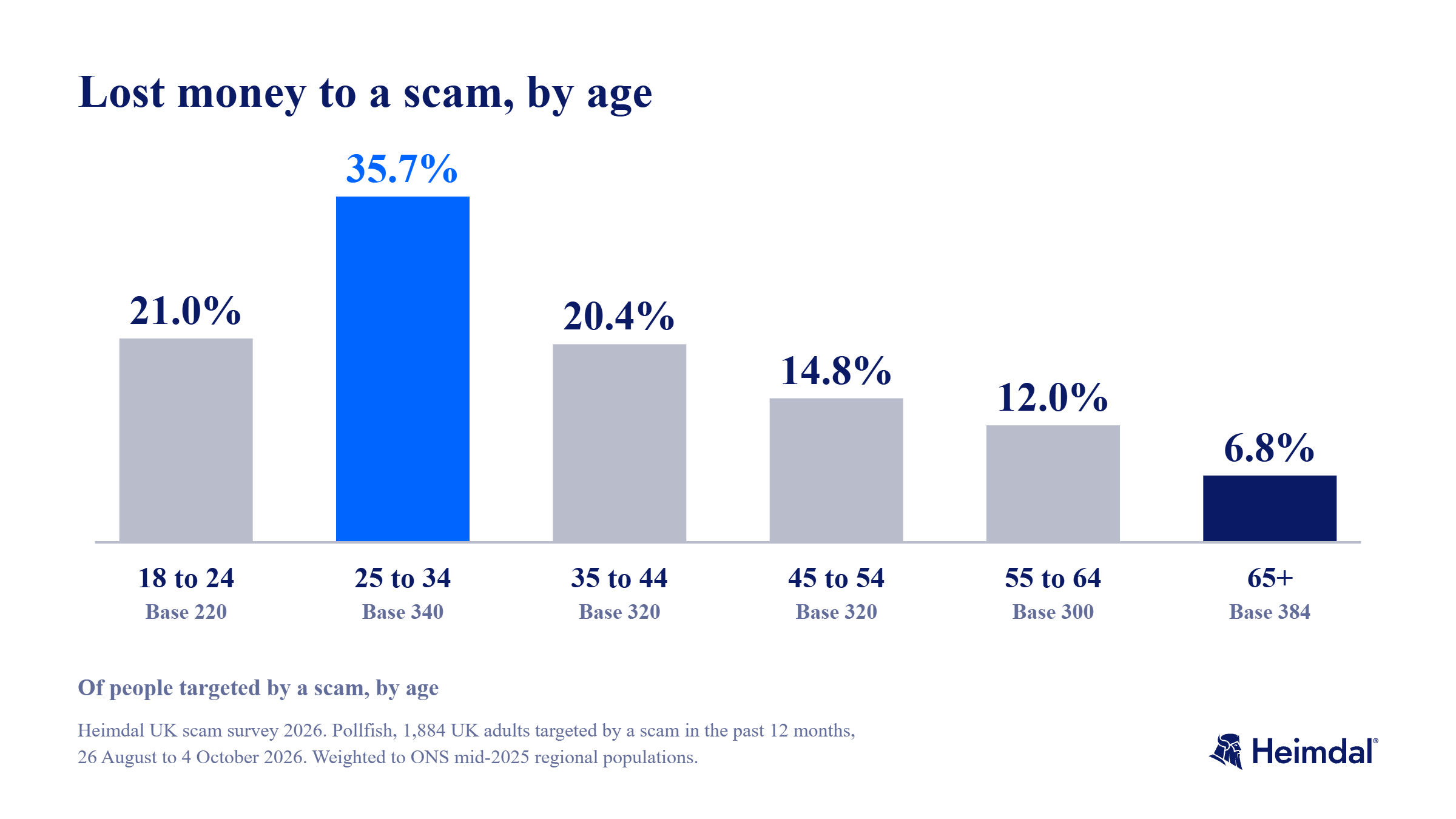
35.7% of 25 to 34 year olds targeted by a scam lost money. That’s more than any other age group, ahead of 18 to 24s (21.0%) and 35 to 44s (20.4%).
25 to 34s were more than five times as likely to lose money as over-65s (6.8%). People in full-time work lost money more often than everyone else, with 23.7% against 11.9%, and the gap held once age was taken into account.
Genuine banks won’t pressure you to act on the spot about your money. If someone is hurrying you to pay, that’s the moment to stop and check.
Losing money to a scam was more common in London and less common in the devolved nations
We compared each region with the rest of the UK, then checked whether any difference was down to the ages of the people who answered.
In London, more than a quarter of people targeted by a scam lost money (27.0%), against 16.8% across the rest of the UK.
In the devolved nations, fewer than one in eight people targeted by a scam lost money, against one in five across the rest of the UK.
In the East of England, people targeted by a scam were less likely to have a fake or too-good-to-be-true shopping deal tried on them, 23.9% against 32.1% across the rest of the UK.
In the North, the Midlands, and the South, responses were in line with the rest of the UK.
Regional figures are unweighted. Each region is compared with the rest of the UK, not with a UK total that includes it.
Report a scam even when you haven’t lost anything
NCSC says that as of September 2026 it had received more than 59.6 million scam reports, and about 264,000 scams had been taken down across 466,300 web addresses.
“During my time in the police, investigating cybercrime, I found time and time again that intelligence was the lifeblood of my investigations,” said Adam Pilton, cybersecurity advisor at Heimdal Security and former cybercrime Detective Sergeant with Dorset Police.
“When it comes to cybercrime investigations, you often have very little information to go off. That is why the reports from other people were impactful. Maybe the same telephone number or email address had been used across multiple separate scams. All of this feeds into the investigations and enables law enforcement to identify and bring to justice those involved in these crimes.”
Where to report depends on where you live and what happened.
- In England, Wales, and Northern Ireland, report fraud to Report Fraud at reportfraud.police.uk or on 0300 123 2040.
- In Scotland, call Police Scotland on 101.
- If you’ve lost money, contact your bank straight away, or call 159.
- If you get an unexpected call about your money, hang up and call 159 to reach your bank.
- Forward scam texts to 7726.
- Forward scam emails to report@phishing.gov.uk.
How we ran the survey
Heimdal commissioned the survey, and Pollfish ran it. Pollfish surveyed 1,884 UK adults who said someone had tried to scam them in the past 12 months. Fieldwork ran from 26 August to 4 October 2026.
We commissioned 2,000 responses. Pollfish didn’t fill the London and East of England quotas, which leaves 1,884.
Regional quotas were equal across six region groups. Age and gender quotas matched the UK population. We weighted every figure except the regional ones to ONS mid-2025 adult populations across 12 regions. The effective sample size is 1,754, and the margin of error is up to ±2.3 points for figures based on everyone who answered.
Regional figures are unweighted. We compared each region with the rest of the UK, then checked whether any difference we found was down to age. The number of people surveyed in each region was North 334, Midlands 333, East of England 243, London 307, South 333, and devolved nations 334. We tested differences at 95% confidence.
The question named “Action Fraud or the police”. Report Fraud replaced Action Fraud in England, Wales, and Northern Ireland on 4 December 2025, inside the 12-month period people were asked about. Pollfish is an app-based panel, which is worth bearing in mind for the age findings.
The data is available on request.


