


Contents:
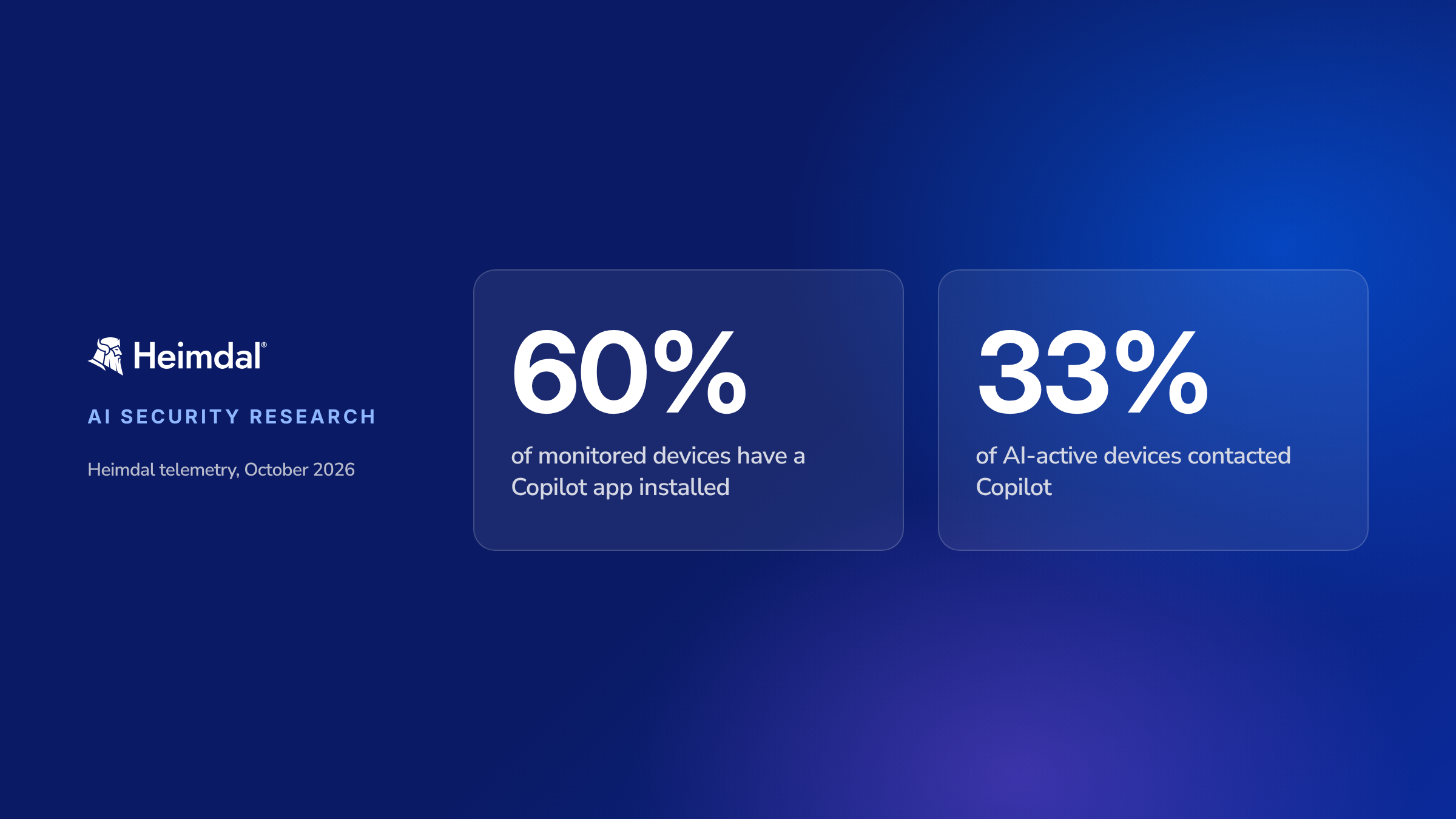
In October we looked at two sets of numbers from the devices Heimdal monitors. On the devices where we see installed software, 60% had a Microsoft Copilot app installed. On the devices where we log every DNS lookup, 13% contacted Copilot
Those figures come from different pools of devices, so they aren’t a conversion rate. But they point the same way. Copilot is on most of these devices, and it isn’t what most of them reach for. More AI-active devices in our data contacted Claude than any other AI service.
That’s the snapshot.
What interests me more is what happens next. Microsoft is now folding Copilot into licences businesses already pay for, and I expect those dormant installs to wake up. Not because staff suddenly prefer Copilot, but because buyers don’t like paying twice and Copilot is the easiest AI for IT to see and control.
The result is that the company that already runs your operating system moves to the centre of how AI reaches your business data. Nobody has to do anything wrong for that to be a problem.
How did Copilot get onto 6 in 10 of the devices we monitor?
Microsoft didn’t wait to be asked. It now installs the Microsoft 365 Copilot app in the background on Windows devices running commercial Microsoft 365 desktop apps. It’s the app that started life as the Office hub. Admins can opt out, but the default is to install.
Microsoft paused that rollout earlier this year, and its own documentation now describes the automatic install as live again. The opt-out is Microsoft’s control, by the way, not something we added.
Our data can’t tell us how each install got there, or exactly which of Microsoft’s Copilot apps every device has. What it does show is that installs vary by region. Copilot is on 54% of the devices we monitor in Western Europe and 68% in the UK.
Microsoft doesn’t run its automatic install for customers in the European Economic Area, and hasn’t said why. That may be part of the gap, but we can’t prove it from our numbers. Either way, the install count tells you more about Microsoft’s distribution than about anyone’s choice.
Which AI tools are staff actually using?
On the devices where we log every DNS lookup, 39% contacted at least one AI service in October. If that looks low, remember that a lot of the devices we protect sit in factories and airports, and some regulated customers restrict AI use heavily.
Of those AI-active devices, 37% reached Claude, 33% Copilot, 27% Gemini, and 14% ChatGPT. The shares add up to more than 100% because many devices use more than one tool, about 1.4 each on average.
A DNS lookup isn’t the same as someone typing a prompt. Some of it is background traffic, so these figures show which services devices contacted, not proof that a person used them.
The UK is the only region where Copilot leads, at 41% of AI-active devices. My read is that this comes down to Business Premium, which includes Copilot Chat, and the fact that our UK base leans heavily towards MSPs, who mostly run on it.
Western Europe is a different story. In the conversations I have with customers there, trust in Microsoft is noticeably lower, and our numbers are consistent with that.
We aren’t the only ones seeing staff pick other tools. Ramp’s AI Index, built from US card and bill payments, found 43.8% of US businesses on its platform paid Anthropic in September against 40.6% for OpenAI.
Gartner’s 2026 Microsoft 365 and Copilot Survey, of IT leaders at 186 organisations, found that 66% of those deploying Copilot are also deploying at least two other enterprise AI assistants, according to Opsin’s summary of the Gartner report.
Ramp can’t see Copilot well, because it’s usually paid for inside a Microsoft invoice. Device data can.
How fast is Copilot growing?
Fast. Microsoft reported 15 million paid Microsoft 365 Copilot seats in January 2026 and more than 30 million by July.
On its October earnings call, Satya Nadella said daily users were up nearly 50% quarter over quarter and more than five times year over year. That’s why the headline says “for now”.
Growth isn’t the same as catching up, though. Recon Analytics, which surveys US paid AI subscribers, found Copilot’s share as people’s main AI tool fell from 18.8% in July 2025 to 11.5% in January 2026.
I think most of that growth comes through bundles. On the same call, CFO Amy Hood said E7, Microsoft’s top bundle with Copilot built in, has already reached millions of paid seats. Microsoft doesn’t break the numbers down, so that’s my read, not theirs.
What is Microsoft bundling into the licences you already pay for?
Licensing is what will move this market, so here’s the full picture. Microsoft isn’t giving Copilot away. It’s putting the entry point into the base licence, raising the price of most of those licences, and charging for the full product on top.
| Plan | Copilot included | US list price per user per month (annual commitment) |
|---|---|---|
| Business Basic | Copilot Chat | $7 (was $6) |
| Business Standard | Copilot Chat | $14 (was $12.50) |
| Business Premium | Copilot Chat | $22 (unchanged) |
| Business Standard with Copilot | Copilot, bundled in | $23.50 |
| Business Premium with Copilot | Copilot, bundled in | $32 |
| Copilot Business add-on | Copilot Business, added to an eligible Business plan | $21 ($18 promotional price to 31 December 2026) |
| Microsoft 365 E3 and E5 | Copilot Chat | $39 and $60 (were $36 and $57) |
| Microsoft 365 E7 (launched 1 May 2026) | Microsoft 365 E5, Microsoft 365 Copilot, Agent 365, and Entra Suite | $99 |
Prices apply from 1 July 2026 unless stated, for annual commitment; monthly billing costs more.
Microsoft 365 Business plans, including the Copilot bundles, are capped at 300 users. The 2026 changes also add security and management features, such as link checks for Business Basic and Standard, and Defender for Office 365 Plan 1 and extra Intune features for Microsoft 365 E3.
Sources: Microsoft, Directions on Microsoft, Velosio, SAMexpert. US list prices.
From July, most Microsoft 365 plans include Copilot Chat, E3 and E5 rose by $3, Business Premium stayed at $22, and E7 at $99 includes full Microsoft 365 Copilot.
Microsoft is also taking things away.
Since 15 April, unlicensed users at organisations with more than 2,000 people have lost Copilot Chat inside Word, Excel, PowerPoint, and OneNote. Smaller organisations kept standard access. And the promotional Copilot Business price ends on 31 December.
Microsoft isn’t unusual in doing this.
Google folded Gemini into Workspace Business and Enterprise plans in January 2025 and raised Business Standard’s price by $2. That’s now how both big productivity suites sell AI. The difference is who’s doing the bundling, and I’ll come to that.
Why will businesses pick Copilot?
Not because staff prefer it. The evidence on preference is clear. Recon Analytics found that when Copilot is the only AI platform an employer provides, 68% of workers in its survey of US paid AI subscribers adopt it as their main tool.
When ChatGPT is offered alongside it, Copilot’s share falls to 18%. Add Gemini and it drops to 8%.
So Copilot doesn’t win on preference. It wins when it’s the only option, and that’s a decision IT makes, not users.
Two things push IT that way. The first is money. It’s a line I hear from customers. We already pay Microsoft, so why would we pay for something else? Nobody wants two invoices for the same capability.
The second is control. With Copilot, IT works through Microsoft admin and compliance tools it already runs, such as Purview. A separate AI service means a separate set of controls, if it has them at all.
I’ll be honest. We’re weighing the same choice at Heimdal, for the same reasons.
Neither reason has anything to do with which assistant is best. That’s why bundling works.
What happens to the dormant installs when Copilot is included?
This part is a forecast, so I’ll label it as one.
On the devices we monitor, Copilot is already installed far more widely than it’s used. Recon’s data says that where Copilot is the only tool an employer provides, most people adopt it. Microsoft’s own daily usage figures are climbing quickly.
Put those together and the direction looks clear to me.
As Copilot arrives inside licences businesses already pay for, the installed base becomes the usage base. The 60% of devices that already carry the app don’t need a rollout. They need a licence change and a policy decision.
I can’t prove the trend from one snapshot. We’d need an earlier data point, and we don’t have one. So we’ll rerun this analysis and publish how far the gap between installed and used has closed. If I’m wrong, the data will show it.
Why is Microsoft different from every other AI vendor?
Every AI company wants access to your business data, because that’s where an assistant becomes useful.
OpenAI has ChatGPT connectors for Outlook, Teams, SharePoint, and Gmail. Anthropic has a Microsoft 365 connector for Claude. Google bundles Gemini into Workspace. Everyone is trying to grow their footprint, Heimdal included.
The difference with Microsoft is that it doesn’t need to ask for the connection. It already runs the operating system, the email, the calendar, the files, and the identity layer. Copilot sits on top of all of it. In effect, the agent is the operating system.
Microsoft says Copilot only surfaces organisational data a user already has permission to view, so it doesn’t create new access.
What it does is make existing access far easier to use, including everywhere permissions are looser than anyone intended. The same Gartner survey found 51% named oversharing and data loss as the top barrier to deploying Copilot.
Microsoft also commits that prompts, responses, and data accessed through Microsoft Graph aren’t used to train foundation models.
For EU customers, Copilot is an EU Data Boundary service, although models provided by Anthropic are currently excluded from that boundary.
None of that is wrongdoing. The issue is concentration. When one vendor runs the operating system, the productivity suite, the identity layer, and the AI on top, more depends on that one vendor getting things right.
The UK’s National Cyber Security Centre says current large language models don’t enforce a security boundary between instructions and data, and it’s “very possible that prompt injection attacks may never be totally mitigated”.
EchoLeak showed what that looks like in practice. It was a zero-click flaw in Microsoft 365 Copilot that could pull data out through a single crafted email.
Microsoft fixed EchoLeak with no action needed from customers, and no exploitation in the wild was reported. That’s a good outcome. It’s also a reminder of how much now sits behind one assistant.
Using Claude inside Copilot still runs through Microsoft
Microsoft now offers Anthropic’s Claude models inside Copilot. Anthropic works as a Microsoft subprocessor, and its models are on by default for most commercial cloud customers.
In the EU, EFTA, and UK they’re off by default, though since April admins there can make Anthropic the default model for Copilot in Microsoft 365 apps. For now, those models also sit outside the EU Data Boundary.
So a business that picks Claude inside Copilot has picked a model, not a vendor. The contract and the admin controls stay with Microsoft, while Anthropic processes the data as Microsoft’s subprocessor.
It also means our own numbers probably undercount Claude. Claude used through Copilot is likely to show up in our data as Copilot traffic.
Isn’t one governed AI platform safer than several ungoverned ones?
Mostly, yes. It’s the strongest argument for consolidating on Copilot, and it’s why I think Copilot will win.
Unsanctioned AI is a real problem, and IT teams know it.
In our own survey of 1,000 IT professionals in the UK and US, roughly three in four said they’re at least moderately concerned about unmanaged AI. Thomson Reuters found about a third of professionals in law, accounting, and compliance use AI their organisation hasn’t sanctioned.
Against that, Microsoft offers Purview data loss prevention policies that can stop Copilot using labelled files and emails, subject to its own licensing terms. Microsoft says customers have used Purview to audit more than 7.6 billion agent activities.
So I’m not arguing against Copilot. I’m arguing against drifting into it. Consolidating on Microsoft means the vendor that runs your operating system, productivity suite, and identity also runs your AI.
That might be the right call for you, but someone should actually make it.
Regulators are asking a version of the same question. The UK’s Competition and Markets Authority has proposed designating Microsoft with strategic market status in business software.
Among other things, it’s assessing whether rival AI providers have a level playing field to compete with Copilot.
The CMA is careful to say designation “does not assume wrongdoing”, and its final decision is due by February 2027. In Europe, the Commission closed its Teams case in 2025 by accepting Microsoft’s commitments, with no finding of infringement.
How to make Copilot a decision, not a default
If you run IT, or advise customers who do, these are the four checks I’d make before your next Microsoft renewal.
- Compare what you license with what your devices actually reach. Most teams know their Microsoft SKUs. Fewer know which AI services their endpoints talk to every day, and that gap is where to start.
- Fix permissions before Copilot finds them for you. Copilot works inside each user’s existing access, so tidy up oversharing and apply sensitivity labels first. Purview data loss prevention can then keep labelled content out of Copilot’s reach.
- Set the defaults on purpose. Your admins can decide whether the Copilot app installs automatically and whether Anthropic models are switched on, rather than inheriting Microsoft’s settings.
- Write down which AI tools you sanction. ISACA found only 38% of organisations have a formal, comprehensive AI policy. A short list of approved tools, with the reason for each, is enough to begin with.
That’s the visibility we built into Heimdal. Patch & Asset Management shows which AI apps are installed, and the CASB in DNS Security shows which AI services each device contacts. It’s also where the numbers in this piece come from.
AI Control, which lets admins discover AI tools on each device and block, allow, or monitor their use, opens for early access in March 2027.
What to watch next
If you take one number into your next Microsoft renewal, make it the gap between the AI you license and the AI your devices actually reach. On our data, that gap is wide today. I expect it to narrow quickly.
Two dates will show how quickly. The promotional Copilot Business price ends on 31 December 2026, and the CMA’s decision on Microsoft is due by February 2027. We’ll be watching our own numbers through both, and you can watch yours the same way.
How we got these numbers
- Snapshot. Anonymised, aggregated data from a subset of Heimdal customers, October 2026. These are devices, not people. They aren’t a sample of the whole market. Most sit in Western Europe and the UK, and our UK base leans towards MSPs.
- Installed. Devices in our patching and asset inventory with a Microsoft Copilot app installed. The inventory lists the app as Copilot, and we haven’t yet confirmed whether that’s the standalone Copilot app, the Microsoft 365 Copilot app, or both. It’s the only installed-app row that passes our regional consistency check.
- Contacted. Devices with full DNS logging, 124,378 in total, that made a DNS lookup to an AI service’s domain. Some lookups are background traffic, so a lookup isn’t proof that a person used the service.
- Two pools. The installed and contacted figures come from different groups of devices, and we don’t know how much they overlap. Read them side by side, not as a conversion rate.
- Shares. AI-active devices reach about 1.4 AI services each, so shares of AI-active devices add up to more than 100%.
- Other platforms. We believe AI services reached through another vendor’s platform, such as Claude used inside Copilot, are counted under that platform. We haven’t confirmed this.
- Our survey. Our State of AI Risk Management survey asked IT teams which tools exist in their estate. This analysis counts devices that actually contacted a service, which is why the figures differ.


Morten Kjaersgaard is the Founder and Chairman of Heimdal®, a global leader in AI-powered cybersecurity. Under his leadership, Heimdal has grown from a startup in Copenhagen to a trusted security partner for over 16,000 organizations and more than 2,000 MSPs worldwide, defending against 260+ million cyber threats annually. With a sharp focus on unifying cybersecurity operations, Morten is recognized for his ability to align technical innovation with strategic business outcomes. His insights have shaped how organizations and partners alike approach risk reduction, compliance, and security maturity in an increasingly complex digital world. A respected voice in the industry, Morten frequently shares his expertise at international events and through media commentary—championing a more proactive, collaborative, and scalable model for cybersecurity success.


