Privileged Access Management







Most small business IT teams have antivirus. Some have EDR. Neither stops ransomware once it reaches the encryption process. Heimdal Ransomware Encryption Protection (REP) blocks encryption attempts in real time, works alongside your existing tools, and requires no dedicated security analyst to run.
Over 16,000 organisations trust Heimdal to protect their endpoints, users, and cloud environments.
IT Manager

IT Services Industry
Fantastic and very cost effective IT security package
"I like that many applications are bundled in one application, making it easy to administrate and very effective. Effective means saving time and money."




Watch Short Demo
 Key Features
 The Encryption Layer Your Antivirus Leaves Unprotected
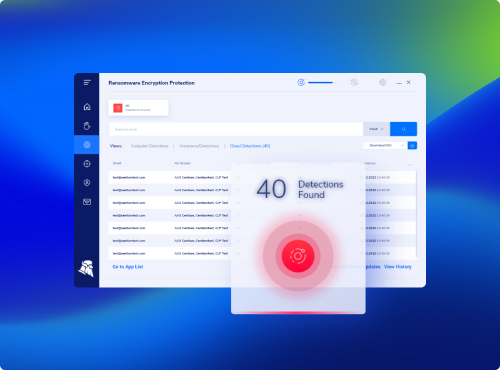
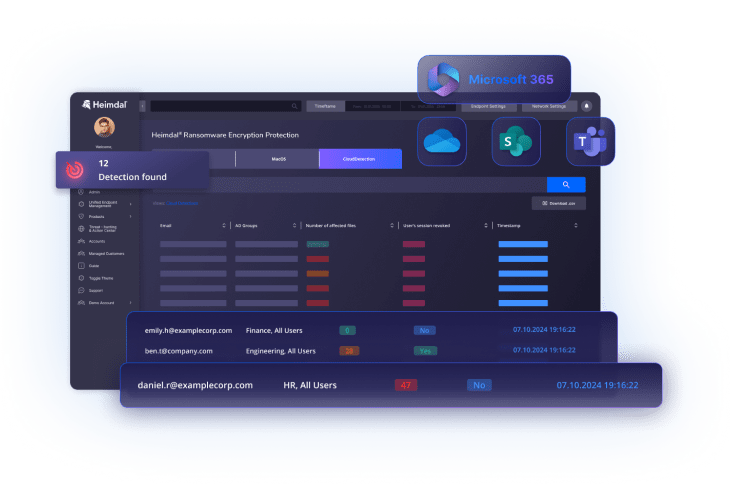 Key benefits
 Most small businesses are not hit by ransomware because attackers specifically targeted them. They are hit because their stack had a gap that credential theft or a phishing link could walk through. The tools they were paying for did their job. They just were not designed to stop what comes next. REP X adds the missing layer. It runs alongside what you already have, stops the encryption before data is lost, and handles its own response without requiring anyone to watch a dashboard.

No Rip and Replace. No New Conflicts.
REP X works alongside your existing antivirus and EDR from day one. Whether you are running Microsoft Defender, Sophos, Bitdefender, or another NGAV, REP X adds a dedicated encryption-blocking layer without touching your current setup. One lightweight deployment. No new agent conflicts. If you already have the basics covered, REP X fills the gap your current tools were never built for.

Four Engines. One Layer of Defence.
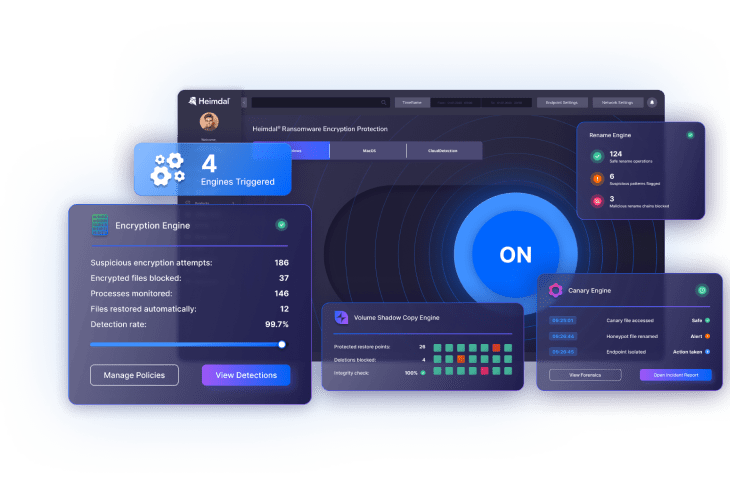
REP X does not rely on a single detection method. Encryption Engine, Rename Engine, Shadow Copy Engine, and Canary Engine work together. An attacker that evades one faces three more. This is why REP X has been validated against more than 800 ransomware samples. Most tools catch the ransomware payload. REP X catches the attack phase that follows.
The Proof Your Insurer and Your Auditor Are About to Ask For.
Cyber insurance renewals and NIS2 supply chain questionnaires now ask for specific evidence of ransomware controls. Not a checkbox. Evidence: event logs, attack timelines, isolation records. REP X produces that evidence automatically. Every attempted attack is logged with the detail you need to report, respond, and demonstrate control. You do not have to rebuild the story after the fact. The record is already there.





Ransomware is malicious software that encrypts your files and locks you out of them until you pay. It enters through a phishing email, a stolen password, or an unpatched vulnerability, then moves quietly through your systems before triggering the encryption.
The attack gives you no good options. Pay, and there is no guarantee the decryption key works. Do not pay, and you rebuild from whatever backups remain. Modern ransomware deletes those first.
A single infected laptop can reach shared drives, cloud-synced folders, and servers before your IT team knows anything is wrong.
Because the consequences go well beyond losing files. A ransomware attack shuts your business down completely. Recovery takes days at minimum. For a small business without the reserves to absorb that, it can be fatal. Reports suggest 60% of SMBs hit by ransomware shut down within six months.
There is also a legal dimension. Under GDPR, a breach involving personal data must be reported to your supervisory authority within 72 hours. NIS2 extends similar obligations to businesses in the supply chains of regulated industries. Without granular event logs, that reporting becomes its own crisis.
Cyber insurers now ask for evidence of specific ransomware controls before issuing or renewing policies. For most businesses, this is no longer optional.
Partially. The gap is where most ransomware attacks do their damage.
Antivirus and EDR tools catch malware at the point of entry. Modern ransomware increasingly bypasses that entirely. Attackers use stolen credentials or legitimate Windows tools — PowerShell, remote desktop, scheduled tasks — to move through your environment without dropping a single file your antivirus can scan. By the time encryption starts, the entry point was already missed.
REP X does not replace Defender or your antivirus. It adds a dedicated layer watching the encryption process itself. Your existing tools cover the entry. REP X covers what comes after.
Not reliably. Current ransomware is specifically designed to prevent it.
Modern ransomware deletes your Volume Shadow Copies before encrypting files. That step is deliberate. By the time encryption starts, your on-device recovery options are already gone. Files synced to OneDrive or SharePoint before detection may have been overwritten with encrypted versions. Less than 14% of businesses relying only on backups are able to fully restore their data after a ransomware incident.
Good backups still matter. But they are not a substitute for stopping the encryption before it starts.
Because small businesses are easier targets, not less valuable ones.
Large enterprises have dedicated security teams and incident response plans. Small businesses typically do not. Attackers running automated campaigns at scale look for the path of least resistance. If your business is a supplier to a larger organisation, you may also represent a route into a higher-value target — which is exactly the attack vector NIS2 supply chain requirements are designed to address.
The assumption that your business is too small to be worth targeting is one of the most common and most costly positions an IT manager can hold.
No rip and replace. REP X works alongside what you already have.
It adds a dedicated encryption-blocking layer without touching your current antivirus or EDR setup. One lightweight deployment, no agent conflicts. It fills the gap your existing tools were never built for.
For businesses that want more, REP X integrates into Heimdal’s broader XDR platform. But standalone deployment is fully supported from day one.
It detects, blocks, and contains — without waiting for a human to act.
The moment an engine identifies ransomware behaviour, the encryption attempt is blocked and the infected endpoint is automatically isolated from the network, stopping lateral spread before it reaches other machines.
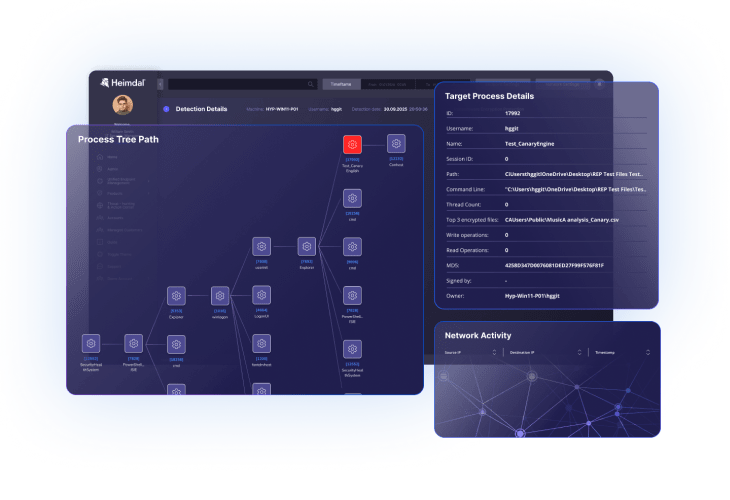
REP X simultaneously logs the full attack chain — process hashes, callbacks, signatures, timeline — so the record is ready for your investigation, your insurer, or a regulatory report. You get the alert. By the time you open it, the threat is contained.