Privileged Access Management







Cloud-native PASM, PEDM, and Application Control in one agent. No vault. No infrastructure project. Automated approvals. Audit-ready from day one.
IT Manager

IT Services Industry
Fantastic and very cost effective IT security package
"I like that many applications are bundled in one application, making it easy to administrate and very effective. Effective means saving time and money."




Watch Short Demo
 Key Features
 Full Cloud PAM. One Agent. No Vault Required.
 Key benefits
 Removing local admin rights breaks workflows. Approvals create friction that users route around. Audit trails require manual work nobody has time for. Each of these is a reason a previous PAM project stalled. Heimdal addresses each one directly.

Remove the Attack Surface. Keep the Workflow.
According to Forrester, 80% of security breaches involve privileged accounts. The standing admin rights on your endpoints are not a theoretical risk. They are the most common entry point for lateral movement.
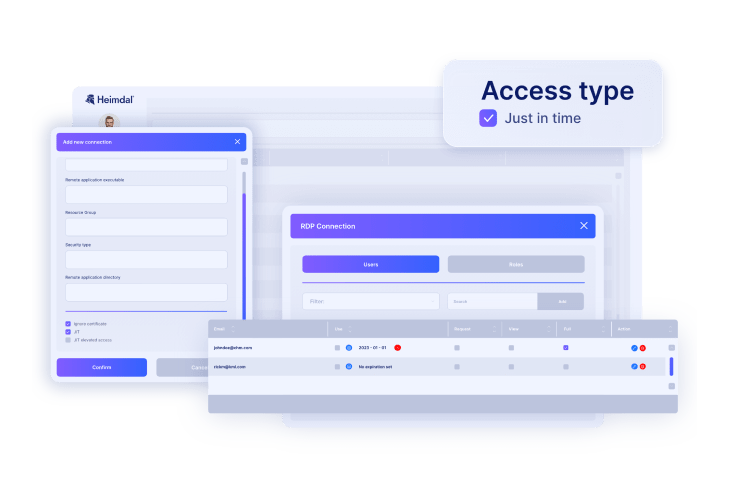
Heimdal replaces persistent admin with JIT elevation: scoped, time-limited, and automatically revoked when the task is done. Your users keep working. The attack surface shrinks.

Compliance Evidence That Holds Up Under Audit.
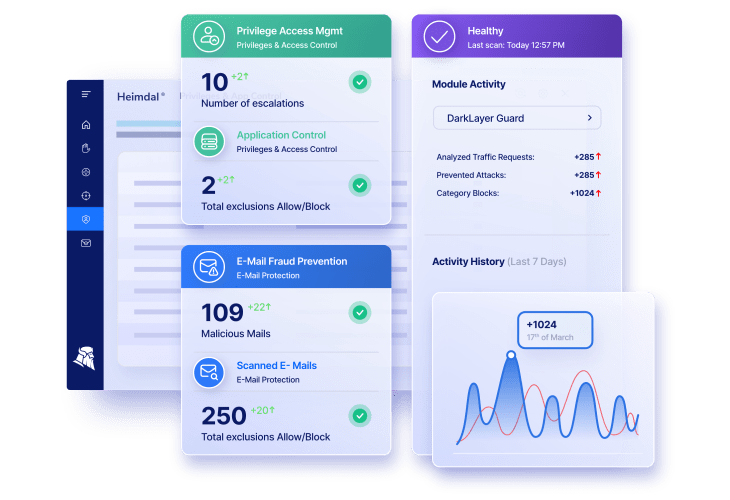
Heimdal's PEDM is built to meet NIS2, NIST AC-6, GDPR, HIPAA, ISO 27001, and CAF/Cyber Essentials. Every privilege escalation is logged with a timestamp and retained for 90 days.
The compliance report is generated from the same dashboard you use to manage policies. When the auditor asks who had admin access and when, the answer is ready before they finish the question.

PAM That Works With the Rest of Your Stack.
A PAM tool that sits in its own silo tells you a privilege escalation happened. A PAM tool connected to your EDR, patching data, DNS security, and SIEM tells you it happened on an endpoint with unpatched critical vulnerabilities that had also made a suspicious DNS lookup twenty minutes earlier.
Heimdal PEDM events connect natively to the rest of the Heimdal XDR platform. No third-party integrations. No manual correlation. No alert that arrives in a separate console six hours later.





Cloud PAM software controls, monitors, and audits access to systems by accounts with elevated permissions, delivered without on-premise vault servers or infrastructure.
Traditional PAM tools require dedicated hardware, session brokers, and professional services to deploy. Cloud PAM delivers the same privilege controls through a cloud-native agent, managed from a browser-based dashboard.
That means IT teams get least-privilege enforcement, JIT elevation, session recording, and audit trails without a deployment project to survive first.
Active Directory manages identity and group policies, but it doesn’t control what privileged users do once they have access.
It has no JIT elevation, no session recording, and no audit trail for specific privilege escalation events. It also can’t block unauthorised applications or automatically revoke elevated rights after a task is complete.
If your AD group policies include local admin rights for a broad user group, those rights persist indefinitely. PAM replaces that with time-limited, scoped elevation that revokes automatically when the task is done.
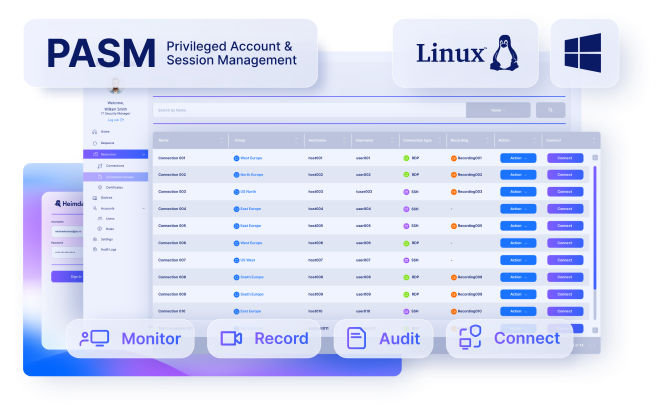
PASM (Privileged Account and Session Management) focuses on who can access which systems. It handles credential vaulting, session monitoring, recording and playback, and remote access via SSH and RDP.
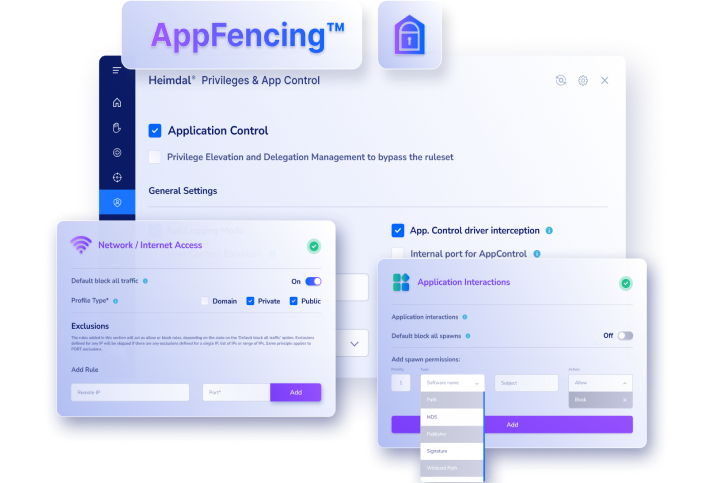
PEDM (Privilege Elevation and Delegation Management) focuses on what users can do once they are on an endpoint. It manages local admin rights, handles JIT elevation requests, and works alongside Application Control to manage which applications can run with elevated privileges.
Heimdal delivers PASM, PEDM, and Application Control together as one suite through a single agent and dashboard.
Heimdal’s PAM suite is cloud-native and agent-based. There is no dedicated vault server infrastructure to provision, no session broker to configure, and no professional services engagement required to get started.
The credential vault is built into the platform, not a separate piece of infrastructure to stand up. Heimdal states that organisations can achieve ROI in under 30 minutes with initial setup.
For organisations already using other Heimdal modules, PAM is an addition to the same agent and dashboard already in place.
Yes. Heimdal’s JIT elevation means users request elevated access for a specific task when they need it, rather than carrying persistent admin rights.
For recurring approval patterns, Heimdal’s ML-based auto-approval processes requests automatically, reducing approval time to as little as 1 second. New requests route to the approver via the dashboard, by email, or through the mobile app on iOS or Android.
When the task is complete, elevated access is revoked automatically. Users keep working. IT stops being the bottleneck for every software install or configuration change.
Yes. Heimdal’s PEDM and Application Control are built to meet NIS2, NIST AC-6, GDPR, HIPAA, ISO 27001, and CAF/Cyber Essentials. NIS2 Article 21 requires organisations to implement access control policies and privileged account management as minimum security measures.
Heimdal provides the technical controls to meet those requirements and the audit trail to demonstrate it. Every privilege escalation is logged with a timestamp and retained for 90 days.
Compliance reports are generated directly from the same dashboard used to manage access policies.
Heimdal PAM is part of the Heimdal XDR platform. PEDM events connect natively to patching, DNS security, endpoint detection, and threat hunting within the same dashboard, with no additional configuration required for teams already on the Heimdal platform.
For teams running an external SIEM such as Splunk or QRadar, Heimdal supports SIEM export so privilege events feed into your existing setup. Either way, you are not building integrations from scratch or correlating alerts manually across separate consoles.